
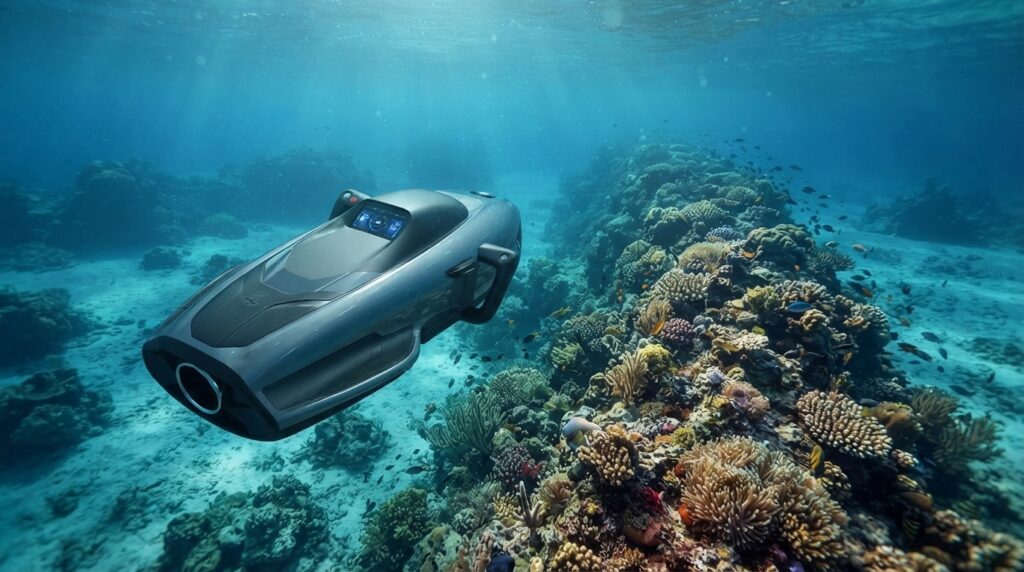
One of the most common questions people ask before buying an underwater scooter is simple:
It sounds like a straightforward question, but underwater scooter range is more complicated than quoting a single distance.
Unlike a car, where manufacturers can provide a reasonably understandable kilometre range, an underwater scooter operates in an environment where rider size, speed, drag, current, diving equipment and battery use can dramatically affect the distance travelled.
A scooter with a 60-minute maximum runtime does not automatically have a fixed range of five, seven or ten kilometres.
Nor should a user simply multiply the scooter's maximum speed by its maximum runtime and assume that represents a sensible distance to travel.
Within Vector Water Craft's current Australian range, published maximum runtimes range from approximately 56 minutes for the lightweight HS-S2 to 100 minutes for the professional H9 Sub Jet Pro. The HS-S3 provides up to 60 minutes while reaching a published maximum speed of 1.8 m/s, or 6.48 km/h.
Those figures provide useful performance benchmarks.
However, theoretical maximum distance, practical operating range and safe operating range are three very different things.
Understanding the distinction is essential before buying or operating an underwater scooter.
When discussing an underwater scooter, “range” can mean several different things.
This is the distance that might be calculated mathematically from maximum speed and maximum published runtime.
For example, if a scooter could travel continuously at 6 km/h for one hour, the simple theoretical calculation would suggest approximately 6 kilometres.
But this is not necessarily achievable in real use, and it certainly should not be interpreted as a recommended travel distance.
Practical range is the distance a particular rider might actually cover under real operating conditions.
It depends on:
Safe range is the distance you can travel while maintaining an appropriate reserve and retaining the ability to return safely.
This is the most important range figure of all.
A scooter may technically be capable of travelling significantly farther than it would be sensible to take it from the starting point.
Manufacturers generally publish operating time rather than a guaranteed distance.
Vector's HS-S3, for example, has a published maximum runtime of 60 minutes. Its three speed settings are:
The maximum speed equates to approximately 6.48 km/h.
It would be tempting to calculate:
6.48 km/h × 1 hour = 6.48 km.
But that does not mean you should expect to travel 6.48 kilometres on every charge.
It certainly does not mean you should travel 3.24 kilometres away from your starting point and expect to use the remaining half of the battery returning.
Maximum speed and maximum runtime may be measured under different operating conditions. Continuous high-speed operation typically places greater demand on a battery than lower-speed use.
Real-world conditions also intervene.
The simple mathematical figure should therefore be treated as an illustration of capability—not as a route-planning guarantee.
Electric motors consume energy to produce propulsion.
Generally, the harder the propulsion system works, the more battery energy it requires.
This means riding at maximum speed continuously can use available energy more quickly than travelling conservatively.
Variable-speed scooters are valuable partly for this reason.
Vector's HS-S2 provides three speed settings with a maximum speed of 1.4 m/s and published battery life of up to 56 minutes.
The HS-S3 also provides three speeds.
For recreational users, lower settings can be useful when:
Maximum power can then be used when genuinely required.
Suppose one scooter travels faster than another but consumes its battery more rapidly at maximum power.
The faster scooter may cover more distance per minute, but this does not automatically mean it will travel proportionally farther before the battery is depleted.
This is why range comparisons should consider:
Speed + battery capacity + motor power + runtime + load.
No single specification tells the whole story.
The underwater scooter is not moving by itself.
It is moving the scooter and the rider.
A larger person may create more resistance through the water than a smaller person.
Body position matters as well.
A streamlined rider presents less drag than someone moving through the water in a less efficient position.
Consequently, two people using the same underwater scooter may experience different practical ranges.
This is normal.
The published specification describes the scooter.
Actual performance involves the scooter, rider and environment together.
A snorkeller and a scuba diver place very different demands on an underwater propulsion system.
A snorkeller may carry only:
A scuba diver may carry:
Every additional piece of equipment can contribute to drag.
This means an underwater scooter travelling with a lightly equipped snorkeller may provide a different practical distance from the same scooter moving a fully equipped scuba diver.
Serious divers therefore tend to consider thrust and sustained performance as well as maximum speed.
Water movement is one of the largest variables in underwater travel.
Imagine that your scooter propels you through the water at a certain speed.
If you are travelling with the current, your actual progress over the seabed can be greater.
Travel against the current and your effective speed over the seabed may fall considerably.
This creates an important safety lesson:
Do not allow an easy outward journey with the current to make you underestimate the difficulty of returning against it.
A scooter may make a current feel insignificant while travelling one way.
The return journey can be very different.
Experienced users should therefore evaluate the water before treating available battery capacity as usable range.
The HS-S2 provides a useful example.
Current Vector specifications list:
A maximum speed of 1.4 m/s is approximately 5.04 km/h.
If someone simply multiplied maximum speed by 56 minutes, the theoretical figure would be approximately 4.7 kilometres.
But that should not be published or treated as the scooter's guaranteed practical range.
Why?
Because the calculation assumes continuous maximum speed for the entire maximum published runtime under ideal conditions.
Real use rarely matches that assumption exactly.
The value of the calculation is simply to demonstrate that even a very compact underwater scooter can potentially cover considerable water.
The HS-S3 reaches a maximum published speed of 1.8 m/s, equivalent to approximately 6.48 km/h, and has a maximum runtime of 60 minutes.
A simple maximum-speed calculation could therefore suggest 6.48 kilometres.
Again, that is a mathematical illustration—not a safe or guaranteed operating range.
In actual use:
For most recreational owners, the more relevant point is that an hour of potential propulsion can provide substantial exploration without needing to use anything approaching the scooter's mathematical maximum possible distance.
Vector's HS-S4 Bat has a maximum published speed of 2 m/s, or 7.2 km/h, and weighs approximately 4.3 kg.
If a scooter with that speed were operated continuously for an hour, the simple mathematical distance would be 7.2 kilometres.
That again demonstrates how misleading the term “range” can become.
Few recreational snorkellers should be thinking about travelling 3.5 kilometres or more away from their starting point underwater simply because a mathematical battery calculation appears to permit it.
A more powerful scooter increases the importance of conservative judgement precisely because it can carry the user farther in a short period.
The H9-1 Sub Runner moves into a higher level of underwater performance.
Vector currently publishes:
A speed of 2.5 m/s equates to approximately 9 km/h.
Once again, simple arithmetic could suggest an impressive theoretical distance.
But an experienced DPV user should be thinking in terms of:
rather than attempting to achieve the largest possible distance from one battery charge.
Vector's H9 Sub Jet Pro represents the professional end of the range.
Its current specifications include:
The performance potential is substantial.
If someone merely multiplied 13 km/h by 100 minutes, the resulting theoretical distance would exceed 20 kilometres.
It would be completely inappropriate, however, to present this number as the H9's normal or safe operating range.
It assumes maximum speed and maximum runtime occur simultaneously and continuously and ignores the rider, drag, current, battery reserve and return requirements.
What the H9 specifications demonstrate is not that a diver should attempt a 20-kilometre journey.
They demonstrate the scale of propulsion capability now available from professional underwater electric equipment.
This is perhaps the most important lesson in the entire article.
Never plan to exhaust the complete battery reaching your destination.
Nor should you plan to reach the starting point with virtually zero battery remaining.
Good operating practice requires reserve.
The precise reserve appropriate to a serious diving operation depends on the activity, equipment, training and dive plan.
For recreational users, the principle can remain very simple:
Turn around well before you need to.
You should be comfortable that:
Electric propulsion can make underwater travel surprisingly effortless.
That convenience creates a risk of psychological dependence.
A snorkeller might think:
“I can go farther because the scooter will bring me back.”
A diver might think:
“I can reach that distant point because I have plenty of battery.”
Both statements contain the same weakness.
They assume the scooter will continue operating perfectly.
Electrical and mechanical equipment can fail.
The user should therefore remain capable of managing the situation if propulsion stops.
For a recreational swimmer, that means remaining within manageable swimming distance.
For a diver, it requires proper dive planning, gas reserves, buddy procedures and the appropriate training.
DAN notes that DPVs can reduce workload and potentially help preserve gas, but it also stresses that higher-performance propulsion brings additional risks and demands appropriate knowledge.
A basic conceptual mistake is thinking only about how far the scooter can travel.
Most trips require you to come back.
If you travel one kilometre from the starting point, the scooter needs sufficient capability for approximately another kilometre of return travel—plus an appropriate reserve.
The same principle applies whether you start from:
Do not think of usable distance as one straight line from the starting point.
Think about the complete journey.
Even dividing your battery exactly in half would not automatically make a journey safe.
Conditions can change.
You may travel outward:
Then return:
Therefore, “half outward, half return” is still too simplistic as a universal range rule.
A margin needs to exist for uncertainty.
Many battery-powered products provide some form of remaining-charge indication.
This information is useful.
But do not wait for a critically low reading before turning around.
Battery indications can be affected by load and operating conditions.
They should support good judgement rather than replace it.
An experienced operator plans ahead.
For recreational snorkelling, the safest approach is generally to stay reasonably close to:
The objective is underwater enjoyment, not setting a distance record.
A modern scooter can potentially cover much more water than you would normally swim.
Use that ability to explore an area more thoroughly rather than automatically travelling farther from safety.
For example, instead of travelling kilometres away from a boat, a snorkeller could use the propulsion to explore multiple features around a suitable anchorage.
That makes far better use of the technology.
Underwater scooters can be particularly enjoyable around appropriate reef environments.
Instead of swimming continuously between reef features, powered propulsion can reduce the effort needed to move between points.
However, range around reefs should also be controlled by the environment.
Users should consider:
Do not allow the scooter's range to encourage unnecessary intrusion into environmentally sensitive areas.
Boat owners can use underwater scooters somewhat differently.
The vessel can provide a clearly defined starting and finishing point.
However, the boat itself may move on its anchor, swing with wind or current, or be difficult to see from underwater.
Before travelling away:
For divers, normal boat-diving procedures remain essential regardless of whether a DPV is used.
Scuba divers must consider much more than the scooter battery.
The complete dive is limited by factors including:
The scooter should fit into the dive plan rather than dictate it.
DAN describes DPVs as useful tools capable of reducing diver workload and gas consumption, but its guidance also recognises that the increased performance requires additional knowledge and risk management.
The ability to travel farther should therefore be treated as a capability to manage—not simply an invitation to extend every dive.
A rider does not need to use maximum speed constantly.
Consider using lower settings for:
Then use higher power selectively when appropriate.
This approach can make the scooter feel far more versatile.
Vector's compact HS-S2 and HS-S3 both provide three-speed operation, while the H9-1 also uses three selectable speed gears.
Variable speed is therefore not merely about making the scooter faster or slower.
It allows the operator to match propulsion to the task.
Rechargeable batteries do not remain identical forever.
As a battery ages through time and charging cycles, usable capacity can gradually change.
Therefore, the range experienced when a scooter is new may not remain precisely identical throughout its ownership life.
Good battery care becomes important.
Owners should:
Australia's Product Safety regulator specifically advises users not to operate lithium-ion batteries or chargers showing damage, swelling, overheating or leakage and warns against leaving lithium-ion products in hot parked vehicles.
Battery care is therefore both a safety issue and an important part of maintaining performance.
Underwater scooters are naturally associated with summer.
That can create a particular Australian problem.
A rider finishes a day at the beach, places the scooter in the car and leaves it there.
The following day the vehicle may be exposed to intense heat.
Lithium-ion equipment should not be stored this way.
The ACCC Product Safety guidance specifically warns against leaving lithium-ion products in hot places such as parked vehicles.
Keeping the battery in appropriate storage conditions helps protect both safety and long-term performance.
If you expect an extended recreational outing, begin with the scooter appropriately charged according to the manufacturer's instructions.
Do not start a significant trip assuming that a partially charged battery will probably be sufficient.
A simple pre-use routine should include:
For divers, the DPV check should form part of the broader pre-dive equipment procedure.
Underwater photographers often use propulsion differently from speed-focused riders.
A photographer may:
This can result in a completely different practical battery experience from continuous high-speed use.
A scooter providing multiple speeds can be especially useful because the operator can move slowly around photographic subjects and use greater propulsion only when travelling between locations.
No.
Longer technical range can be valuable, but only if you require it.
Greater range may require:
A recreational snorkeller who remains within a few hundred metres of a boat may gain little from carrying a large professional battery system.
A serious underwater operator may consider that extra capability essential.
The best range is therefore the range appropriate to the application.
This is one of the major trade-offs in underwater scooter design.
Vector's HS-S2 weighs just 1.4 kg and provides up to 56 minutes published battery life.
Vector's professional H9 is dramatically larger and provides up to 100 minutes runtime with a much larger battery and propulsion system.
The H9 offers substantially more endurance and performance.
The HS-S2 offers remarkable portability.
Which is better?
For a traveller or recreational snorkeller, perhaps the HS-S2.
For a demanding professional user, perhaps the H9.
The correct answer depends on what you value.
If typical sessions last 20–30 minutes, an hour of maximum runtime may already be substantial.
Many recreational users do not.
Shared use can consume more of the day's available battery capacity.
Boat owners and families should consider total daily usage.
Charging availability changes how much battery endurance matters.
Diving brings much more demanding range-planning requirements.
Longer-range professional equipment can be substantially heavier.
Conditions can dramatically affect effective travel distance.
This is only a theoretical calculation.
That leaves no real margin for changing conditions or equipment problems.
Distance accumulates rapidly under power.
An easy outward journey can become a difficult return.
Battery capacity does not eliminate the possibility of equipment malfunction.
More range may come with additional weight and cost.
A fully equipped diver and a snorkeller impose different loads.
Published figures are useful specifications, but actual conditions vary.
A beginner should not be trying to discover the scooter's maximum distance.
Initial sessions should take place in:
Learn how quickly the battery indicator changes.
Understand how different speeds feel.
Become familiar with how the scooter responds as battery capacity falls.
Only then should the user consider progressively longer exploration.
There are several sensible ways to make better use of available battery energy.
Maximum power is unnecessary for relaxed exploration.
Reducing drag helps the propulsion system work efficiently.
Particularly for recreational use, excessive equipment can add resistance.
Avoid using large amounts of battery fighting unsuitable currents.
Good mechanical and battery condition help maintain expected performance.
You do not need to hold the motor on continuously throughout every recreational session.
Whether a spare battery is useful depends entirely on the model and application.
For a recreational user planning multiple sessions during a full day, an approved spare battery may be useful where the model supports one and where transport, storage and charging requirements are understood.
However, lithium battery transport rules can become important, particularly for air travel.
Never substitute an incompatible or unapproved battery simply to obtain more range.
Use equipment specifically intended for the scooter.
Australia provides enormous opportunities for underwater recreation, but conditions differ dramatically.
The same scooter may be used around:
Range expectations should therefore change with location.
A calm protected bay may allow easy propulsion.
A coastal location with current and swell may require far more conservative operation.
The scooter specification has not changed.
The usable range has.
Range questions are a good example of why specialist product advice can be useful.
A buyer looking only at online specifications may see:
“60-minute runtime.”
A more useful discussion considers:
Vector Water Craft currently offers underwater scooters ranging from compact HS-series models through to the H9-1 and professional H9 platform, so buyers can choose different combinations of portability, performance and endurance rather than simply buying the largest battery available.
Best considered when portability is a major priority.
Published maximum battery life is 56 minutes, with a maximum speed of 1.4 m/s and weight of only 1.4 kg.
A versatile recreational model offering up to 60 minutes runtime, three speed levels and a maximum published speed of 1.8 m/s.
A dual-motor recreational scooter reaching up to 2 m/s or 7.2 km/h, aimed at users wanting stronger compact performance.
A higher-performance model with three gears reaching up to 2.5 m/s, a 40-metre depth rating and 60-minute published runtime.
The professional option with up to 100 minutes runtime, 13 km/h published top speed and a 923.52 Wh battery.
The correct model depends less on which can theoretically travel farthest and more on which matches your normal operation.
An underwater scooter can potentially cover a surprisingly large distance.
But there is no single kilometre figure that accurately describes underwater scooter range.
Real range depends upon:
Most importantly, the maximum distance the scooter could theoretically cover should never be confused with the distance you should actually travel from your starting point.
For recreational users, use the additional capability to explore more of a controlled area rather than simply travelling as far away as possible.
For divers, propulsion needs to form part of a properly planned dive that considers gas, current, buddy procedures, equipment failure and battery reserve. DPVs can reduce workload and increase capability, but the increased performance also requires increased judgement.
A good underwater scooter is not valuable because it takes you to the point where its battery becomes empty.
It is valuable because it allows you to explore farther and more efficiently while still returning comfortably with an appropriate safety margin.
If you are comparing underwater scooters and are uncertain how much range you genuinely require, speak with Vector Water Craft.
Tell us:
We can help you compare Vector's lightweight recreational scooters, dual-motor models and higher-performance underwater propulsion systems according to your actual use.
The right question is not:
It is:
“Which scooter gives me enough performance and battery capacity to comfortably complete the type of underwater activity I actually enjoy?”
There is no reliable universal distance. Range depends on speed, battery capacity, rider drag, conditions and how the scooter is operated. Manufacturers usually provide maximum runtime and speed rather than a guaranteed kilometre range.
You can calculate a theoretical maximum, but it should not be treated as guaranteed or safe range. Maximum runtime may not apply to continuous maximum-speed operation, and real-world factors such as drag and current change performance.
The HS-S2 has a published maximum battery life of 56 minutes, maximum speed of 1.4 m/s and three speed settings.
Multiplying its maximum published speed by its maximum battery duration gives a mathematical figure of around 4.7 km, but this is not a guaranteed or recommended operating range. Actual use varies with speed, load and conditions.
The HS-S3 provides a published maximum runtime of 60 minutes and maximum speed of 1.8 m/s or 6.48 km/h.
That is only the simple mathematical distance obtained by multiplying maximum speed by one hour. It should not be treated as a guaranteed real-world range or a recommended distance from your starting point.
The H9-1 provides three speed gears reaching a published maximum of 2.5 m/s, or approximately 9 km/h, with a 60-minute runtime.
The H9 Sub Jet Pro has the longest published runtime among the current models discussed here, at up to 100 minutes.
The H9 Sub Jet Pro has a published maximum speed of 13 km/h.
That is not a suitable universal rule because it leaves little allowance for changing current, rider fatigue, battery variation or other contingencies. Conservative operation should include an appropriate reserve.
Yes. Travelling with a current can increase progress over the seabed, while travelling against it can reduce effective speed and require more propulsion effort.
Greater rider size and equipment can increase underwater drag, potentially changing practical performance and battery consumption.
High propulsion output generally uses more energy, so continuous high-power operation can reduce practical battery endurance compared with more conservative use.
For many users, yes. Recreational snorkellers often use propulsion intermittently rather than continuously for a full hour. The correct requirement depends on session length and whether several people share the scooter.
No. Safe range should be considerably more conservative and allow for battery reserve, return travel, conditions and the possibility of propulsion becoming unavailable.
A dive should not be planned on the assumption that propulsion cannot fail. Divers need appropriate contingency planning, gas management, buddy procedures and training.
Use lower speeds when appropriate, maintain an efficient body position, avoid unnecessary drag, maintain the scooter correctly and use propulsion selectively rather than running maximum output continuously.