
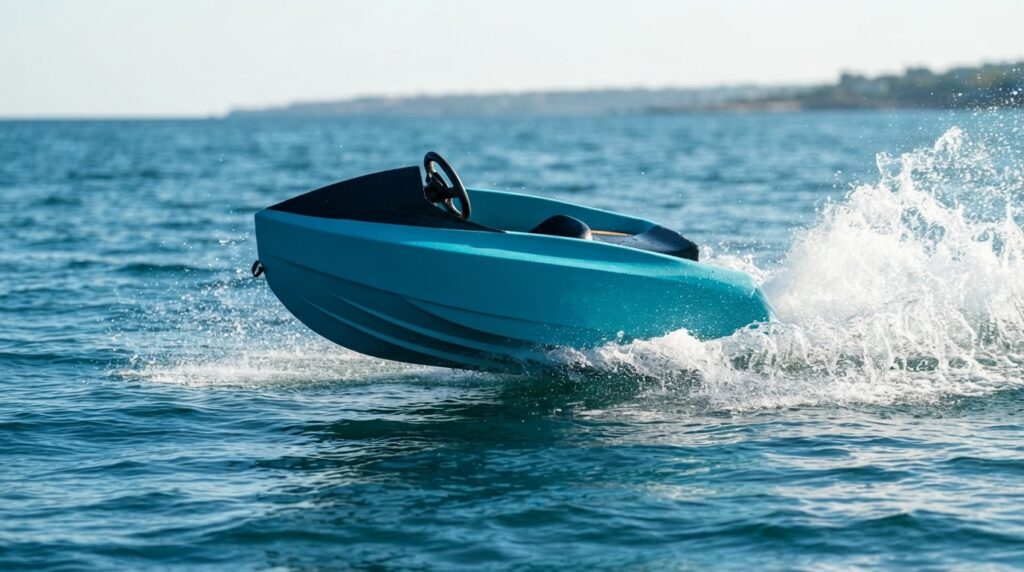
Watch two mini jet boats leave from a standstill side by side, and it's common to see one climb smoothly onto the plane in a couple of seconds while the other labours through an extended, bow-high transition before finally levelling out. This difference has nothing to do with the operator's skill and everything to do with how the hull, weight and power delivery interact during that specific transition — one of the more demanding phases of a mini jet boat's performance envelope.
At low speed, a boat's hull pushes through the water in what's called displacement mode — the hull is supported almost entirely by buoyancy, and moving faster means pushing more water out of the way, which becomes increasingly inefficient as speed rises. Planing is the transition to riding on top of the water rather than through it, where hydrodynamic lift generated by the hull's shape and speed starts supporting a significant share of the boat's weight, dramatically reducing drag and allowing much higher efficient speeds.
The trip between these two states — often visible as the bow rising sharply before the boat "settles" flat and accelerates away — is where time-to-plane is measured, and it's this transition that varies so noticeably between different mini jet boats.
As covered in more detail in a related article, power-to-weight ratio — motor output relative to total weight — is the single biggest factor in how quickly a hull can climb onto the plane. Getting onto the plane requires the motor to generate enough thrust to overcome the hull's displacement drag at exactly the point where that drag is at its highest, just before the hull breaks free onto its bow wave.
A boat with a generous power-to-weight ratio has thrust to spare during this demanding phase, allowing it to punch through quickly. A boat with a marginal ratio has to work harder relative to its available power, which extends the transition and can make the boat feel like it's "hanging" in the bow-high position for longer before finally planing.
Power-to-weight ratio explains a lot, but hull shape is just as influential in determining how much resistance the motor actually has to overcome during the transition. A few specific hull design elements matter here:
As covered in the article on hull weight, a lighter overall boat requires less force to accelerate and lift onto the plane, all else being equal. But total weight isn't the only factor — where that weight sits matters too. A boat with the battery, motor and any heavy fittings concentrated too far toward the stern can experience a more pronounced, prolonged bow-up transition, since the stern is effectively being pushed down while the bow has to rise further before the whole hull levels out.
This is part of why well-engineered mini jet boats pay close attention to component placement, not just total weight — a slightly heavier boat with well-balanced weight distribution can sometimes plane more efficiently than a lighter boat with poorly distributed weight.
This is a practical factor riders have direct control over. Where passengers and gear are positioned during the planing transition can noticeably affect how quickly and smoothly a boat comes up onto the plane. Weight positioned too far aft during acceleration exaggerates the bow-up phase, while weight positioned more centrally, or even shifted slightly forward during the initial acceleration phase, can help the hull transition more quickly and with less drama.
This is a technique many experienced small-boat operators use instinctively — leaning forward slightly or having a passenger shift weight forward briefly during acceleration — and it's worth understanding as a genuinely useful, boat-specific skill rather than an unusual habit.
Calm, flat water offers the least resistance to planing, allowing the quickest, cleanest transition. Chop, wind-driven waves, or a following current can all extend the time and distance needed to get onto the plane, since the hull has to contend with additional, irregular resistance during exactly the phase where it's most vulnerable to drag. This is worth factoring in when comparing boats based on a single test ride — a hull that planes quickly in dead-calm water may take noticeably longer in typical, mildly choppy real-world conditions.
Quick, confident planing isn't just satisfying to experience — it has practical implications:
How quickly a mini jet boat gets onto the plane is shaped by the interaction of power-to-weight ratio, hull shape, weight distribution and water conditions — not any single factor in isolation. It's a genuinely useful performance characteristic to understand and compare, both because it affects real-world efficiency and manoeuvrability, and because a smooth, confident planing transition simply makes a boat more enjoyable and predictable to operate, outing after outing.