
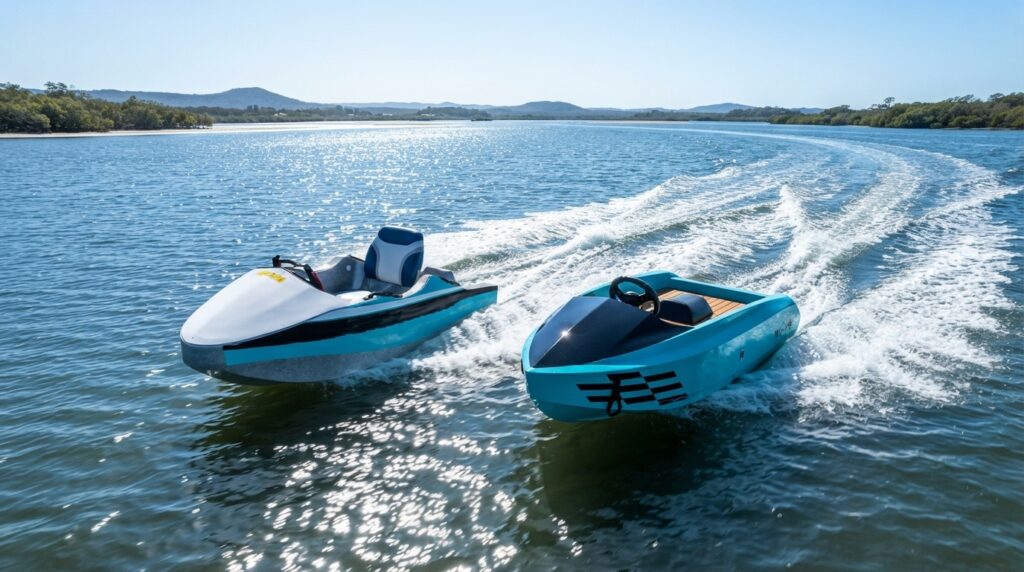
Motor power is one of the first specifications buyers notice when comparing electric mini jet boats. A 15kW model can appear modest beside a 25kW boat, while a 70kW model may seem to offer an entirely different level of performance.
It is tempting to assume that the largest motor must produce the best boat. In practice, that is not how mini jet boat selection works.
The correct power level depends on the relationship between:
A well-designed 15kW boat can provide lively recreational performance for an appropriate operator. A 25kW model can offer stronger acceleration and improved performance under greater load. A 70kW high-performance boat can deliver an entirely more demanding experience, but that additional power may be unnecessary for many recreational owners.
The purpose of this guide is not to declare one power level superior. It is to help buyers understand what each level is designed to achieve and determine how much power they genuinely need.
A kilowatt is a measure of power.
In an electric mini jet boat, the quoted motor output indicates the rate at which the propulsion system can convert electrical energy into mechanical output. It does not, by itself, tell you:
Two boats with the same motor output can perform very differently.
The difference may come from:
Motor power should therefore be treated as one part of a complete propulsion and hull system.
A high kilowatt figure is easy to promote because it appears objective. However, the figure may not explain how the power is delivered.
Buyers should determine whether the quoted figure refers to:
A motor may be capable of a high peak output for a short period but operate at a lower continuous level during normal use.
The difference matters because sustained power creates heat in the:
The propulsion system must manage this heat effectively. A boat that produces impressive short bursts may not maintain the same output continuously.
A responsible supplier should explain whether the advertised figure is a continuous or peak rating and how long the system can safely operate at maximum power.
Maximum speed is influenced by considerably more than motor output.
The principal factors include:
A 25kW boat is not automatically 67 per cent faster than a 15kW boat simply because its motor rating is approximately 67 per cent higher.
As speed rises, hydrodynamic resistance can increase substantially. Additional power may produce stronger acceleration or better load-carrying performance without creating an equivalent percentage increase in maximum speed.
This is why buyers should compare real-world boat performance rather than calculate expected speed directly from motor ratings.
Power-to-weight ratio is often more useful than motor power alone.
A lightweight single-seater with a 15kW motor may feel quick because the motor is moving a relatively small total mass.
A heavier two-seater with the same 15kW motor may provide:
A 25kW motor can compensate for additional hull and passenger weight, but only when the battery, controller and jet system are matched properly.
A 70kW boat may have a very high power-to-weight ratio. That can produce forceful acceleration and rapid response, but it also increases the need for operator skill and restraint.
When comparing models, buyers should ask for:
This allows the advertised power to be placed in context.
A 15kW electric mini jet boat can be suitable for recreational owners who value balanced performance rather than extreme power.
It may suit:
The current Vector Sprint range, for example, includes a 15kW Cruise configuration alongside a 25kW Sport configuration. This illustrates how the same general boat family can be offered in different power levels for different operating expectations.
A well-designed 15kW model should not be dismissed as underpowered merely because larger systems are available.
For many owners, 15kW can provide more than enough capability for:
The possible benefits of a 15kW system include:
Acceleration can still be strong, but it may be easier for a beginner to control than a very high-powered boat.
When paired with a suitable battery, moderate power demands may support useful operating time, particularly when the boat is not held at maximum throttle.
A lower-output system may place less demand on the battery, controller, wiring and cooling system during ordinary use.
The motor, controller and battery system may be less expensive than those required for a high-performance model.
An owner who wants quiet cruising and occasional bursts of speed may not benefit from paying for a much larger propulsion system.
A less aggressive boat can help a new operator develop judgement, throttle control and steering technique progressively.
A 15kW model may be less suitable where the buyer expects:
Load is particularly important.
A 15kW boat that feels lively with a 70-kilogram operator may feel noticeably different with a 110-kilogram operator or two adult occupants.
This does not necessarily make the boat unsuitable. It means buyers should ask for realistic performance information at their expected load.
A 15kW boat deserves serious consideration when the owner:
It may also suit an experienced owner who simply prefers a balanced and efficient recreational craft.
Power should be matched to purpose, not ego.
A 25kW electric mini jet boat occupies an important middle position.
It can offer a significant increase in available propulsion without moving fully into the very high-performance category.
A 25kW system may provide:
Vector Water Craft currently lists a 25kW two-seater HDPE Duo and also offers the Vector Sprint with a 25kW Sport configuration.
These examples show that 25kW can be used in different hull types and seating arrangements. The resulting performance still depends on the complete boat.
For many buyers, 25kW provides a useful balance between moderate recreation and serious performance.
It may be sufficient for:
A buyer may also choose 25kW to retain a performance margin.
For example, a two-seater operated alone may feel particularly responsive, while still having enough output to remain enjoyable with a passenger aboard.
That flexibility is valuable when the boat will be used in several different ways.
A 25kW system can better support the additional displacement of a passenger or heavier hull.
The boat may respond more decisively when moving onto the plane or accelerating after a turn.
It may accommodate a wider range of operator weights and use patterns.
A 25kW model can offer a more performance-oriented experience without necessarily reaching the intensity of a 70kW boat.
Additional power can be useful when operating against wind or current, although it should never replace proper planning and battery reserve.
The additional output can also involve:
A buyer who uses maximum power frequently should expect energy consumption to rise.
Choosing 25kW does not guarantee long range. Battery capacity and driving style remain central.
A 25kW boat may be the right choice for someone who:
It is likely to be excessive only when the buyer has no interest in stronger performance and intends to cruise gently at all times.
A 70kW electric mini jet boat belongs in a different performance category.
The increase from 25kW to 70kW is not a minor upgrade. It is a substantial change in potential acceleration, battery demand, control requirements and system complexity.
Vector Water Craft currently lists a 70kW high-performance single-seater electric karting boat and a 72kW two-seater version.
These models are specifically positioned as high-performance craft. Buyers should approach them accordingly.
A 70kW boat may deliver:
This level of power should not be selected simply because it is available.
As acceleration and speed increase, mistakes can develop more quickly.
A high-powered operator must be able to:
In Queensland, practical marine licence training includes manoeuvres at speed, bringing a vessel onto and off the plane, emergency stopping, maintaining awareness of traffic, wind, tide and obstacles, and demonstrating controlled operation.
Those skills become increasingly important as available power rises.
A licence confirms a minimum regulatory qualification. It does not automatically establish proficiency in a particular 70kW mini jet boat.
Vessel-specific familiarisation remains essential.
A high-output motor can consume energy rapidly when operated near maximum power.
A battery must be capable of supporting:
The battery-management system must protect the cells against:
A large motor connected to an inadequate battery cannot deliver satisfactory sustained performance.
Buyers should ask:
A 70kW motor rating without detailed battery information is not enough to assess the boat.
Runtime should never be estimated from motor output alone.
A 15kW boat does not necessarily run for three times as long as a 45kW boat. The higher-powered boat may have a much larger battery.
However, when two boats have similar battery capacity, the one using more average power will generally deplete the battery sooner.
The most important concept is average power use.
A 70kW system does not consume 70kW continuously unless it is being operated continuously at that output. Moderate throttle may use far less.
Likewise, a 15kW boat operated continually at full output may consume its available battery more quickly than expected.
Driving style therefore has an enormous effect.
The following actions increase energy use:
Buyers should request runtime figures at several power settings rather than relying on one maximum figure.
Acceleration may reveal more about practical power than headline speed.
A more powerful boat may:
These benefits may matter even if the difference in maximum speed is relatively modest.
For a recreational owner, stronger mid-range response may be more useful than the final few kilometres per hour of top speed.
The buyer should ask:
Selectable operating modes can make a powerful boat more manageable, but the exact controls and limitations must be verified for the specific model.
Operator weight should influence the power decision, but it should not be used as a simple formula.
A heavier operator may benefit from additional power because the boat must move greater displacement.
However, the correct solution may also involve:
Choosing a very powerful motor does not correct a hull that is too small for the operator.
A heavier buyer should first confirm:
Power selection comes after those matters have been addressed.
Regular two-person operation generally requires more propulsion than solo use in an otherwise comparable boat.
The additional weight affects:
A 15kW two-seater may be satisfactory for moderate use with suitable occupants.
A 25kW two-seater may provide a stronger performance margin.
A 70kW or 72kW two-seater may provide very high performance, but the passenger must be properly seated, briefed and capable of remaining secure under acceleration.
Never evaluate a two-seater using solo performance figures alone.
More power can be useful, but it does not make a small boat suitable for rough conditions.
A 70kW motor cannot overcome:
High power may allow rapid acceleration, but it can also increase the consequences of striking wake or entering unsuitable water at speed.
For calm lakes and sheltered rivers, 15kW or 25kW may provide more than adequate enjoyment.
For tidal waterways, reserve power may be helpful, but the operator must still plan for:
Power should support good seamanship rather than replace it.
Electric boats remain powered vessels.
In Queensland, a recreational marine driver licence is required to operate a boat with engine power greater than 4.5kW. All three power levels discussed in this article exceed that threshold.
Queensland also requires registration for boats with an engine of 3kW or more when used on the water.
The boat’s precise classification should be confirmed because a conventionally seated mini jet boat may not necessarily fall within the same definition as a sit-astride personal watercraft. Maritime Safety Queensland defines a PWC as a fully enclosed powered craft designed to be operated standing, crouching, kneeling or sitting astride it.
Requirements differ across states and territories, so buyers must check the authority governing their normal operating area.
Where applicable, the Australian Builders Plate provides information concerning a boat’s operational limits, which may include maximum power, maximum persons and load capacity.
AMSA explains that the current national standard has been adopted into the marine legislation of Australian states and territories and that the plate assists in identifying a recreational boat’s capacity and limitations.
A buyer should confirm that the hull is approved for the installed motor output.
A boat designed for 15kW should not simply be fitted with a 25kW or 70kW system without proper engineering assessment and documentation.
Increasing power can affect:
Motor upgrades should only be completed when approved by the manufacturer and consistent with the boat’s documented limits.
Higher power generally increases the cost of:
The question is whether the owner will receive practical value from those additions.
A 70kW boat may represent excellent value for an experienced buyer specifically seeking high-performance use.
It may represent poor value for someone who:
Similarly, a 15kW boat may be poor value for someone who regularly carries two heavy adults and expects forceful acceleration.
Value is created when the boat’s capability matches the owner’s needs.
Before choosing the power level, ask:
Clear answers are more valuable than the largest number in a brochure.
A 15kW mini jet boat can provide enjoyable, responsive and practical electric boating for an owner who wants balanced recreational performance.
A 25kW model can offer stronger acceleration, better performance under load and greater flexibility for two-person or sport-oriented use.
A 70kW boat is a genuine high-performance craft. It may provide exceptional acceleration and excitement, but it also brings greater battery demand, system complexity and operator responsibility.
The correct power level is the lowest level that comfortably satisfies the buyer’s real requirements while preserving an appropriate performance margin.
Buyers should not pay for power they will never use. They should also avoid selecting an underpowered configuration that will continually carry a heavy load or fail to meet their expectations.
The best decision is made by comparing the complete boat: hull, battery, jet system, operating weight, seating capacity, performance data and intended conditions.
Vector Water Craft offers electric mini jet boats across moderate, sporting and high-performance power levels. The right model should be chosen according to how the boat will genuinely be used—not simply according to which specification produces the largest headline number.