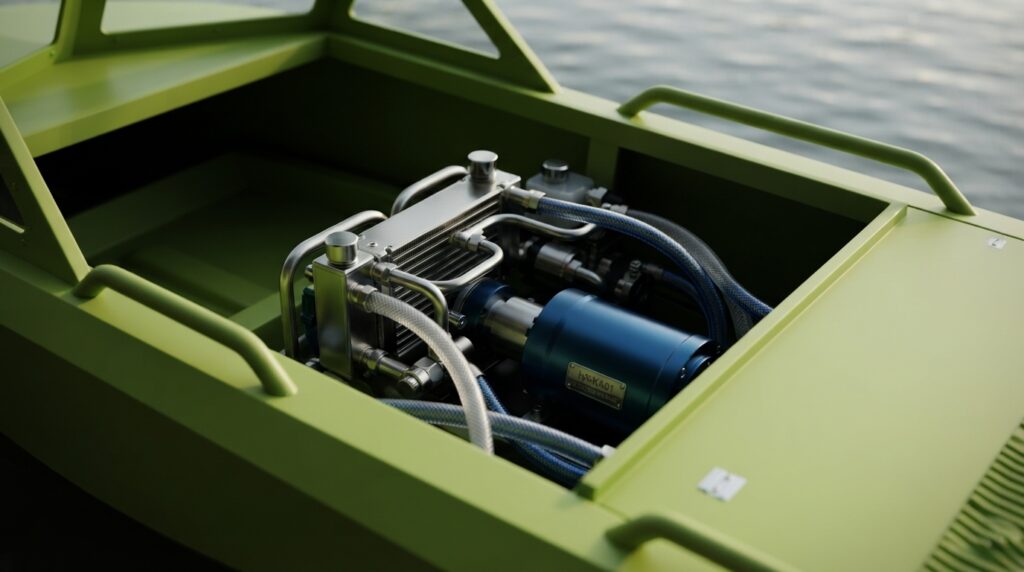
Cooling system design rarely makes it into casual conversations about mini jet boats, yet it's one of the more consequential engineering decisions behind how consistently a boat performs across a full day on the water. Air cooling and water cooling represent two genuinely different approaches to managing motor and controller heat, each with real advantages and real compromises. Neither is universally "better" — the right choice depends heavily on how the boat is actually going to be used.
The Basic Difference Between the Two Approaches
Air cooling relies on moving air — whether passively through natural airflow or actively via a fan — across the motor and controller to draw heat away. Water cooling instead circulates water (sometimes mixed with a coolant such as glycol) through a heat exchanger in direct thermal contact with the motor, controller, or both, using the surrounding water the boat is already operating in as an effectively unlimited heat sink.
The fundamental physical reason these two approaches differ so much in effectiveness comes down to a basic property of the two mediums: water can absorb and carry away far more heat per unit volume than air can, for a given temperature difference. This is why water cooling is the preferred approach in many high-performance applications generally, not just in mini jet boats.
Where Air Cooling Genuinely Wins
Air cooling isn't simply a "budget" or inferior option — it has real, practical advantages that make it the right choice for many mini jet boat applications:
- Mechanical simplicity: There are no pumps, hoses, seals or water passages to potentially fail, leak, or require maintenance. Fewer moving parts generally means fewer potential points of failure over the boat's operating life.
- Lower weight: Water cooling systems add weight through pumps, plumbing and coolant, which — as covered in the article on hull weight — has a direct, ongoing effect on both performance and range in an electric mini jet boat.
- No risk of coolant-related issues: Water cooling systems that use a mixed coolant fluid introduce a small but real risk of leaks, contamination, or the need for periodic fluid maintenance, none of which apply to a properly designed air-cooled system.
- Adequate for moderate use patterns: For boats primarily used for shorter outings, moderate cruising speeds, or occasional rather than sustained high-power running, air cooling can manage heat perfectly adequately without the added complexity of a water-based system.
Where Water Cooling Genuinely Wins
Water cooling earns its place in higher-performance or sustained-use applications for equally real reasons:
- Significantly higher heat transfer capacity: Because water is such an effective heat transfer medium, water-cooled systems can manage much higher sustained heat loads than air cooling, which directly translates to more consistent performance during extended high-speed running.
- Reduced thermal throttling: As covered in the companion article on thermal management, motors and controllers automatically reduce power output as they approach their safe temperature limits. A more effective cooling system delays this point significantly, meaning a water-cooled boat can typically sustain higher power output for longer before performance tapers.
- Effectively unlimited coolant supply: Unlike a closed-loop system with a fixed coolant volume, many water-cooled marine systems draw directly from the surrounding water, meaning the cooling medium is continuously replenished rather than being a finite, warming resource.
- Better suited to demanding conditions: Hot climates, sustained high-speed cruising, or frequent hard acceleration all generate more heat than moderate use, and this is exactly the scenario where water cooling's higher capacity becomes most valuable.
The Trade-Offs of Water Cooling
Water cooling's advantages come at a real cost, which is why it isn't automatically the "correct" choice for every mini jet boat:
- Added mechanical complexity: Pumps, water intakes, hoses and seals all introduce potential failure points that a well-designed air-cooled system simply doesn't have.
- Added weight: The plumbing, pump and any coolant fluid add mass, which — as discussed in the hull weight article — has a direct effect on acceleration and range in an electric mini jet boat.
- Intake blockage risk: Water-cooling systems that draw directly from the surrounding water rely on an intake that can potentially become blocked by debris, weed or sediment in certain water conditions, which is a maintenance and reliability consideration that doesn't apply to air cooling.
- More components to service: Over the life of the boat, a water-cooling system generally has more parts that may eventually need inspection, cleaning or replacement compared to a comparatively maintenance-free air-cooled system.
Matching the Cooling System to Actual Use
Neither approach is objectively superior — the more useful question is which system suits the way you actually plan to use the boat:
- Short, moderate-speed outings, occasional use, prioritising simplicity and low maintenance: air cooling is likely to be entirely sufficient, and its mechanical simplicity is a genuine advantage rather than a compromise.
- Sustained high-speed cruising, frequent hard acceleration, or use in consistently hot climates: water cooling's higher heat management capacity is likely to deliver more consistent performance and reduce the likelihood of noticeable thermal throttling during a demanding outing.
- Use in water with significant debris, weed or shallow sediment: this is worth factoring in specifically if considering a water-cooled system with a direct water intake, since intake blockage risk is a genuine practical consideration in these conditions.
- Priority on lowest possible weight for maximum range and acceleration: air cooling's lighter overall system contributes, even if modestly, to the boat's power-to-weight ratio and range, as discussed in earlier articles.
Questions Worth Asking When Comparing Boats
- Is the motor, controller, or both cooled by air, water, or a hybrid approach combining elements of each?
- If water-cooled, how is the water intake designed, and is it likely to be vulnerable to blockage in the conditions the boat will typically be used in?
- What continuous high-power run time does the manufacturer specify, and does this align with how the cooling system is described?
- Does the boat's intended use — casual cruising versus sustained higher-speed running — actually demand the higher heat capacity of water cooling, or would a simpler air-cooled system be entirely adequate?
The Practical Takeaway
Air cooling and water cooling represent a genuine engineering trade-off rather than a simple hierarchy of "better" and "worse." Air cooling offers simplicity, lower weight and low maintenance, and is entirely adequate for moderate, occasional use. Water cooling offers significantly greater heat management capacity, better suited to sustained high-speed running or demanding conditions, at the cost of added complexity, weight and a small number of additional components that may eventually need attention. Matching the cooling approach to your actual, realistic usage pattern — rather than assuming one system is universally superior — is the most useful way to evaluate this specification when comparing electric mini jet boats.