
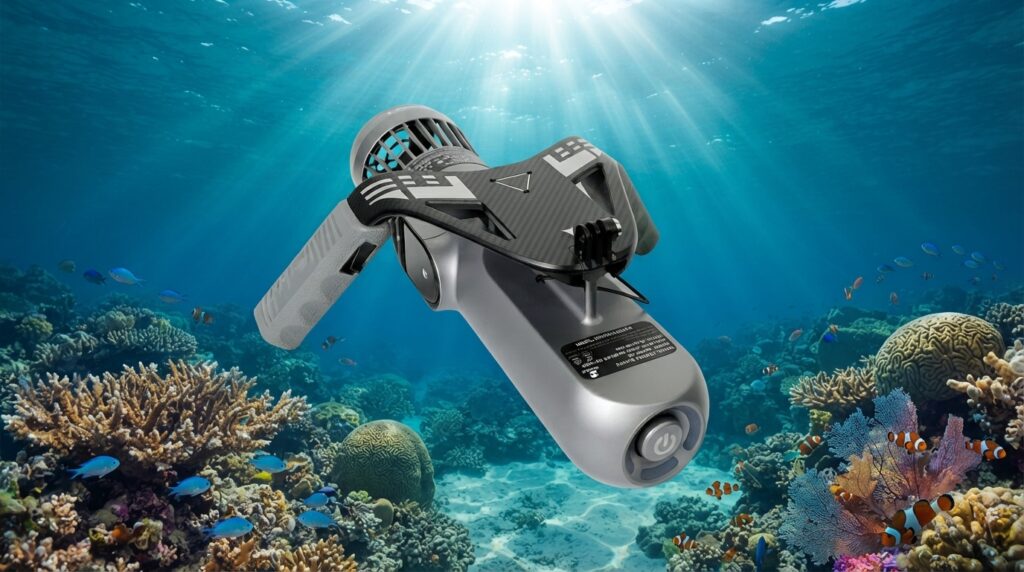
Underwater scooters can be an exciting and practical way to explore beneath the surface, but like all powered watersports equipment, they need to be used correctly.
For most recreational users, modern underwater scooters can be operated safely when the rider chooses equipment appropriate to their ability, understands the controls, uses sensible speeds, monitors conditions and follows the manufacturer's operating and battery instructions.
Vector Water Craft summarises the principle simply: underwater scooters are safe when used correctly, with appropriate supervision, safe conditions and quality equipment.
That does not mean underwater scooters are risk-free.
They are motorised equipment operating in an environment where visibility, currents, depth, marine structures, other swimmers and the user's own swimming or diving ability can all influence safety.
More powerful Diver Propulsion Vehicles can also carry divers substantially farther and faster than normal finning. Divers Alert Network notes that increased DPV performance brings increased risks and requires appropriate knowledge and training.
For Australian buyers, good underwater scooter safety can be divided into several areas:
This guide explains each area in practical terms.
An appropriately selected recreational underwater scooter can be suitable for a beginner who is already competent and comfortable in the water.
The important point is that the scooter should not be used to compensate for poor swimming ability.
A beginner should be able to:
The motor should add propulsion to existing water skills.
It should not become the user's only way of moving safely.
A beginner should also start with a lower-powered or easily controllable scooter rather than assuming maximum performance is desirable.
Vector's HS-S3, for example, is a 3 kg recreational underwater scooter with three speed settings, a 30-metre published depth rating and up to 60 minutes runtime.
Multiple speed settings can be particularly valuable to a new user because they allow the rider to start conservatively and increase speed only after becoming comfortable.
The safest place to learn an underwater scooter is generally calm, familiar and relatively shallow water appropriate to the user's swimming ability.
Before travelling any meaningful distance, practise:
A first session should be about learning how the scooter behaves.
It should not be about discovering its maximum speed or range.
Even compact recreational scooters can provide surprisingly strong propulsion compared with ordinary swimming.
Modern underwater scooters can travel much faster than a swimmer normally moves.
Vector's HS-S4 Bat, for example, uses dual 500 W motors and has a published maximum speed of 2 m/s, or approximately 7.2 km/h.
At the professional end, Vector's H9 Sub Jet Pro has substantially greater performance. Its design includes enclosed propulsion and electronic monitoring of important operating systems.
The faster the scooter, the sooner the user reaches:
Therefore, the best operating speed is not necessarily the highest speed available.
A simple safety rule is:
The less you can see, the slower you should travel.
In crystal-clear water, a rider may have substantial time to identify obstacles.
In poor visibility, the same speed may provide little reaction time.
Visibility can change during a session because of:
Adjust speed accordingly.
It sounds obvious, but riders can become distracted by:
Powered movement means a rider can travel a considerable distance while attention is elsewhere.
Look in the direction of travel regularly and maintain awareness of what is ahead and around you.
If using an action camera, set it up before beginning the session rather than constantly adjusting it while under propulsion.
An underwater scooter can make travel feel remarkably easy.
That convenience can encourage users to go farther from shore, a boat or a safe exit point than they would normally swim.
This is one of the most important risks to understand.
The scooter may have plenty of battery powerâbut equipment can malfunction.
A user should consider:
For a recreational snorkeller, that generally means remaining within a distance and conditions that can be managed without depending on the motor.
For a scuba diver, the issue becomes more complex and requires proper DPV procedures, gas management and contingency planning.
A battery's maximum runtime should never be treated as an invitation to use half travelling outward and exactly half returning.
Conditions may be different on the return journey.
The outward trip could be:
The return could involve:
Always keep an appropriate reserve.
The precise operational reserve required by serious divers depends upon training and the dive plan, but the principle applies equally to recreational users:
Turn around before you need to.
An underwater scooter can make moving with a current feel effortless.
That can disguise how strong the water movement actually is.
A user may travel rapidly away from the starting point and then discover that returning against the current requires significantly greater motor effort.
Never assume the scooter can overcome every current.
Conditions that are inappropriate for normal swimming can remain inappropriate simply because electric propulsion is available.
Assess water movement before travelling away from a safe area.
An underwater scooter provides propulsion.
It should not be confused with lifesaving or flotation equipment.
Users should select personal flotation equipment appropriate to the activity and location where required and follow normal safe-water practices.
An underwater scooter should never be relied upon to keep a non-swimmer safe.
Snorkelling is one of the most popular applications for compact underwater scooters.
For snorkellers, major safety priorities include:
The scooter should help the snorkeller explore a suitable area more efficiently.
It should not encourage the user to travel into conditions they would otherwise avoid.
For scuba diving, underwater scooter safety becomes more specialised.
Divers Alert Network describes DPVs as valuable equipment that can reduce underwater workload and potentially lower gas consumption, but also stresses that greater capability introduces additional risks.
A diver using a DPV must continue to manage:
The DPV cannot replace any of these fundamental diving responsibilities.
A diver can travel farther under power than by normal finning.
That means a failed DPV may leave the diver at a considerable distance from the exit point.
Dive planning should therefore consider what happens if:
Serious DPV users should seek appropriate training rather than learning purely through trial and error.
A DPV should move a diver through the water.
It should not become a substitute for buoyancy control.
The diver should remain able to control depth independently while:
Using propulsion vertically without proper depth awareness can create unnecessary risk.
Good diving skills remain the foundation.
Scuba divers must continue to follow appropriate ascent procedures.
A powerful underwater scooter should never be used casually to propel a diver rapidly toward the surface.
DAN has documented DPV-related diving situations where uncontrolled ascent risk became significant, illustrating the importance of maintaining depth control regardless of available propulsion.
The scooter does not change the physiological requirements of diving.
Powered propulsion can create separation between divers surprisingly quickly.
Before beginning a DPV dive, buddies should agree on:
Do not assume that because two divers start together they will automatically remain together at higher speeds.
Traditional open propulsion systems can present entanglement concerns around:
Good equipment management is therefore important.
Secure loose items before activating propulsion.
Keep hands, hair, straps and other equipment away from moving propulsion components.
Some modern designs provide additional protection. Vector states that its H9 uses a fully enclosed propulsion duct designed to eliminate exposed propellers and reduce entanglement risk with lines, kelp and debris.
Even with enclosed propulsion, users should continue to maintain good equipment discipline.
Electric underwater scooters can be relatively quiet.
Another swimmer may not realise you are approaching.
Reduce speed around:
Give others plenty of space.
Powered recreational equipment should never be operated in a way that intimidates or endangers other water users.
Snorkellers and divers can be difficult for boat operators to see.
An underwater scooter can also allow a swimmer to move farther from shore or the boat they entered from.
Avoid travelling through busy boating areas where possible.
Use appropriate dive or surface visibility procedures for the activity and location.
Local marine and waterway requirements can vary, so users should check the rules applying to the particular state and waterway before operating.
One of the attractions of an underwater scooter is the ability to see more underwater scenery and marine life.
That increased mobility should be used responsibly.
Do not use powered propulsion to:
The purpose should be observation rather than pursuit.
Reefs can be both delicate and physically hazardous.
Avoid travelling close enough that a sudden change in direction could cause contact.
Coral can be damaged by physical impact, and reef structures can also cause injury to the rider.
Travel slowly enough that you can stop or change direction comfortably.
The propulsion system is one of the most important mechanical safety areas.
Before buying an underwater scooter, inspect or investigate:
Do not remove protective guards or modify the propulsion system.
A performance modification that compromises safety is not an improvement.
Modern underwater scooters typically rely on rechargeable lithium-ion batteries.
These batteries provide excellent energy density and make compact electric propulsion possible.
They also require proper handling.
Australia's Product Safety regulator warns that lithium-ion batteries can present fire risks if they are damaged, defective, improperly charged or exposed to unsuitable conditions.
Battery safety should therefore be treated as seriously as water safety.
Always use charging equipment specified for the underwater scooter.
The ACCC advises consumers to use appropriate charging equipment and never use batteries or chargers showing signs of damage or failure.
Do not:
If replacement charging equipment is required, obtain the correct specification.
Battery damage can include:
Australia's Product Safety guidance specifically advises consumers to stop using lithium-ion batteries and chargers that show signs of failure or physical damage.
If you suspect a battery problem, stop using the scooter and obtain appropriate advice.
Do not return from the ocean and immediately treat the scooter as if it were dry household equipment.
Follow the manufacturer's cleaning, drying and charging procedure.
Saltwater and electrical connections require careful management.
Before charging:
Good post-use maintenance is part of safe ownership.
This point is particularly important in Australia.
The ACCC warns consumers not to expose lithium-ion batteries to excessive heat and specifically advises against leaving them in hot vehicles.
An Australian vehicle parked in summer can become extremely hot.
Do not make the boot of your car the permanent storage area for an underwater scooter.
Store the equipment according to manufacturer recommendations in an appropriate location.
Lithium-powered equipment should be charged according to manufacturer instructions and in an appropriate location.
The ACCC has continued to emphasise careful lithium-ion charging and storage because incorrectly used, charged or damaged batteries can overheat, ignite or in some cases explode.
A sensible routine is to charge equipment where it can be monitored rather than habitually connecting it in an unsuitable location and forgetting about it.
A simple pre-use inspection takes very little time.
Check:
If something looks wrong, investigate before entering the water.
Do not assume a defect will be harmless simply because the scooter still turns on.
Before activating the motor, make sure there are no:
near the propulsor.
Never reach into a propulsion opening while the system is energised.
Follow the manufacturer's isolation procedure before clearing an obstruction.
Salt deposits can damage marine equipment over time.
Follow the manufacturer's maintenance procedure, which will commonly include fresh-water rinsing after saltwater exposure.
Pay particular attention to:
Correct maintenance supports reliability, and reliability is itself a safety consideration.
Beach use exposes equipment to fine sand.
Avoid putting the scooter directly into loose dry sand where practical.
Sand can accumulate around:
Use an equipment mat, towel or clean surface where possible and rinse contamination away according to manufacturer instructions.
Underwater scooters rely on waterproof housings and seals.
Do not dismantle sealed components unless the manufacturer's instructions specifically require or permit it.
Incorrect reassembly can compromise waterproof integrity.
If servicing is beyond the normal owner's maintenance procedure, obtain appropriate technical assistance.
Parents should not assume that an underwater scooter is automatically a children's toy because it is compact.
Suitability should be assessed according to:
Young or inexperienced users should be closely supervised.
A parent or responsible adult should remain close enough to intervene.
High-performance equipment should not be handed to an inexperienced child simply because the child can activate the controls.
If several people are sharing one scooter, establish some simple rules:
Clear rules make family recreational use considerably easier to manage.
Safety begins with buying the correct equipment.
A lightweight recreational snorkeller generally does not need a professional high-speed DPV.
Vector's current range demonstrates several different levels.
The HS-S3 weighs approximately 3 kg and provides three speed settings with up to 60 minutes runtime.
The HS-S4 Bat weighs approximately 4.3 kg, uses dual 500 W motors and reaches up to 7.2 km/h.
The H9-1 Sub Runner reaches up to 2.5 m/s, has a 40-metre depth rating and offers up to 60 minutes runtime.
The H9 Sub Jet Pro incorporates much more substantial professional-level propulsion and safety-monitoring architecture.
Matching equipment to experience matters more than simply buying the highest specification.
Higher-performance equipment provides greater capability.
That also means the rider can:
DAN's guidance on DPVs makes this relationship clear: greater underwater propulsion performance should be matched by appropriate training and risk awareness.
There is nothing inherently unsafe about higher performance when used correctly.
The issue is matching the equipment to the operator.
For most Australian recreational users, these ten principles provide a useful starting point.
Do not rely on the scooter as a flotation or rescue device.
Start slowly and practise stopping and steering.
Maximum speed is not always appropriate.
Do not depend entirely on battery propulsion.
Do not plan to arrive back with the battery effectively empty.
Electric power does not make hazardous conditions safe.
Manage straps, hair, lines and diving equipment.
Use the correct charger and stop using damaged batteries.
Reliability depends partly on correct ownership.
More power is worthwhile only when the operator can control it responsibly.
A good underwater scooter should make safe operation easier.
Consider:
This reduces access to moving propulsion components.
Lower speeds are particularly useful for beginners and confined areas.
The rider should be able to stop propulsion quickly.
Knowing remaining battery state assists conservative planning.
The scooter must be engineered for its stated depth and intended application.
Higher-performance equipment can benefit from electronic protection.
Vector states that the H9 continuously monitors motor temperature, controller load, battery voltage and discharge rate as part of its integrated safety architecture.
Not automatically.
Low weight can make handling easier, but safety depends upon the complete combination of:
Vector's HS-S2, for example, weighs only 1.4 kg while still producing 6.5 kg of thrust and reaching up to 1.4 m/s.
That is useful performance from a very compact product.
The appropriate question is not whether lightweight or heavy scooters are inherently safer.
It is whether the scooter is appropriate for the intended operator and activity.
Propulsion protection is a worthwhile consideration.
Vector states that the professional H9 uses a fully enclosed propulsion duct to eliminate exposed propellers and reduce risks from entanglement with lines, kelp and debris.
Different scooter designs use different protection systems, so buyers should inspect the particular model rather than assuming all propulsion systems are identical.
Never intentionally defeat a manufacturer's protective design.
Stop the session if:
There is little benefit in continuing a recreational session once conditions no longer feel appropriate.
Basic recreational users may learn an appropriately designed scooter through careful familiarisation and the manufacturer's instructions.
Specialised instruction becomes increasingly worthwhile when moving into:
Equipment capability does not create operator competence.
This is particularly important with professional underwater propulsion.
They can be used responsibly around appropriate reef environments where local regulations permit.
The rider should:
Powered mobility should improve access to underwater scenery without increasing environmental damage.
They can be suitable for ocean and saltwater operation where the specific scooter is designed for it and conditions are appropriate.
Ocean conditions require additional attention to:
A calm protected bay and an exposed surf beach are very different environments.
Do not generalise from one to the other.
Yes.
An underwater scooter combines:
If something behaves abnormally, having access to knowledgeable support is preferable to experimenting with electrical or waterproof components yourself.
Vector Water Craft supplies specialist electric underwater equipment in Australia across recreational and professional performance levels.
Buyers should also confirm the warranty and after-sales arrangements applying to the specific model before purchasing.
Learn the equipment gradually.
The scooter must not become your only route home.
An effortless outward trip can create a difficult return.
Reduce speed when you cannot see far ahead.
Navigation always comes first.
Secure equipment before starting the motor.
Stop using damaged or abnormal lithium equipment.
Lithium-ion equipment should be protected from excessive heat.
Proper cleaning contributes to long-term equipment reliability.
Equipment specifications and diving qualifications are completely different matters.
Yesâunderwater scooters can be safe and highly enjoyable when suitable equipment is used responsibly in appropriate conditions. Vector Water Craft gives the same core guidance, stating that underwater scooters are safe when used correctly, with suitable supervision, safe conditions and quality equipment.
However, powered underwater movement deserves respect.
The most important principles are:
For scuba divers and users progressing to high-performance DPVs, the additional capability should be matched with suitable training and conservative planning. DAN's DPV guidance emphasises precisely this relationship between increased performance and increased responsibility.
The safest underwater scooter is therefore not necessarily the slowest or smallest.
It is the one that is appropriate for its operator, maintained correctly and used with good judgement.
If you are unsure which underwater scooter is appropriate for your experience and intended use, speak with Vector Water Craft before purchasing.
Tell us:
We can help you compare Vector's underwater scooter range according to performance, weight, runtime, depth capability and intended use.
The aim is not simply to put you on the fastest scooter available.
It is to help you choose an underwater scooter that provides the right level of performance for safe, enjoyable and practical use.
They are powered watersports equipment and therefore involve risks, but they can be used safely when operated correctly, in appropriate conditions and by people with suitable water skills. Vector specifically advises correct use, supervision and safe operating conditions.
Yes, with an appropriate recreational model and adequate swimming ability. Beginners should start in calm shallow water and learn the controls at low speed before travelling farther.
Yes. An underwater scooter should not replace swimming ability and should not be relied upon as a flotation or lifesaving device.
Suitability depends upon the manufacturer's recommendations, the child's swimming ability, size and the scooter's performance. Close adult supervision is essential.
Appropriately rated DPVs can be used for diving, but serious DPV use introduces additional planning and training requirements. DAN notes that increased DPV performance brings increased risks as well as benefits.
Yes. Powered movement can allow users to cover much more distance than normal swimming. Remain within a conservative operating area and do not rely on the motor as your only way back.
No. Maintain an appropriate reserve and account for changing conditions and possible equipment problems.
Lithium-ion batteries are widely used and can be safely operated when handled correctly, but the ACCC warns that damaged, defective or incorrectly charged batteries can create fire risks.
Stop using it. Australia's Product Safety regulator advises consumers not to use batteries showing swelling, overheating, leakage or other signs of failure.
Avoid storing lithium-powered equipment in a hot parked vehicle. Australian Product Safety guidance specifically warns against exposing lithium-ion products to excessive heat.
Follow the manufacturer's saltwater maintenance procedure, which commonly includes thorough fresh-water rinsing and appropriate drying.
There is no single figure. The appropriate speed depends upon visibility, rider experience, water conditions, obstacles and other people in the water. Beginners should start at low speed.
Protected propulsion can reduce access to moving components. Vector's H9, for example, uses a fully enclosed propulsion duct designed to reduce injury and entanglement risks.
A scooter should not be treated as a way to make unsuitable water conditions safe. Strong currents can substantially affect return ability and battery demand.
Check battery condition, charge level, controls, housing, propulsion protection, attachments and visible damage before entering the water.
There is no universal answer. The safest choice is the model whose performance, weight and controls match your swimming or diving ability and intended environment.