
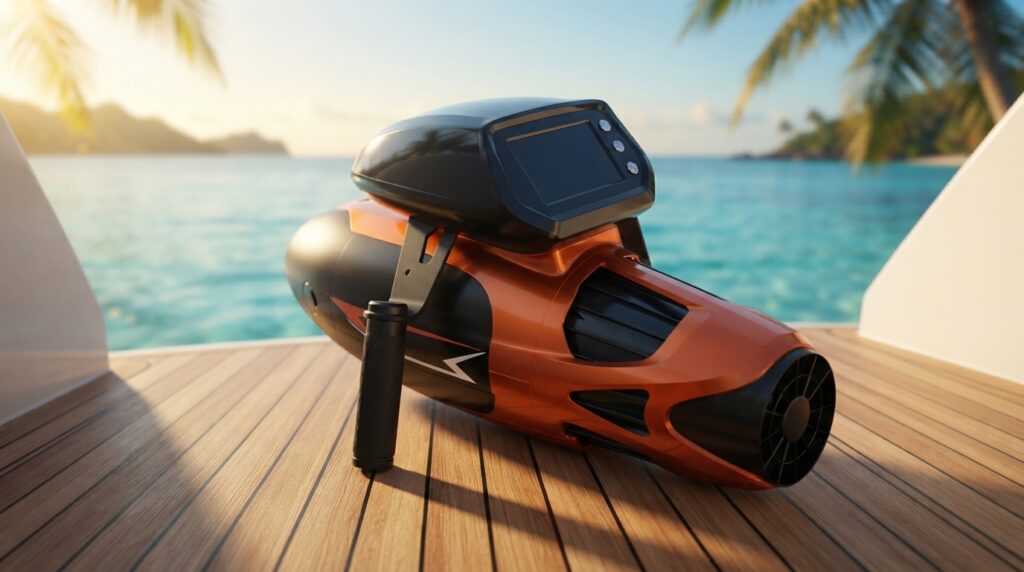
Underwater scooters are opening up a very different way for Australians to explore beneath the surface.
Also known as sea scooters, diver propulsion vehicles or underwater propulsion devices, these compact electric craft use battery-powered thrust to pull or propel a swimmer, snorkeller or diver through the water. Instead of relying entirely on kicking with fins, the rider can cover more water with considerably less physical effort.
For recreational users, that can mean exploring more of a sheltered bay, reef or swimming area during the available time in the water. For experienced divers, an appropriately selected underwater scooter can help reduce the effort required to travel between points underwater. For families and holiday users, smaller models can simply add another dimension to days spent around the water.
The important point, however, is that not all underwater scooters are the same.
The Australian market now covers everything from very light portable units designed mainly for recreational swimming and snorkelling through to significantly more powerful machines capable of higher speeds, longer operating periods and considerably greater depths.
Choosing the best underwater scooter therefore does not mean simply buying the fastest or most expensive machine. It means selecting the scooter that best matches where you intend to use it, how experienced you are, the performance you require and how easily you need to transport and maintain it.
This 2026 Australian buyer's guide explains the major considerations.
An underwater scooter contains an electric motor, a battery, controls and a propulsion system enclosed within a water-resistant or waterproof body.
The rider normally holds the scooter in front of the body, although some designs can be mounted or worn in other configurations. When the motor is activated, the scooter generates forward thrust and the user is pulled or propelled through the water.
The basic principle is straightforward, but considerable differences exist between models.
Important differences include:
These differences are why a buyer should start with the intended application rather than selecting a scooter from speed figures alone.
Vector Water Craft's current Australian range illustrates this diversity. Its underwater scooter category includes compact recreational models alongside more powerful products intended for more demanding applications.
There is no single typical underwater scooter owner.
For snorkellers, an underwater scooter can make it possible to explore a larger area without constantly swimming at maximum effort.
This can be particularly enjoyable in suitable sheltered coastal waters where there are interesting areas separated by relatively long swimming distances.
A smaller, lighter scooter is often preferable for recreational snorkelling because extreme depth capability or very high thrust may offer little practical advantage.
Some users simply want a powered water activity rather than a serious diving tool.
For them, ease of use, manageable weight, controllable speeds and simple charging can matter more than maximum specifications.
Divers generally have more demanding requirements.
Depth capability becomes important, as do runtime, reliable controls and predictable power delivery.
An underwater scooter should never be treated as a substitute for proper diving skills, dive planning or adequate gas management. A diver using propulsion can potentially travel farther from the exit point than they would normally swim, so conservative planning remains essential.
A suitable lower-powered model can add a new activity to family holidays and weekends around the water.
Parents should assess a unit's power, controls and suitability for the individual user rather than assuming that every compact scooter is a children's product. Manufacturer age recommendations and supervision requirements should always be followed.
An underwater scooter is relatively easy to carry compared with many powered watersports products.
This makes compact models particularly interesting for boat owners who want an additional activity onboard without dedicating substantial storage space to equipment.
Underwater scooters can also have commercial applications in appropriately managed tourism activities.
Businesses have additional considerations involving staff supervision, operating procedures, charging, maintenance, insurance and local regulatory requirements.
There is no universal “best” underwater scooter because the correct choice depends on the application.
A better way to divide the market is into three broad groups.
Lightweight scooters are generally the logical starting point for people who place portability and simplicity ahead of outright performance.
They can suit:
Weight matters more than many first-time buyers expect.
You may only use a scooter for an hour in the water, but you still need to carry it from your vehicle, load it into a boat, store it at home and possibly travel with it.
A substantially lighter unit can therefore be preferable to a more powerful scooter if the additional performance will rarely be used.
For example, Vector Water Craft currently lists the HS-S2 at approximately 1.4 kg. The model is described as using an arm-mounted configuration with thumb control and has a published maximum speed of approximately 1.4 metres per second.
The important buying lesson is not simply the specification of one model. It is that underwater scooters have now become sufficiently compact that Australian buyers can select propulsion without automatically accepting the weight associated with older-style diving equipment.
The next category provides a balance between portability and performance.
These models may offer multiple speeds, longer runtimes and greater versatility while remaining manageable enough for regular recreational use.
Vector Water Craft's current HS-S3, for example, is listed at approximately 3 kg, with three speed settings, underwater-camera support, a published depth capability of 30 metres and runtime of up to 60 minutes.
This type of product may make sense for someone who expects to use an underwater scooter regularly rather than only occasionally.
Multiple speed settings are particularly useful because maximum speed is not always desirable.
Lower settings may provide more comfortable control during relaxed exploration and can also help manage available battery capacity.
More powerful scooters become relevant when a buyer wants substantially greater speed, sustained propulsion or diving capability.
Vector's H9 Sub Jet Pro, for example, is currently listed with a published speed of up to 13 km/h, runtime of up to 100 minutes and a maximum published depth of 40 metres.
Those figures demonstrate just how different a high-performance scooter can be from an entry-level recreational unit.
However, increased capability also creates greater responsibility.
A machine capable of taking a diver farther and faster should be matched to the person's experience and operating environment.
The strongest scooter is not automatically the safest or most enjoyable scooter for every user.
Another development is the compact dual-motor scooter.
Two motors can provide substantial thrust while allowing manufacturers to use a wider body or wing-style format.
Vector's HS-S4 Bat is an example. Its current specifications list twin 500-watt motors, a weight of approximately 4.3 kg and speeds of up to 2 metres per second, or approximately 7.2 km/h.
For buyers comparing models, motor configuration is worth considering, but the headline wattage should still not be viewed in isolation.
What matters to the rider is how effectively the complete scooter turns its available power into usable underwater thrust and controllability.
Begin with one question:
If the answer is leisurely snorkelling on holidays, a lightweight unit may be ideal.
If the answer is regular diving, the requirements change considerably.
Try to identify your main application before looking at individual specifications.
That prevents the common mistake of paying for performance that you will rarely use—or buying an entry-level product and subsequently discovering that it does not provide enough capability.
Speed is one of the easiest specifications to compare, which is why it receives so much attention.
It should not be the first specification you use to choose a scooter.
Higher speed can be exciting, but underwater visibility, currents, obstacles, other swimmers and your personal skill level all affect what speed is sensible.
Variable-speed control is therefore valuable.
A scooter with several usable speed levels can potentially serve more situations than one that concentrates almost entirely on maximum output.
Thrust is particularly important when comparing products for serious use.
A heavier diver wearing scuba equipment creates very different demands from a snorkeller wearing a mask, snorkel and fins.
Check whether a manufacturer provides thrust specifications and consider them alongside speed rather than independently.
Manufacturers usually provide an estimated maximum operating time.
Treat this as a comparison figure rather than a guarantee that every owner will achieve precisely that duration in all conditions.
Real-world runtime can be influenced by factors such as:
A buyer intending to make longer excursions should place much greater emphasis on runtime than someone buying a scooter for short recreational sessions.
Depth capability must suit the application.
A recreational snorkeller staying close to the surface does not require the same capability as an experienced scuba diver.
Never assume that because two scooters look similar they have similar depth ratings.
Current Vector models demonstrate a considerable range of published capabilities. For example, the HS-S3 is listed to 30 metres, while the HS-S2 is published with a capability of up to 60 metres.
Always follow the manufacturer's operating limitations.
Consider both underwater use and what happens before and after you enter the water.
Ask:
Can I comfortably carry it from the car?
Will it fit into my boat?
Will I take it travelling?
Can I lift it safely when wet?
Do I have somewhere appropriate to store it?
A difference of several kilograms can materially change the ownership experience.
Controls should be intuitive and easy to operate while wearing whatever equipment you normally use.
For divers, that can include gloves.
Look at:
Controls are an area where good design can matter more than another small increase in theoretical top speed.
Any powered underwater device should incorporate appropriate protection around moving propulsion components.
The design should minimise the ability of hands, loose equipment, vegetation or other objects to reach moving parts.
Users should still keep hands, hair, straps, lines and loose equipment clear of the propulsion system and follow the manufacturer's safety procedures.
For Australian owners, saltwater operation is likely to be important.
Many underwater scooters are designed for saltwater use, but salt dramatically increases the importance of post-use care.
Vector Water Craft advises that models intended for saltwater should be rinsed and properly maintained after use.
A fresh-water rinse following saltwater operation should therefore become part of the normal ownership routine where specified by the manufacturer.
This is frequently overlooked when comparing products online.
An underwater scooter combines water, electronics, batteries, motors, seals and chargers.
Before purchasing, investigate:
Vector Water Craft operates as an Australian specialist electric-watercraft supplier and currently advertises Australian-backed warranty and support arrangements. Buyers should check the warranty applicable to the specific scooter at the time of purchase, because terms can differ between products and can be updated.
Underwater scooter pricing varies considerably because buyers are not comparing identical products.
At one end are compact recreational scooters.
At the other are higher-powered propulsion systems designed for more demanding applications.
At the time of writing in 2026, Vector Water Craft's Australian underwater-scooter category includes models such as the HS-S3 at $1,197 and HS-S4 Bat at $1,725. Prices should always be confirmed before purchasing because product specifications and pricing can change.
The right question is therefore not:
It is:
A low purchase price offers poor value if the product cannot satisfy its intended role.
Likewise, buying the highest-performance scooter available is unnecessary for someone who simply wants relaxed holiday snorkelling.
The battery is one of the most important components in any modern electric watercraft.
Lithium-ion technology is widely used in rechargeable devices because it combines compact dimensions with strong power capability.
However, lithium-ion batteries must be treated correctly.
Australian product-safety authorities warn that poorly manufactured, damaged, incorrectly charged or incorrectly stored lithium-ion batteries can create serious fire risks.
For an underwater scooter owner, sensible battery practice should include:
WorkSafe Queensland specifically recommends using the correct charger and voltage, avoiding battery or charger modification and charging when someone is present rather than routinely leaving devices charging overnight.
Battery care is therefore both a performance issue and a safety issue.
An underwater scooter should add enjoyment and capability to water activities. It should never encourage users to exceed their swimming, snorkelling or diving abilities.
Good practice includes:
Become familiar with acceleration, steering and stopping before using higher settings.
Avoid areas with excessive boat traffic, breaking surf, strong currents or hazards until you have the skills and equipment appropriate for those conditions.
Powered movement means you can close the distance to an object, swimmer or underwater feature much faster than when swimming normally.
This is particularly important for divers.
Equipment can fail. Batteries can become depleted. Conditions can change.
Plan activities so that loss of propulsion does not create an emergency.
Australian maritime and water-use requirements can vary by state, territory and location. Marine parks, managed waterways, swimming areas and commercial operations may have their own restrictions.
Before operating in an unfamiliar area, check the current requirements applying to that particular location.
Do not treat an underwater scooter as an unsupervised toy simply because it is small and electric.
Follow manufacturer requirements and match the unit to the user's size, swimming ability and experience.
Saltwater and mechanical equipment demand good maintenance.
A simple routine can greatly improve the ownership experience.
After use:
Never dismantle waterproof assemblies unless the manufacturer's instructions specifically require or permit it.
A waterproof scooter depends on its sealing system remaining intact.
One of the most enjoyable developments in underwater scooters is their relationship with compact action cameras.
Some models provide mounting arrangements for underwater cameras. Vector's HS-S3, for example, specifically lists support for camera mounting.
This can allow the rider to capture more stable sequences while travelling across a reef, through clear water or alongside marine scenery.
Camera capability should nevertheless remain secondary to safe control of the scooter.
The rider's first responsibility is always navigation and awareness.
This is one of the most useful comparisons for a prospective buyer.
Choose portability when your priorities are:
Move toward greater power and runtime when your priorities are:
There is no inherent superiority in either direction.
The best underwater scooter is the one you will enjoy using regularly and that has the capability appropriate for its intended environment.
Before placing an order, work through this checklist.
Snorkelling, swimming, diving, boating or another application?
Select power and performance that suit your abilities.
Do not buy from maximum-speed figures alone.
Compare expected operating time and battery capacity.
Match the depth rating to realistic use.
Think about transport as well as underwater handling.
Product support is particularly worthwhile with specialist electric equipment.
Use the correct equipment and follow safe charging procedures.
Confirm this if coastal use is planned.
Understand ownership requirements before purchase.
Several developments have made this category increasingly practical.
Electric motors have become compact.
Rechargeable battery technology provides substantial energy from relatively small packs.
Waterproof engineering has improved.
Compact electronic controls allow multiple power settings.
Modern materials have reduced weight.
The result is that powered underwater movement is no longer restricted to large specialist diving equipment.
A modern recreational scooter can be small enough to carry relatively easily while still providing meaningful propulsion.
At the same time, specialist products have become capable enough to satisfy much more experienced users.
This widening range is one of the reasons underwater scooters are worth considering as a serious electric watersports category rather than simply as novelty products.
Buying specialist electric equipment exclusively on headline specifications can create problems later.
The purchase decision should also consider the company standing behind the equipment.
An Australian buyer benefits from being able to ask questions about:
Vector Water Craft specialises in electric watercraft rather than treating underwater scooters as an isolated consumer gadget. Its broader Australian range currently encompasses electric surfboards, hydrofoils, mini electric jet boats and underwater propulsion products.
That specialist focus is particularly useful for buyers entering a product category that may be completely new to them.
The best underwater scooter in Australia in 2026 cannot be identified solely by the biggest motor, highest speed or lowest price.
It is the scooter that best matches your use.
For a recreational snorkeller, light weight and ease of operation may be the deciding factors.
For someone who spends considerable time around boats and beaches, portability, saltwater suitability and straightforward maintenance may dominate the decision.
For experienced divers, depth rating, thrust, runtime and dependable controls become much more important.
For performance-focused users, higher-powered and dual-motor designs provide another level of capability again.
The key is to compare complete packages rather than isolated specifications.
Consider:
Do that carefully and an underwater scooter can become much more than another item of watersports equipment. It can change how much of the underwater environment you are able to experience during every outing.
If you are considering an underwater scooter but are unsure which level of performance is appropriate, speak with Vector Water Craft before making the decision.
Rather than simply selecting the fastest model, tell us how you intend to use it, whether you will mainly snorkel or dive, how important portability is and what level of performance you expect.
We can then help you compare the available Vector underwater scooters and identify the model that most closely suits your requirements.
Explore the Vector Water Craft underwater scooter range and contact us for assistance choosing the right model for your needs.
An underwater scooter is a battery-powered propulsion device designed to help move a swimmer, snorkeller or diver through the water. It is also commonly called a sea scooter or diver propulsion device.
Yes, suitable models can be used for recreational snorkelling. For this application, manageable weight, controllable speed and ease of use are often more important than extreme depth or maximum power.
It varies substantially by model. Current Vector models illustrate this range: the lightweight HS-S2 is published at up to approximately 1.4 metres per second, while the considerably more powerful H9 Sub Jet Pro is listed at up to 13 km/h.
Runtime varies according to the model and operating conditions. Current published Vector examples range from up to approximately 60 minutes for the HS-S3 to up to 100 minutes for the H9. Actual operating time can be affected by speed selection, conditions and use.
Many are designed for saltwater use. Owners should follow the manufacturer's cleaning and maintenance instructions and normally pay particular attention to thorough fresh-water rinsing following saltwater operation.
Recreational models can be relatively straightforward to learn, but users should begin conservatively, understand the controls and operate within their ability. Higher-powered products require greater care and experience.
The main factors are intended use, speed, thrust, runtime, depth capability, weight, battery quality, controls, safety design, maintenance requirements and Australian product support.
Not necessarily. More power is useful for particular applications, but it may add weight, cost or capability that a recreational user does not require. Matching the scooter to your actual use generally produces a better result.
Quality lithium-ion batteries are widely used in rechargeable equipment, but they must be charged, stored and handled correctly. Australian safety authorities recommend using the appropriate charger, inspecting batteries for damage and avoiding unsuitable or unattended charging practices.
Vector Water Craft supplies a specialist range of electric underwater scooters in Australia, from lightweight recreational models through to higher-performance propulsion products. Current specifications, pricing and availability should be checked at the time of purchase.