
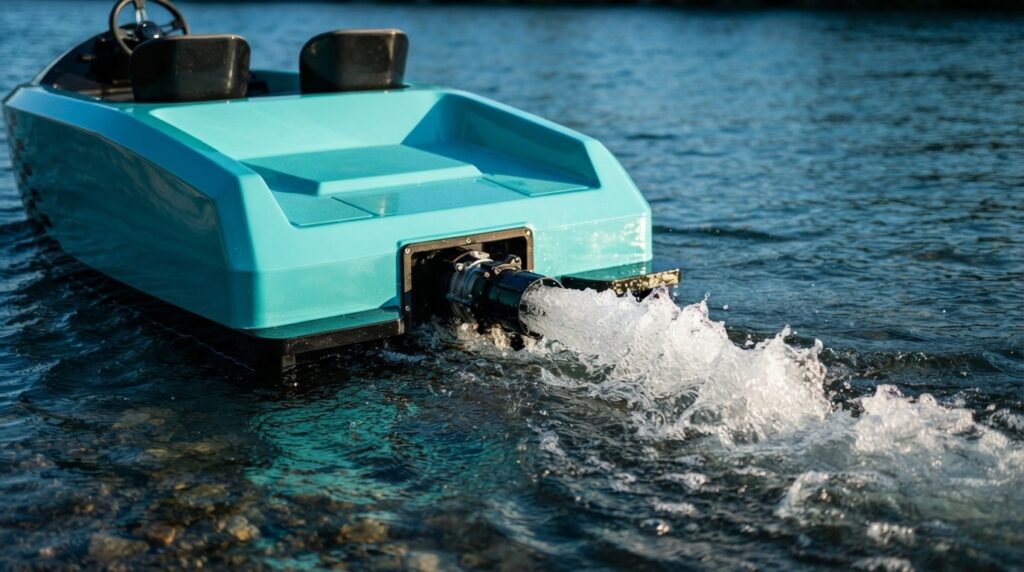
Popular understanding of jet propulsion often stops at a fairly simple mental picture: water goes in one end, gets pushed out the other end faster, and the boat moves forward. This is not wrong, exactly, but it leaves out nearly everything that actually determines how well a particular jet propulsion system performs, and understanding the fuller picture genuinely matters for Australian buyers and owners trying to make sense of why different mini jet boats, even those with broadly similar motor specifications, can feel meaningfully different once they are actually out on the water.
At its core, jet propulsion relies on a straightforward physical principle: accelerating a mass of water backward generates an equal and opposite forward force on the boat itself, following the same basic physics that governs rocket propulsion, garden hoses recoiling when the tap is opened fully, and countless other everyday examples of reaction thrust. A jet propulsion system draws water in, accelerates it considerably through an impeller, and expels it at high velocity through a nozzle, and the reaction force from that acceleration pushes the boat forward.
Water enters a jet propulsion system through an intake positioned on the underside of the hull, and the design of this intake matters considerably more than its simple function might suggest. A well-designed intake delivers a smooth, consistent flow of water to the impeller with minimal turbulence, while a poorly designed intake can introduce uneven flow that reduces how efficiently the entire system converts input water into usable thrust downstream.
Intake design also interacts meaningfully with hull shape, since the flow of water along the hull's underside directly affects the quality and consistency of what actually reaches the intake. For Australian conditions specifically, where boats regularly operate in shallower rivers, estuaries and around variable seabed conditions, intake positioning and grille design also play a genuine role in reducing the risk of debris ingestion, a topic covered in more depth in a companion article addressing intake blockages and lost water flow.
Once water reaches the impeller, this rotating component — driven directly by the electric motor — does the genuine work of accelerating that water dramatically, converting the motor's rotational energy into rapidly moving water. Impeller design, including blade pitch and shape, significantly affects how efficiently this energy conversion happens across different speed ranges, and different impeller designs genuinely suit different performance priorities, whether that is strong low-speed acceleration or efficient high-speed cruising.
The clearance between the impeller and its surrounding housing also matters considerably for overall efficiency, since excessive clearance allows some water to slip past the impeller without being properly accelerated.
After passing through the impeller, accelerated water is directed through a nozzle, which further concentrates and directs the resulting thrust. Nozzle design plays a dual role in most mini jet boats — not only shaping the final thrust output, but also, through its ability to pivot, providing the primary means of directional steering. This dual-purpose design is one of the genuinely distinctive characteristics of jet propulsion compared to a conventional rudder-and-propeller arrangement, and it contributes directly to the sharp, immediate turning responsiveness mini jet boats are generally known for.
The absence of an exposed, spinning propeller beneath the hull offers a genuine safety advantage in shallow water and around swimmers. The direct coupling of steering to thrust output, through the pivoting nozzle, also supports the sharp, immediate turning responsiveness that makes these boats so manoeuvrable in the tighter, more technical Australia waterways discussed throughout this series, from Marlborough Sounds channels to braided Canterbury rivers.
A propeller-driven boat generates thrust through a spinning propeller pushing water backward directly, with steering handled separately through a rudder positioned in the water flow. Jet propulsion, by contrast, can deliver genuinely useful steering response even at quite low speeds, since the nozzle directly redirects whatever thrust is currently being generated. This is part of why mini jet boats often feel more immediately responsive and manoeuvrable at low speed compared to an equivalent propeller-driven vessel.
Not every unit of energy delivered to a jet propulsion system converts perfectly into usable thrust. Losses occur at each stage discussed throughout this article — turbulence at the intake, clearance losses around the impeller, and some inevitable inefficiency in how cleanly the nozzle converts accelerated water into directed thrust. Cavitation represents a further, genuinely significant source of potential efficiency loss.
It helps explain why intake blockages can cause a sudden, noticeable loss of thrust even when the motor itself remains perfectly healthy. It helps explain why steering response can feel different at low speed compared to higher cruising speed. And it helps set realistic expectations for how a boat will handle in the kind of shallow, debris-prone Australia waterways — braided rivers, weedy harbour margins, estuarine flats — where intake performance genuinely matters.
Jet propulsion is not a genuinely new or unproven technology being applied to mini jet boats for the first time — it has a long, well-established history in Australia specifically, having been developed and refined for shallow, fast-flowing river conditions that this country's braided river systems presented particular challenges for. This heritage matters for Australia buyers in a genuinely reassuring way, since the fundamental engineering principles underpinning modern electric mini jet boat propulsion systems trace back to decades of proven, locally relevant development.
A jet propulsion system's efficiency is not necessarily constant across a boat's entire operating speed range. Many jet propulsion systems are genuinely optimised to perform most efficiently within a particular speed band, with efficiency tapering somewhat at both the very low speed end and the very top of the speed range. This is part of why a boat's genuinely most efficient cruising speed also reflects the speed range where the jet propulsion system itself is working at its best.
Australia buyers are well served by seeking out specific information about a given boat's propulsion system quality beyond simply confirming that it uses jet propulsion in the first place — asking about impeller design, seeking out independent reviews addressing thrust efficiency or low-speed responsiveness, and speaking directly with existing owners about their genuine, real-world experience.
Braided river systems present exactly the kind of shallow, variable-depth conditions where jet propulsion's lack of an exposed propeller offers genuine practical advantage. The Marlborough Sounds benefits considerably from jet propulsion's direct, immediate steering response, supporting precise navigation of tighter channels. The more exposed coastal and larger lake waters rely more heavily on jet propulsion's genuine thrust efficiency at higher cruising speeds, where impeller and nozzle engineering quality has its most pronounced effect on real-world range and performance.
Impeller pitch and its effect on performance, cavitation and why it matters, intake design and thrust efficiency, air ingestion and sudden thrust loss, nozzle design and steering, reverse system operation, vibration diagnosis, and recognising early signs of jet drive wear all build directly on the foundational understanding this article has aimed to establish.
Water is drawn into the hull through a carefully positioned intake, ideally with minimal turbulence and appropriate protection against debris. This water then reaches the impeller, which dramatically accelerates the water's velocity through carefully engineered blade geometry. That rapidly moving water is then directed through a nozzle, which both concentrates the resulting thrust and provides direct steering control. The reaction force generated by expelling this accelerated water rearward pushes the boat forward.
Jet propulsion in a mini jet boat relies on a genuinely elegant physical principle — accelerating water backward to generate forward thrust — but the quality of engineering at each stage of this process, from intake design through impeller efficiency to nozzle shaping, meaningfully determines how well that principle actually translates into real-world performance. Genuine understanding of this system forms the essential foundation for everything else this broader series explores about jet propulsion, from cavitation and impeller pitch through to intake maintenance and long-term component wear. It is knowledge well worth acquiring before diving into the more specific, technical companion pieces that follow throughout the remainder of this jet propulsion category. Armed with this understanding, Australian owners and buyers are genuinely well prepared to move forward into the more specific technical detail that follows.