
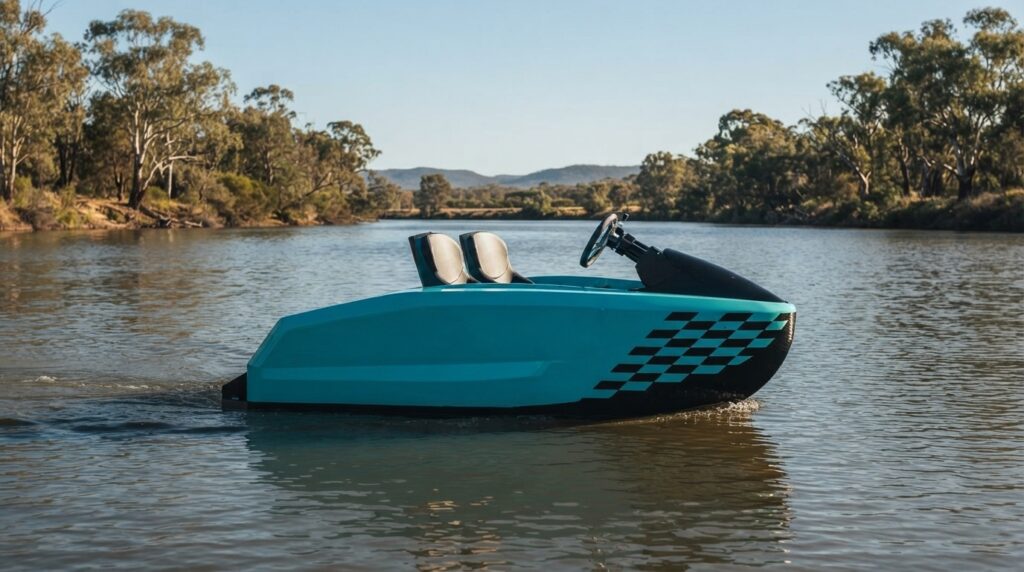
Most published performance and range figures for mini jet boats are based on a single rider, yet a great deal of real-world use involves two people aboard — a partner, a friend, a child. Understanding exactly how a second passenger changes range and performance is one of the more practically useful things a prospective owner can learn, because the gap between solo and two-up figures is often larger than intuition suggests.
As covered in the article on hull weight, energy consumption and acceleration are both closely tied to total mass being moved through the water. Mini jet boats, by design, are compact and comparatively light craft, which means a second adult passenger — plus whatever gear they bring — often represents a meaningful percentage increase in the boat's total operating weight, considerably more than the same passenger would represent aboard a larger, heavier boat.
This proportional effect is the key reason why adding a passenger to a mini jet boat tends to produce a more noticeable change in performance and range than the same addition would on a larger vessel, where the passenger's weight is a smaller fraction of the total mass already being moved.
As discussed in the dedicated article on power-to-weight ratio, adding passenger weight directly reduces the ratio of available motor power to total mass. In practice, this typically shows up as:
This doesn't mean a boat becomes unsafe or inadequate with a passenger aboard — most mini jet boats are designed and rated with two-up use in mind — but the performance character genuinely shifts, and riders who are used to a lively solo experience should expect a noticeably calmer, more measured feel with a second person aboard.
Range is affected in the same direction and for the same underlying reason: more mass requires more energy to move at any given speed. As covered in the article on how far an electric mini jet boat can travel on one charge, a second passenger and their gear is one of the most significant single factors separating a manufacturer's advertised range figure (almost always based on a solo rider) from realistic two-up range.
The size of this effect varies by boat, but it's reasonable to expect a meaningfully shorter achievable range with two aboard compared to the advertised solo figure, particularly if cruising speed isn't deliberately moderated to compensate.
Passenger weight doesn't only affect straight-line performance — it interacts with the hull's stability characteristics too, as touched on in the articles covering hull length and beam width. A second passenger generally:
This means a boat can actually feel more stable and settled with a second passenger aboard in calm conditions, even while its acceleration and range are reduced — stability and outright performance don't always move in the same direction when weight is added.
Weight distribution, not just total added weight, affects how a boat handles with a passenger aboard. A passenger seated too far aft can exacerbate the bow-up planing transition discussed in the article on why some boats plane more quickly than others, while a passenger seated closer to the boat's natural balance point tends to have a less pronounced effect on handling during acceleration.
This is worth being mindful of particularly during the planing transition specifically — a brief, deliberate weight shift forward during acceleration (whether from the operator, the passenger, or both) can genuinely help the boat climb onto the plane more efficiently with two aboard, echoing the technique discussed in the planing article.
Given the compounding effects on both range and performance, a few practical adjustments tend to help riders get the most out of two-up outings:
Understanding the passenger effect isn't just about setting realistic performance expectations — it has genuine safety relevance too. A rider who assumes solo-rated range and performance figures will hold with a passenger aboard risks misjudging how much battery reserve genuinely remains for a return trip, which connects directly to the broader practice of planning around a sensible battery reserve, covered in a companion article.
Carrying a passenger changes a mini jet boat's performance and range more noticeably than many riders expect, precisely because compact hulls are more sensitive to added weight than larger vessels. Acceleration becomes more gradual, range shortens, and the planing transition takes longer — while, somewhat counterintuitively, low-speed stability often improves. Riders who understand and plan for these combined effects, rather than assuming solo-rated figures will hold, get a far more realistic and enjoyable two-up experience, with far fewer surprises about how much energy genuinely remains for the trip home.