
Efficiency plays a central role in modern engineering. Across industries ranging from aviation and automotive transport through to marine technology, engineers continually seek ways to reduce resistance, improve energy usage and create smoother performance.
Electric foil boards represent one of the clearest examples of this principle within recreational watersports.
By combining hydrofoil technology with electric propulsion systems, electric foil boards dramatically reduce drag compared to traditional surface-based boards and watercraft.
This reduction in drag fundamentally changes how the board moves across the water, creating a smoother, quieter and more efficient riding experience.
Understanding how foil boards reduce drag helps explain why they feel so unique and why hydrofoil technology is attracting increasing attention across both recreational and commercial marine industries.
Drag refers to resistance created as an object moves through water or air.
In marine environments, drag is generated through several factors including:
Traditional surf boards, boats and watercraft remain in continuous contact with the water surface, creating substantial resistance.
This resistance requires energy to overcome.
Reducing drag improves:
Hydrofoil systems are specifically designed to minimise this resistance.
Most traditional watersports equipment remains on the water surface.
As the board moves, large areas remain in contact with the water, generating friction and turbulence.
Surface chop and small waves further increase resistance and instability.
This creates:
Traditional planing systems can only reduce this resistance to a certain extent.
Hydrofoil systems take a completely different approach.
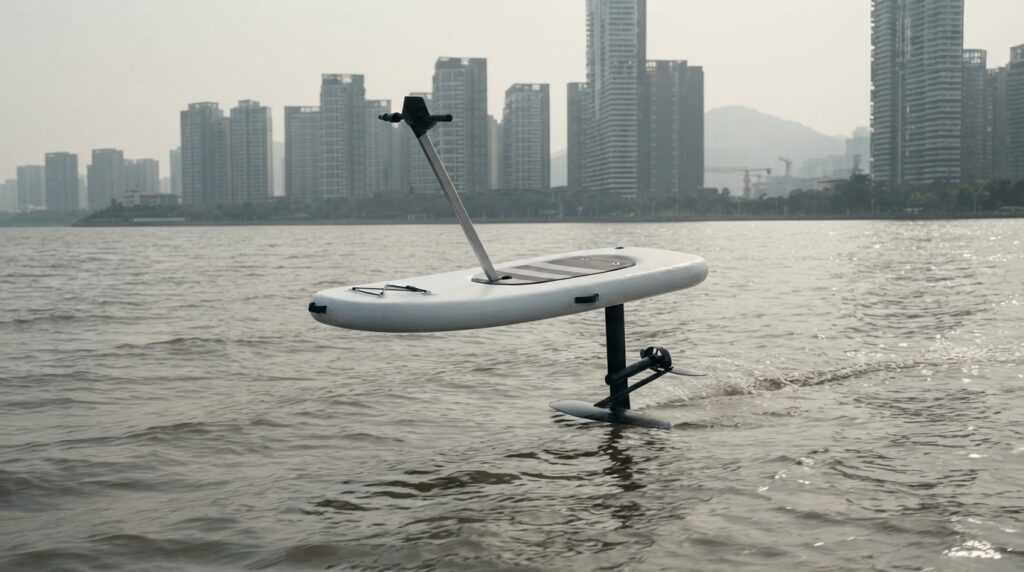
The defining feature of electric foil boards is the hydrofoil mounted beneath the board.
As speed increases, water flowing across the foil generates lift.
Once sufficient lift develops, the board rises above the water surface.
Only the narrow mast and underwater foil remain submerged.
This dramatically reduces the amount of surface area interacting with the water.
The reduction in contact area creates far less drag.
Because the board itself lifts clear of the surface, surface friction decreases dramatically.
This improves:
The hydrofoil effectively allows the board to glide through the water with far less resistance than traditional surface-based systems.
This efficiency is one reason riders often describe foil boarding as feeling effortless.
Reduced drag not only improves energy efficiency but also changes the overall riding sensation.
Traditional boards constantly interact with:
Electric foil boards rise above much of this disturbance.
The rider experiences:
This smoothness strongly contributes to the sensation of flying above the water.
Electric motors are particularly well suited to hydrofoil systems because they deliver:
The reduced drag created by the hydrofoil means the electric motor requires less energy to maintain speed once the board is lifted.
This synergy between hydrofoil efficiency and electric propulsion is one of the major reasons electric foil boards are so effective.
Reducing drag directly improves battery efficiency.
Less resistance means:
This is critically important for electric-powered marine products where battery capacity remains a key operational consideration.
Hydrofoil efficiency helps maximise usable riding time.
Hydrofoil geometry plays a major role in determining efficiency.
Foil design influences:
Premium foil boards use carefully engineered hydrofoil profiles designed to balance:
Poor foil design may reduce stability or create excessive turbulence.
Many premium electric foil boards use carbon fibre construction because it offers:
Reducing weight further improves efficiency by lowering the energy required for lift and propulsion.
Lightweight materials therefore contribute directly to hydrodynamic performance.
Efficient hydrofoil operation depends heavily on smooth water flow across the foil surfaces.
Disrupted flow may increase drag or reduce lift efficiency.
Engineers therefore focus heavily on:
Premium manufacturing quality plays a major role in achieving efficient hydrodynamic behaviour.
Traditional watercraft often create substantial wake due to water displacement and surface interaction.
Electric foil boards generate relatively minimal wake once elevated above the surface.
This contributes to:
The cleaner movement further reinforces the refined nature of foil boarding.
The sensation of reduced drag creates an unusually smooth riding experience that feels dramatically different from traditional watersports.
Many riders describe foil boarding as:
This emotional experience is directly connected to hydrodynamic efficiency and reduced resistance.
The efficiency advantages demonstrated by electric foil boards are attracting growing interest across broader marine engineering sectors.
Hydrofoil concepts are increasingly being explored for:
Electric foil boards help demonstrate how dramatically drag reduction can improve marine efficiency.
Future developments may include:
These advancements may further improve drag reduction and energy efficiency.
Electric foil boards demonstrate how advanced hydrodynamics and electric propulsion can work together to create remarkably efficient marine recreation systems.
By dramatically reducing drag through hydrofoil lift, they create smoother, quieter and more energy-efficient riding experiences than traditional surface-based watersports equipment.
As hydrofoil technology continues evolving, drag reduction and hydrodynamic efficiency are likely to become increasingly important across the future of marine recreation and transport worldwide.
See More at www.vectorwatercraft.com.au