
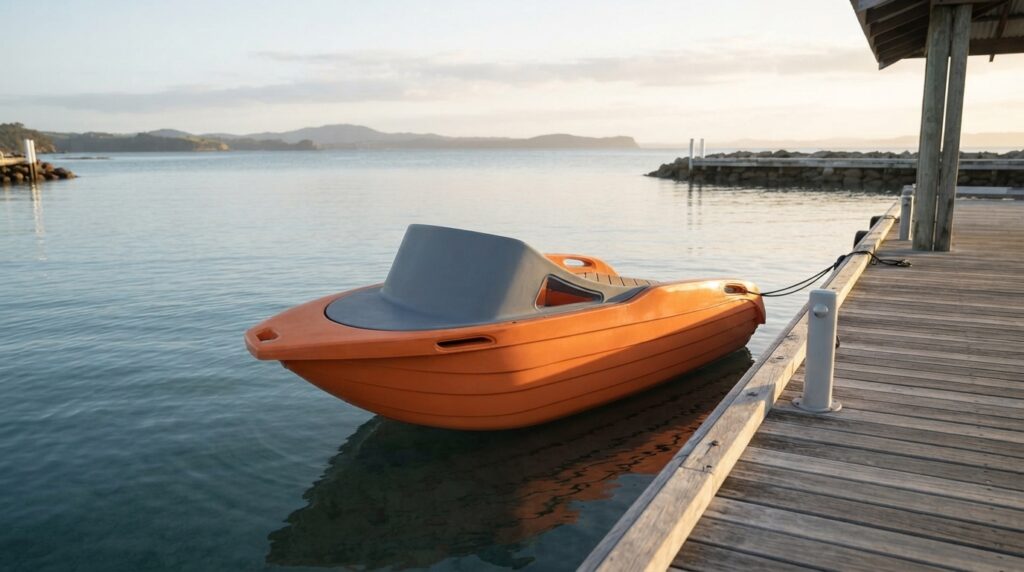
Discussions of electric versus petrol propulsion in small watercraft often focus on environmental considerations or running costs, but there's a genuinely important safety dimension to this comparison that deserves its own dedicated attention. Several inherent characteristics of electric propulsion translate directly into meaningful safety advantages for mini jet boat operators and everyone sharing the water around them.
Petrol is a genuinely hazardous substance to store and handle around water — it's flammable, its vapours can accumulate in enclosed spaces creating explosion risk, and any spill during refuelling introduces both a fire hazard and an environmental contamination risk directly into the waterway. Electric propulsion eliminates this entire category of risk. There's no fuel tank to develop a leak, no risk of vapour accumulation in an enclosed hull space, and no refuelling process that could result in spillage into the water or onto the boat itself.
This isn't a minor or theoretical advantage — fuel-related incidents represent a genuine, recurring safety concern in recreational boating more broadly, and removing this risk category entirely through electric propulsion is one of the more significant, if underappreciated, safety benefits of this technology.
Beyond the specific issue of fuel storage and spillage, electric propulsion systems generally present a lower overall fire risk profile compared to a petrol engine and its associated fuel system, hoses, and connections — provided the electrical system itself, including the battery, is well designed and properly maintained, a topic covered in more detail in the companion article on thermal management. This isn't to say electric systems carry zero fire risk (battery-related fire risk is a genuine consideration, managed through the thermal management and protective systems discussed in earlier articles), but the comparison against petrol's well-established fire risk profile generally favours electric propulsion.
Petrol engines produce exhaust fumes, including carbon monoxide, which can pose a genuine health risk if allowed to accumulate in any enclosed or semi-enclosed space aboard a boat, particularly relevant for compact vessels where occupants sit in close proximity to the engine. Electric propulsion produces no exhaust emissions at all, removing this risk entirely and allowing for genuinely fresh air throughout an outing regardless of wind direction or boat orientation.
As discussed throughout this series, electric propulsion's near-silent operation is often framed primarily as a comfort or lifestyle benefit, but it carries a genuine safety dimension too. Maintaining a proper lookout by sight and hearing is a fundamental navigation obligation, and a quieter boat allows an operator to actually hear other vessels, verbal warnings from other water users, or environmental cues (such as approaching weather or nearby wildlife activity) that would be considerably harder to detect over a petrol engine's noise. This supports genuinely better situational awareness, which connects directly to the collision-avoidance principles discussed in the navigation rules article.
Petrol outboard motors involve considerably more mechanical complexity than an electric propulsion system — fuel delivery, ignition systems, cooling systems specific to combustion engines, and more moving parts generally. Each additional mechanical component represents a potential failure point, and while both propulsion types can experience issues, electric propulsion's comparative mechanical simplicity generally means fewer potential points of mechanical failure that could leave an operator stranded or without power unexpectedly.
As discussed in the article on motor controllers, electric propulsion typically offers smoother, more consistent and more precisely controllable power delivery than a petrol engine, particularly at low speed. This predictability has genuine safety value in close-quarters manoeuvring situations — around docks, other vessels, or swimmers — where precise, predictable throttle response reduces the risk of an unintended surge or hesitation at exactly the moment fine control matters most.
While electric propulsion introduces its own range management considerations, thoroughly discussed throughout the range and journey planning articles in this series, it's worth noting a specific safety advantage: battery charge level is continuously, precisely monitorable throughout an outing, generally with more granular and reliable feedback than a petrol fuel gauge typically provides. This supports the kind of deliberate, ongoing range monitoring discussed in the journey planning article, reducing the risk of an unexpected, sudden loss of propulsion that can occur with an inaccurately gauged petrol tank.
It's worth being balanced here — electric propulsion isn't a substitute for genuine safety diligence, and it introduces its own considerations that petrol propulsion doesn't share, particularly around battery management, charging safety, and the range planning discipline discussed throughout this series. The comparison isn't that electric propulsion eliminates the need for careful, responsible operation, but that it removes several specific, well-established risk categories associated with petrol propulsion, while introducing its own distinct set of considerations that a well-informed owner learns to manage effectively.
Electric propulsion offers several genuine, meaningful safety advantages over petrol power in small watercraft — eliminating fuel storage and spillage risk, reducing certain fire risk factors, removing exhaust fume exposure, supporting better situational awareness through quieter operation, offering greater mechanical simplicity, and providing more precise, predictable power delivery and charge monitoring. These advantages don't eliminate the need for the broader safety diligence discussed throughout this series, but they do represent a genuine, evidence-based case for electric propulsion as a meaningfully safer choice in several specific, well-defined respects, alongside its more commonly discussed environmental and lifestyle benefits.