
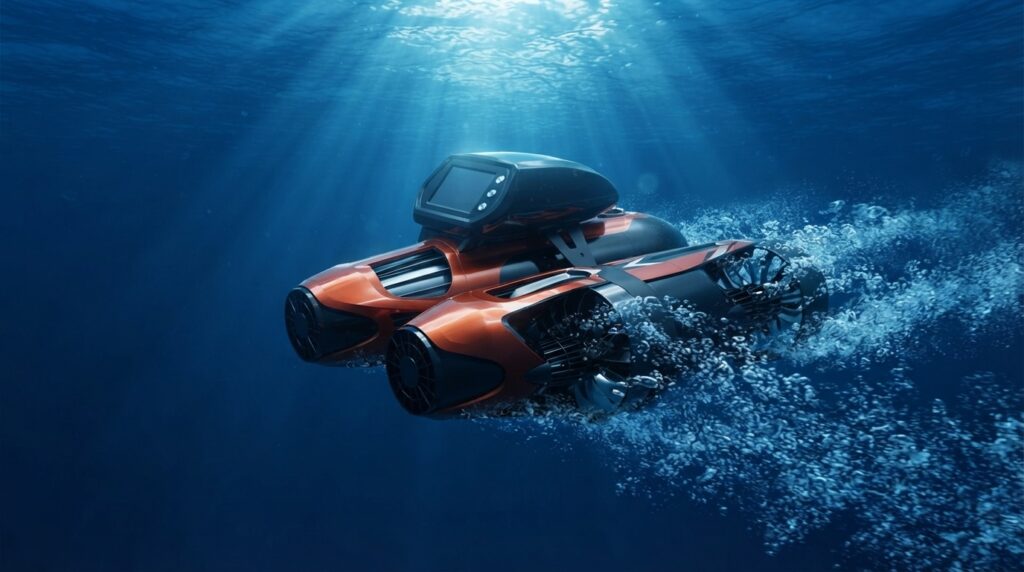
Speed is one of the first specifications most buyers notice when comparing underwater scooters.
It is understandable why.
Powered movement underwater is one of the main reasons people buy an electric sea scooter or Diver Propulsion Vehicle in the first place. A faster machine can cover more water, provide a more exciting experience and, in some applications, make it possible to travel between underwater points far more efficiently than by swimming alone.
But maximum speed tells only part of the story.
A scooter that reaches 13 km/h is not automatically “better” than one that travels at 5 km/h. The faster model may be intended for serious diving or professional use, while the slower machine may weigh a fraction as much and be far more practical for snorkelling, boating holidays and recreational use.
Within Vector Water Craft's current Australian range, published maximum speeds extend from approximately 1.4 metres per second on the lightweight HS-S2 through to 13 km/h on the professional H9 Sub Jet Pro.
That substantial variation shows why buyers should compare speed together with thrust, weight, battery life, control and intended use.
This guide explains what underwater scooter speed figures really mean and how Australian buyers can compare performance intelligently.
Modern underwater scooters vary enormously in performance.
At the recreational end of the market, speeds of roughly 1.4 to 2 metres per second can provide considerable assistance to a swimmer or snorkeller.
At the higher-performance end, Vector's H9-1 Sub Runner reaches a published maximum of 2.5 metres per second, while the flagship H9 Sub Jet Pro reaches 13 km/h.
To put those numbers into a common format:
These figures demonstrate how much faster powered underwater propulsion can be than relaxed recreational swimming.
However, maximum published speed is achieved under particular conditions and should be treated as a product specification rather than a guarantee that every rider will achieve exactly the same figure in every situation.
Real-world underwater performance is influenced by the rider, equipment, conditions and how the scooter is operated.
Vector Water Craft's range gives Australian buyers several useful performance levels to compare.
The HS-S2 has a published maximum speed of 1.4 metres per second, equivalent to approximately 5 km/h.
It provides three speed settings, up to 6.5 kg of thrust and weighs only approximately 1.4 kg.
This is an important example because it shows why performance should not be judged by speed alone.
At 1.4 kg, the HS-S2 is exceptionally portable compared with a professional propulsion vehicle.
It therefore targets a different priority:
useful underwater propulsion with minimal weight and easy handling.
For a recreational snorkeller, holiday user or boat owner, this may be much more important than achieving the highest possible speed.
The HS-S3 is a 3 kg scooter offering three speed settings and is designed for versatile recreational use, including snorkelling and underwater camera applications. It has a published depth rating of 30 metres.
For many recreational users, the ability to select between several speeds may be more valuable than another small increase in maximum velocity.
You may want a lower setting when:
A higher setting can then be used when moving across a more open area.
This flexibility is central to good underwater scooter design.
The dual-motor HS-S4 Bat has a published maximum speed of 2 metres per second, or 7.2 km/h.
This represents a meaningful performance increase over the lightest recreational models while still remaining within Vector's compact underwater scooter range.
For a recreational buyer seeking stronger acceleration or greater thrust, this type of product can represent an attractive middle ground.
Vector's H9-1 Sub Runner moves substantially further into the higher-performance category.
It provides three speed gears reaching up to 2.5 metres per second, equivalent to around 9 km/h, together with a published depth rating of 40 metres and runtime of 60 minutes.
This is the type of performance that begins to appeal much more strongly to serious diving and underwater propulsion users.
At the top of the current Vector range, the H9 Sub Jet Pro reaches a published maximum speed of 13 km/h.
It uses a 3.3 kW motor, carries a 923.52 Wh lithium battery, weighs approximately 35 kg and has a published runtime of 100 minutes.
The H9 demonstrates that professional underwater propulsion is a very different category from a compact recreational sea scooter.
It is not simply faster.
It is an entirely larger propulsion platform designed around endurance and serious underwater use.
Five or seven kilometres per hour may not sound particularly fast when compared with a car, bicycle or boat.
Underwater, it feels completely different.
You are moving through a dense medium, often close to:
Visibility may also be significantly limited.
As a result, even moderate powered speeds can feel surprisingly fast.
The user should therefore never judge underwater performance by comparing the number directly with road or boating speeds.
The physical environment is completely different.
A common buying mistake is to compare two scooters using only maximum speed.
Real performance consists of several elements.
These include:
A scooter could theoretically have an excellent top speed while being less suitable for your application because it is heavy, difficult to transport or provides less usable low-speed control.
Performance should therefore be considered as a complete package.
Thrust is particularly important when comparing underwater scooters.
Speed describes how quickly the scooter can travel.
Thrust describes the propulsive force available to move the rider.
The distinction matters because different users create very different levels of resistance.
A lightly equipped snorkeller may be wearing only:
A scuba diver might be carrying:
The diver creates considerably greater drag.
A scooter capable of moving a snorkeller quickly may perform differently when towing a fully equipped diver.
Vector's HS-S2, for example, combines its 1.4 m/s maximum speed with published maximum thrust of 6.5 kg.
This is why experienced buyers look at both numbers.
Motor power is another specification that attracts attention.
Vector's H9 uses a substantial 3.3 kW motor, which helps explain its position at the professional end of the range.
But motor wattage should not be viewed in isolation.
The complete propulsion system determines usable performance.
Factors include:
A larger motor can support greater performance, but a buyer still needs to ask whether that performance is required.
Published maximum speeds are product specifications.
Actual rider experience will vary.
A larger rider typically presents more frontal area and may generate greater drag than a smaller rider.
Scuba equipment increases resistance further.
Therefore, two people using the same scooter may not experience identical acceleration or speed.
This does not make the specification inaccurate.
It simply reflects the realities of moving different loads through water.
When comparing scooters, consider yourself as part of the propulsion equation.
Underwater drag increases as more equipment is carried.
For snorkellers, drag may be relatively low.
For divers, equipment can include bulky cylinders, hoses, cameras and other accessories.
This is why serious DPV users often place considerable emphasis on thrust and sustained performance rather than selecting solely from maximum speed.
A scooter that maintains useful propulsion while moving a fully equipped diver can be more valuable than a lighter product with an attractive headline number.
Water does not behave like a test laboratory.
Current, surge and other conditions can affect the rider's effective progress.
If a scooter is moving against a current, actual speed over the seabed can be lower than the scooter's speed through the water.
Moving with a current can produce the opposite effect.
This is particularly important for recreational users.
Do not assume that because your scooter can produce a particular maximum speed, it can always overcome whatever conditions you encounter.
An underwater scooter does not make unsuitable water conditions safe.
For most snorkellers, maximum speed should not be the primary objective.
Snorkelling is normally about observing the underwater environment.
A useful scooter should allow you to move comfortably while retaining enough control to:
Moderate speeds are often ideal.
This is why several speed settings are so valuable.
Vector's HS-S2 offers three speed settings despite being a lightweight recreational scooter.
The ability to slow down can be every bit as useful as the ability to accelerate.
There is no universal answer.
Divers need to choose an operating speed appropriate to:
High speed over open water may be appropriate for an experienced DPV user in some situations.
The same speed close to wreck structure or reef may be inappropriate.
A serious underwater scooter should therefore offer controllable propulsion, not just maximum output.
Vector's H9-1 provides three speed gears rather than forcing the rider to use one fixed level.
Sometimes.
But not always.
For riders seeking performance, acceleration and top speed are naturally part of the appeal.
For snorkellers, a smooth relaxed cruise may be more enjoyable.
For photographers, stability and low-speed control may matter more than speed.
For divers, efficient propulsion and reduced effort can matter more than racing underwater.
The correct definition of “performance” depends on the activity.
This is one of the biggest advantages—and one of the most important safety considerations.
At 13 km/h, a scooter theoretically covers a kilometre in less than five minutes if travelling continuously at that speed.
That demonstrates how dramatically powerful propulsion can increase the distance a user could potentially cover.
But this must not be confused with recommended operating range.
Actual safe range depends on:
The faster the scooter, the easier it becomes to travel a long way from the starting point.
This makes conservative range planning increasingly important.
This distinction is familiar in boats and cars, and it applies underwater as well.
A scooter may have a high maximum speed without the rider normally operating at that output continuously.
Lower speeds can offer advantages including:
Maximum speed tells you about the upper performance envelope.
Cruising performance tells you more about how you may actually use the scooter.
Electric propulsion requires energy.
Higher motor output generally demands more battery power.
As a result, operating continuously at high output can reduce practical runtime compared with conservative operation.
This is one reason manufacturer runtime figures should be viewed as maximum published specifications rather than assuming that full-speed operation will always provide the same duration.
Vector's H9, for example, combines its 13 km/h maximum speed with a large 923.52 Wh battery and published runtime of 100 minutes.
The large battery is a major part of what enables a professional platform to sustain significant propulsion capability.
Higher performance often comes with additional weight.
Vector's current range illustrates the trade-off dramatically.
The HS-S2:
The H9:
The H9 is much faster, but it is also about 25 times the weight.
That does not make either design superior.
It shows that the two products solve different problems.
For someone carrying a scooter down a beach, 1.4 kg could be enormously attractive.
For a professional user prioritising sustained propulsion, 35 kg may be acceptable.
Buyers often think of performance only as what happens once the motor starts.
But a scooter that is easy to transport has practical performance advantages of its own.
If you can easily:
you may use it much more often.
This is why Vector positions compact electric underwater propulsion as part of its broader focus on practical, accessible electric watercraft.
A beginner should start at the lowest sensible speed.
The aim of the first sessions should be to learn:
Only after becoming comfortable should the rider progressively use higher settings.
There is no advantage in immediately selecting maximum power simply because it is available.
Imagine driving a car quickly in thick fog.
The car's performance has not changed, but the safe speed certainly has.
The same principle applies underwater.
When visibility is limited, reduce speed.
You need enough time to respond to:
The maximum speed printed on the product specification is irrelevant if visibility makes that speed unsuitable.
Australia has remarkable reef environments.
Powered propulsion should be used responsibly around them.
Travelling rapidly close to coral increases the chance of accidental contact.
Maintain sufficient distance and reduce speed around delicate marine environments.
An underwater scooter should enable you to see more, not create greater disturbance.
An underwater scooter can approach swimmers much faster than someone moving under normal swimming power.
Maintain adequate separation.
Do not use high speed in:
The quietness of electric propulsion makes visual awareness particularly important.
The H9 demonstrates what modern high-performance underwater propulsion can achieve.
Its 3.3 kW motor, 13 km/h published top speed, 923.52 Wh battery, 100-minute runtime and 35 kg weight clearly place it in a different category from compact recreational scooters.
A buyer considering this level of equipment should therefore think about:
Performance is valuable only when the operator has the knowledge and judgement to use it properly.
A useful way to think about the Vector range is by application.
The HS-S2's 1.4 m/s maximum speed equates to roughly 5 km/h.
This level can suit:
Its key advantage is the balance of useful propulsion with an extremely low 1.4 kg weight.
The HS-S4 reaches approximately 7.2 km/h.
This suits buyers seeking more recreational performance and dual-motor propulsion.
The H9-1 reaches approximately 9 km/h.
This represents a step towards serious underwater propulsion, with a 40-metre depth rating and three selectable speed levels.
The H9 sits at Vector's professional end.
This capability is appropriate to experienced users whose application genuinely requires strong performance and endurance.
When comparing underwater scooters, use this order.
Snorkelling or serious diving?
Will you realistically transport it regularly?
Can it move you and your equipment effectively?
Do you have enough control?
Is the available performance appropriate?
How long can you realistically operate?
Does it suit your intended use?
Can you obtain assistance in Australia if required?
This prevents maximum speed from dominating the entire purchase decision.
More speed can also mean more weight, cost and equipment than you require.
Much underwater exploration takes place at moderate speeds.
Rider load and conditions affect real-world performance.
Speed and thrust measure different aspects of propulsion.
Visibility and surroundings should determine operating speed.
Always plan for a safe return.
A 1.4 kg recreational scooter and a 35 kg professional DPV should not be judged solely according to which is faster.
Generally, moving into the highest-performance professional equipment means a substantially larger investment.
But price does not rise directly with speed alone.
Buyers also pay for:
This is another reason not to use price or speed as the sole quality measure.
For many Australian recreational users, something in the compact 1.4–2.0 m/s range can provide plenty of powered underwater enjoyment.
That already represents roughly 5 to 7.2 km/h of published maximum speed.
For snorkelling, boating and holiday use, that can be substantial.
A recreational buyer should move towards 2.5 m/s and beyond when there is a clear reason for requiring greater performance.
There is no universal figure.
A diver should evaluate:
For some, a compact scooter will be adequate.
For others, an H9-1 or H9-class platform may be more suitable.
The important point is to select performance according to a defined application rather than simply buying the highest figure available.
Vector Water Craft's current range extends across distinctly different types of underwater users.
Its broader company approach emphasises compact electric propulsion, controlled movement and products selected for practical Australian use.
That is why it makes sense to have:
There is no reason for every buyer to use the same machine.
Underwater scooters can now provide impressive performance.
Within Vector's current Australian range, maximum published speed progresses from approximately 1.4 m/s on the 1.4 kg HS-S2 through to 13 km/h on the 3.3 kW H9 Sub Jet Pro.
But the best underwater scooter cannot be identified by speed alone.
For recreational snorkelling, a lightweight 5–7 km/h scooter may provide an excellent balance between excitement, control and portability.
For more experienced users, 9 km/h-class equipment provides another level of underwater propulsion.
For serious and professional applications, the 13 km/h H9 provides substantially greater capability.
The key is to ask:
Then consider that answer alongside:
Maximum speed is exciting.
Usable performance is what makes an underwater scooter worth owning.
If you are trying to decide how much underwater scooter performance you actually need, speak with Vector Water Craft.
Tell us whether you are:
We can help compare the available Vector models according to the type of performance that will genuinely benefit you.
The objective is not automatically to recommend the fastest underwater scooter.
It is to identify the scooter that provides the right balance of speed, thrust, runtime, weight and control for your application.
Performance varies widely. Within Vector Water Craft's current range, published maximum speeds extend from 1.4 m/s on the HS-S2 to 13 km/h on the H9 Sub Jet Pro.
It is approximately 5 km/h.
That may sound modest compared with road speeds, but it can feel considerably faster when moving underwater close to reef, seabed and other objects.
The dual-motor HS-S4 has a published maximum speed of 2 m/s, or 7.2 km/h.
The H9-1 Sub Runner offers three speed levels reaching a published maximum of 2.5 m/s, equivalent to approximately 9 km/h.
The current H9 Sub Jet Pro is the fastest model in the Vector range cited here, with a published maximum speed of 13 km/h.
Not necessarily. Weight, thrust, runtime, controls, portability and intended use can be more important than maximum speed.
A beginner should start at the lowest suitable speed and become familiar with acceleration, steering and stopping before progressively using higher settings.
Rider size and drag can influence real-world performance. A fully equipped scuba diver creates substantially different resistance from a lightly equipped snorkeller.
Higher propulsion output generally demands more energy, so continuous high-power operation can affect practical battery duration. Published maximum runtime should not automatically be interpreted as guaranteed full-speed runtime.
There is no single ideal speed. Moderate, controllable propulsion is usually more useful for observing reef, filming and maintaining awareness than simply operating at maximum speed.
The Vector H9 uses a 3.3 kW motor, a 923.52 Wh battery, has a published maximum speed of 13 km/h and runtime of up to 100 minutes.
Compare both. Speed tells you how quickly a scooter can move, while thrust indicates its ability to propel the rider and equipment. The right balance depends on your intended use.