
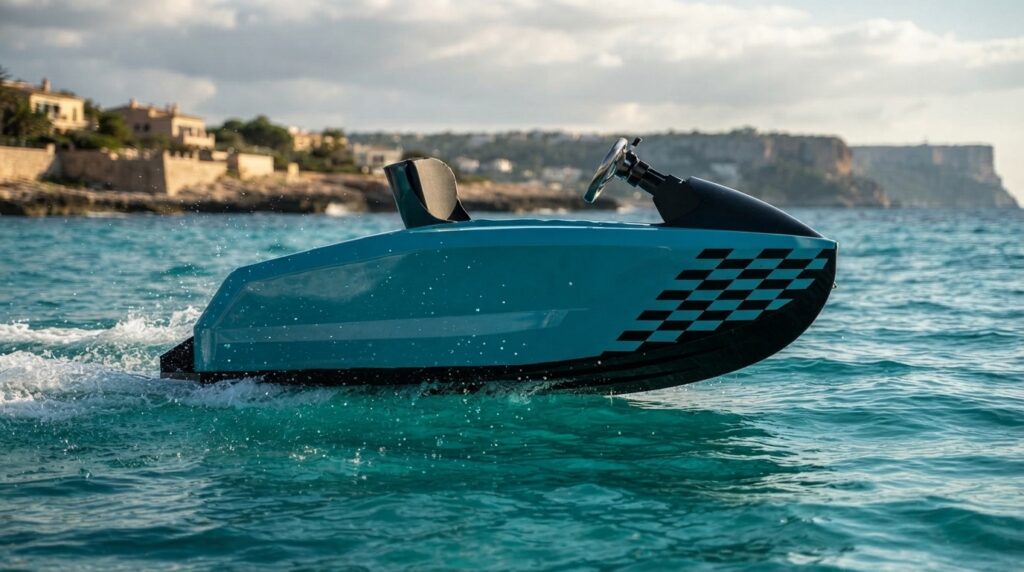
Anyone who has ridden two superficially similar small watercraft and come away from one soaked and from the other almost completely dry has experienced, first-hand, the effect of hull shape on spray. It's one of the least discussed but most immediately noticeable differences between mini jet boats, and it has a direct, ongoing effect on how comfortable and enjoyable a boat is to actually use.
Spray is generated where the hull meets the water at speed. As a planing hull moves forward, it displaces water outward and downward along its leading edges. How that water is directed — whether it's thrown outward and away from the boat, or deflected upward toward the occupants — depends almost entirely on the shape of the hull's underside and the design of its forward sections.
This means spray isn't simply a function of speed, weather, or luck. It's substantially engineered into (or out of) a hull through specific design choices, and it's genuinely possible to compare boats on this basis if you know what to look for.
Deadrise refers to the angle of the hull's underside relative to horizontal, measured typically at the transom. A hull with a flatter bottom (low deadrise) tends to plane more easily and can feel more stable at low speed, but it also tends to slap against small waves and throw spray more aggressively outward and sometimes upward, particularly in any chop.
A hull with a deeper vee (higher deadrise) generally slices through small waves more cleanly, redirecting water outward and down rather than up, which typically produces a drier ride. This comes with trade-offs of its own — deeper-vee hulls often require more power to get onto the plane and can feel slightly less stable at very low speed or at rest — which is part of why hull shape decisions are rarely made on spray control alone.
Beyond the basic deadrise angle, many mini jet boat hulls include spray rails — small strakes or ridges running along the hull's sides — specifically designed to intercept water being thrown outward by the hull and redirect it downward before it can reach the deck or occupants. Well-designed spray rails can make a meaningful difference to ride dryness without requiring a deeper, less stable hull shape.
The chine — the line where the hull's bottom meets its sides — also plays a role. A sharper, more defined chine tends to help "release" water cleanly away from the hull, while a softer, more rounded chine can allow water to climb up the hull's sides more readily, increasing spray reaching the deck and occupants.
The shape of the bow, and specifically how much it flares outward as it rises, has a significant effect on spray control, particularly at the front of the boat where waves and the hull's own bow wave are most likely to generate spray. A well-flared bow tends to deflect oncoming spray outward and away from the boat, while a narrower, less flared bow can allow spray to travel further back along the hull toward passengers.
This is particularly relevant for mini jet boats given their generally compact proportions — there is less distance between the bow and the passenger seating area compared to a larger boat, meaning bow spray management has a proportionally bigger effect on rider comfort.
It's tempting to think of spray purely as a comfort issue — nobody enjoys a soaking on what should be an enjoyable outing — but it has practical implications too:
Hull shape's effect on spray isn't constant across all conditions — it becomes more pronounced as water gets choppier or as speed increases. On flat, calm water at moderate speed, even a hull shape that isn't optimised for spray control may produce a relatively dry ride, simply because there's little chop for the hull to interact with.
The differences become much more apparent in light chop, when crossing another boat's wake, or when travelling into a headwind that pushes spray back toward the boat rather than letting it fall away cleanly. This is worth keeping in mind when evaluating a boat based on a single calm-water test ride — a hull that seems perfectly dry in ideal conditions may behave quite differently once conditions are less than perfect.
If ride dryness is a priority — and for most owners planning to use their mini jet boat regularly, it's worth prioritising — a few practical things to look for or ask about:
Hull shape has a substantial, engineered influence on how much spray reaches a mini jet boat's occupants — it isn't simply down to weather or bad luck. Deadrise angle, spray rail design, chine shape and bow flare all combine to determine whether a boat stays comfortably dry or delivers a regular soaking, and these differences become much more pronounced once conditions move beyond flat calm water. For anyone planning to use their mini jet boat regularly, and especially for anyone hoping to share it comfortably with passengers, ride dryness is a genuinely practical factor worth evaluating carefully rather than assuming all similarly sized hulls will behave the same way.