When people compare mini jet boats, they tend to focus first on power figures, battery capacity or top speed. Hull length rarely gets the same attention, yet it is one of the most influential factors in how a mini jet boat actually feels and performs on the water. Understanding it properly changes how you shop for a boat — and it changes what you should expect once you're on the water.
This article draws on hands-on observation of hull behaviour across the mini jet boat category, along with established small-craft naval architecture principles that apply just as much to a 2.5-metre electric mini jet boat as they do to any other planing hull. The aim is to give you a genuinely useful, practical understanding — not a sales pitch for one particular length over another.
In naval architecture, waterline length is one of the primary variables that determines a hull's theoretical maximum displacement speed, its motion in chop, and how it distributes weight fore and aft. For planing craft like mini jet boats, length also affects how quickly the hull can transition from pushing through the water (displacement mode) to riding on top of it (planing mode).
A longer hull has a longer waterline, which generally means:
A shorter hull, by contrast, tends to be lighter for a given construction method, easier to manoeuvre in tight spaces, and often quicker to get up onto the plane because there is less hull surface area to lift clear of the water.
Neither is "better" in an absolute sense. The right length depends on where and how the boat will be used.
It's tempting to assume that speed is purely a function of motor power and propulsion efficiency, but hull length plays a real role too. A longer hull typically has a higher displacement speed ceiling — the maximum speed it can achieve before the hull "climbs its own bow wave" and either has to work much harder to accelerate, or transitions into planing.
Once a mini jet boat is planing, hull length still matters, but the relationship becomes more about total wetted surface area and hull shape than length alone. A well-designed shorter hull that is optimised for planing efficiency can outperform a poorly optimised longer hull. This is why comparing mini jet boats purely on stated top speed, without considering hull length and shape together, can be misleading.
For buyers comparing options, the more useful question isn't "which is longer" but "which hull length and shape combination suits the type of speed I actually want" — sustained cruising speed on open water, or short, punchy bursts of acceleration around a river bend.
Stability in a mini jet boat comes from a combination of beam (width), hull shape, weight distribution and length — but length has a specific role that's often overlooked: pitch stability.
Pitch is the front-to-back rocking motion a boat experiences when it hits waves, wake, or its own bow wave at speed. A longer hull spreads buoyancy over a greater distance, which generally reduces how dramatically the bow rises and falls in choppy conditions. This is part of why larger boats feel more settled offshore than smaller ones — length is doing real work, not just adding visual presence.
For mini jet boats specifically, which are inherently compact compared to full-sized runabouts, hull length differences of even 20–30cm can be noticeable in how the boat handles a wake crossing or a gust of wind on open water. Shorter hulls can feel "busier" in chop, requiring more active throttle and steering input to stay comfortable, while longer hulls tend to soak up minor disturbances more passively.
This doesn't mean a shorter mini jet boat is unsafe or unstable for its intended use — most are specifically designed and tested for the conditions they're marketed for, such as sheltered rivers, canals and calm bays. It does mean that if you're planning to spend meaningful time in open, wind-affected water, hull length is worth weighing more heavily in your decision.
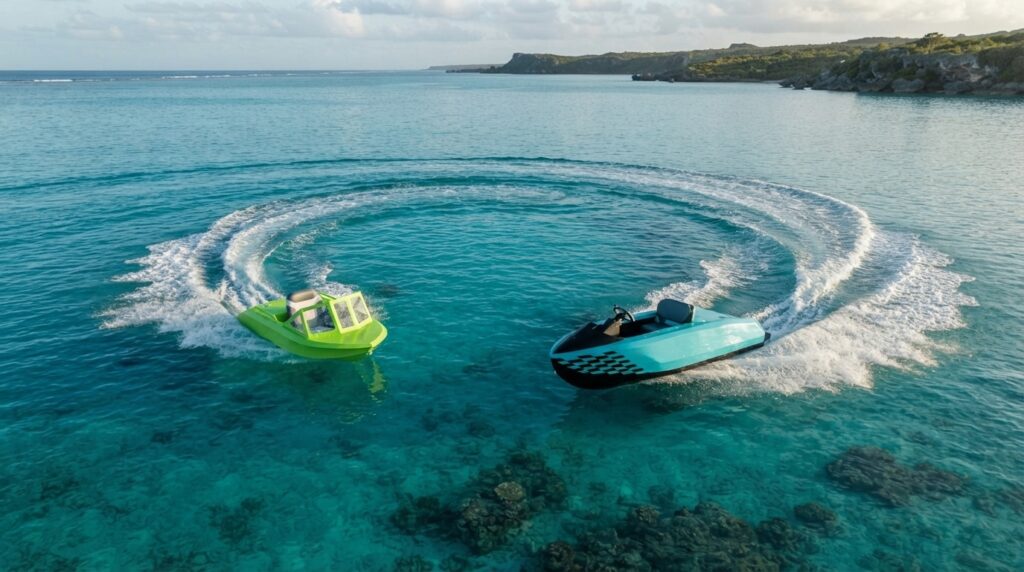
This is where the relationship reverses. A shorter hull, all else being equal, has a smaller turning radius and responds more quickly to helm input. This comes down to basic physics: a shorter waterline length means less hull mass needs to rotate around the pivot point during a turn, and there's proportionally less hull dragging through the turn arc.
For riders who plan to navigate narrow creeks, tight canal systems, marina channels or crowded waterways, this responsiveness can be a genuine practical advantage — not just a "fun factor". A shorter mini jet boat can thread through spaces a longer hull would need to approach more cautiously.
The trade-off is that highly manoeuvrable, shorter hulls can also be quicker to react to unintended inputs — a small correction can produce a more noticeable course change. This isn't necessarily a downside, but it is a different handling character that new operators should be aware of and get comfortable with in calm, open water before venturing into tighter spaces at speed.
Passenger comfort is arguably where hull length has the most direct, easily felt impact — and it's rarely discussed in as much depth as speed or handling.
A longer hull typically offers:
A shorter hull, while more compact and often easier to store, transport and launch, concentrates passengers closer to the pivot points of pitch and roll motion. On calm, sheltered water this is rarely noticeable. In wind chop or boat wake, passengers on a shorter hull are more likely to feel each motion more directly.
This is particularly relevant for buyers planning to carry a second person regularly. A boat that feels perfectly comfortable solo can feel noticeably busier with two people aboard and a slightly choppier day on the water, partly because of the added weight and partly because of how that weight interacts with a shorter waterline.
Rather than treating hull length as a single number to compare on a spec sheet, it's more useful to match it against your actual use case:
It's also worth remembering that hull length doesn't act alone. Beam width, hull shape (deep-vee versus flatter sections), weight distribution and even seating position all interact with length to determine the final feel of the boat. A shorter hull with a wider beam can behave quite differently to a shorter hull with a narrow beam, for example.
Hull length is a genuinely load-bearing spec — not a cosmetic detail — when it comes to how a mini jet boat performs, feels and holds up across different conditions. It shapes the ceiling on displacement speed, plays a meaningful role in pitch stability and passenger comfort, and directly trades off against manoeuvrability in tight turns.
The right answer isn't "longer is better" or "shorter is better" — it's about matching hull length to where you'll actually use the boat, who you'll usually have on board, and how much time you expect to spend out on the water at a time. Buyers who take the time to think through this trade-off tend to end up far happier with their choice than those who compare boats on top speed alone.