
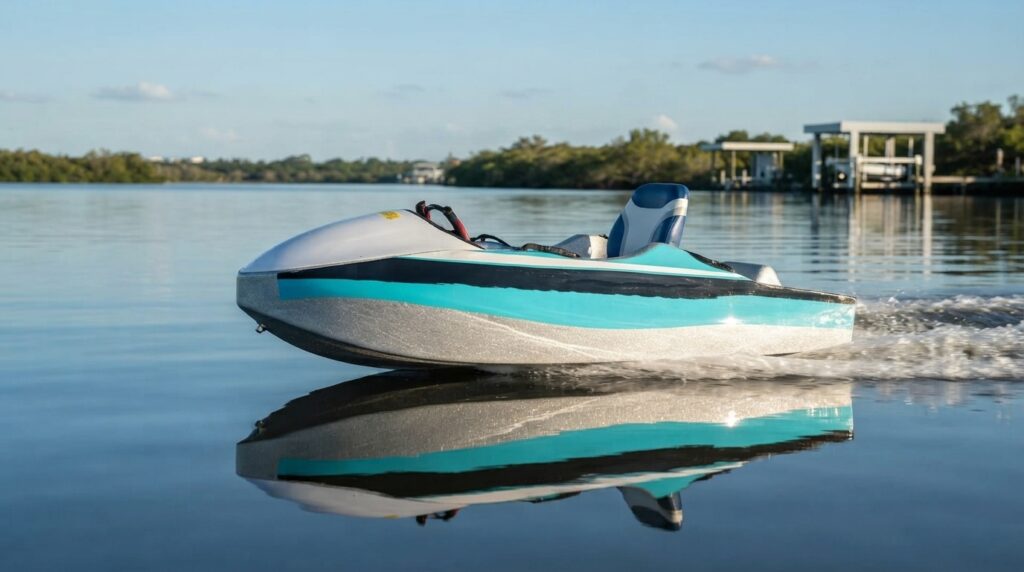
Weight is one of those specifications that quietly touches almost every aspect of a mini jet boat's performance, yet it rarely gets the attention given to top speed or battery capacity. It affects how quickly the boat accelerates, how far it can travel on a charge, how easily it can be transported and stored, and how it behaves once it's out on the water. Understanding weight properly gives you a much clearer picture of what day-to-day ownership will actually feel like.
In a petrol-powered craft, weight matters, but fuel consumption isn't nearly as sensitive to it as electric range is. In an electric mini jet boat, weight has a direct, almost linear relationship with energy consumption: every kilogram the motor has to accelerate, carry across the water, and overcome drag with, draws directly from the battery.
This is why weight deserves closer scrutiny for electric mini jet boats than it might for other watercraft categories. It isn't just a transport or storage consideration — it's a performance and range consideration that affects the boat every single time it's used.
Acceleration is governed by the basic physics relationship between force and mass: for a given motor output, a lighter hull accelerates more quickly than a heavier one. This is particularly noticeable in the critical phase of getting a mini jet boat up onto the plane, where the motor needs to overcome both the hull's displacement drag and its inertia simultaneously.
A lighter mini jet boat will generally:
A heavier boat isn't necessarily sluggish — many heavier mini jet boats are designed with higher-output motors specifically to compensate — but for a given power output, added weight is felt directly in how eager the boat feels under acceleration.
This is where weight has its most significant practical impact for electric mini jet boat owners. Every kilogram of hull, battery, motor, fittings and onboard equipment has to be moved through the water, and moving mass through water at speed consumes energy in rough proportion to that mass (along with hull efficiency and speed, covered in more detail elsewhere).
Two mini jet boats with identical battery capacity but different overall weights will not achieve the same real-world range. The lighter boat will typically travel further on the same charge, all else being equal, simply because less energy is spent overcoming its own inertia and drag.
This has a few practical implications for buyers:
For most mini jet boat owners, weight is felt most directly at the point of loading, unloading, and towing. A significantly lighter boat can often be:
Heavier mini jet boats, while often offering advantages elsewhere (such as stability, discussed below), typically require more robust trailers, stronger tow vehicles, and sometimes a second person to safely manage loading and launching, particularly on a sloped or uneven ramp.
This is a genuinely practical consideration that's easy to overlook when comparing specifications on paper, but it has a real effect on how often a boat actually gets used. A boat that's a hassle to load and tow tends to get used less often than one that can be hitched up and launched without much friction.
Weight interacts with hull length and beam (covered in earlier articles) to shape how a mini jet boat behaves once it's underway. A few key effects:
None of these effects exist in isolation — they combine with the boat's other dimensions to create its overall handling character, which is why two mini jet boats of similar weight but different length or beam can still feel quite different on the water.
Weight is rarely something manufacturers can optimise in isolation, because it's directly tied to construction material, battery size, motor specification, and hull dimensions. A larger battery for more range adds weight that partially offsets the range gain. A more robust hull construction for durability adds weight that affects acceleration and handling. Every specification decision interacts with weight in some way.
For buyers, this means weight is worth evaluating in context rather than as a standalone number:
Weight is one of the more consequential specifications for mini jet boat ownership precisely because it touches everything — acceleration, range, ease of transport, and on-water handling all shift in response to it. For electric mini jet boats in particular, weight deserves the same level of scrutiny buyers typically apply to battery capacity or motor output, because it directly determines how much of that battery capacity translates into real-world range, and how much of that motor output translates into real-world acceleration. Understanding weight as an interconnected factor, rather than an isolated spec, leads to a far more realistic picture of what day-to-day ownership will actually be like.