
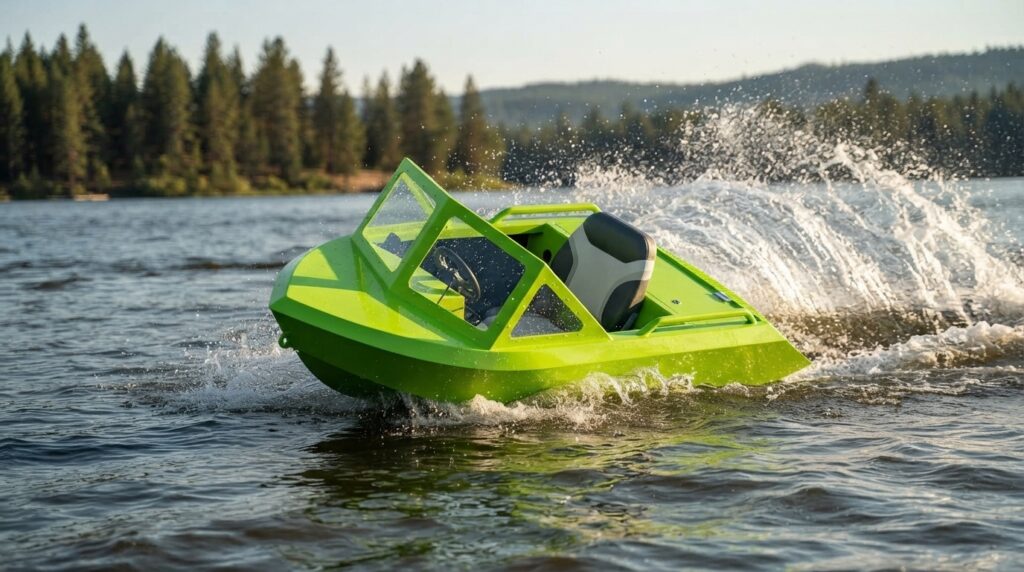
Rider weight is one of the most consistently underestimated variables in how an electric mini jet boat actually performs. It's rarely front and centre in marketing material, yet it has a genuine, measurable effect on nearly every aspect of a boat's on-water behaviour — speed, acceleration, handling and runtime all shift depending on who's aboard and how much they weigh. This article works through exactly how and why rider weight matters, so buyers and owners can set realistic expectations rather than being surprised by the gap between advertised figures and their own real-world experience.
On a large, heavy powerboat, the addition of a single rider's body weight is a small fraction of the boat's total mass, and its effect on performance is correspondingly modest. A mini jet boat is a different proposition entirely. These are deliberately lightweight, compact craft, often weighing not much more than a few times a typical adult's body weight even before a battery and drivetrain are accounted for. This means a rider's weight represents a genuinely significant proportion of the boat's total operating mass, and the performance consequences of that weight are proportionally much larger than they would be on a bigger vessel.
This isn't a flaw in mini jet boat design — it's an inherent characteristic of a lightweight, efficient, easily trailered and stored category of craft. But it does mean rider weight deserves far more attention when setting expectations for a mini jet boat than it typically receives for a larger, heavier boat.
A heavier rider increases the total mass the motor and propulsion system need to move through the water, which generally results in a somewhat lower achievable top speed compared with the same boat carrying a lighter rider. The size of this effect varies by model, power tier and hull design, but it's a real, physically inevitable relationship rather than a marginal or theoretical one.
This is part of why advertised top speed figures, typically achieved with a single, relatively light test rider, can differ meaningfully from what a heavier rider experiences in practice. It's worth treating advertised top speed as a best-case reference point rather than a guaranteed figure, and where possible, seeking out performance information specific to a rider weight closer to your own.
Acceleration is, if anything, even more sensitive to rider weight than top speed. A heavier total mass requires more force to accelerate at a given rate, meaning a heavier rider will generally experience noticeably slower acceleration from a standing start or from low speed compared with a lighter rider on the same boat. This is particularly noticeable on lower-powered models, where there's less power in reserve to compensate for the additional mass, and less noticeable — though still present — on higher-powered models with more power available to overcome the extra weight.
This has practical implications beyond simply feeling less "peppy." Slower acceleration can matter in situations requiring a quick response — pulling away from a hazard, correcting for an unexpected wave or wake, or simply keeping pace with other watercraft in a shared area — and it's worth factoring into the decision between power tiers if you know you're at the heavier end of the range a particular model is designed around.
Rider weight affects handling in ways that go beyond straightforward speed and acceleration. A heavier rider sitting higher in the boat can shift the centre of gravity in ways that affect how the boat responds to turns, chop and sudden weight shifts, though the specific effect depends considerably on hull design and where the rider's weight sits relative to the boat's designed balance point. Some hulls are specifically engineered to remain stable and predictable across a wide range of rider weights, while others are more optimised around a narrower target weight range, with handling characteristics that become noticeably different toward the upper or lower ends of what the boat can comfortably accommodate.
This is genuinely difficult to assess from specifications alone, which is part of why a test ride — ideally with the actual rider who'll be using the boat regularly — is one of the most valuable steps in the buying process, particularly for riders at the heavier or lighter ends of the typical adult range.
Rider weight affects range in a broadly similar way to how it affects acceleration and top speed — more mass requires more energy to move through the water at a given speed, which translates into higher energy consumption and, correspondingly, reduced range for a given battery capacity. The magnitude of this effect varies with riding style and conditions, but a meaningfully heavier rider can expect a genuinely lower range than a lighter rider achieves on the same boat and battery, all else being equal.
This is one of the most commonly misunderstood aspects of electric mini jet boat ownership, since advertised range figures are typically achieved under close-to-ideal conditions with a specific, often lighter-than-average, test rider. A heavier rider who takes an advertised range figure at face value may find their actual real-world range falls meaningfully short of that number, not due to any fault in the boat, but simply due to the physics of moving more mass through water.
It's worth briefly understanding the underlying physics, since it helps explain why the effect of rider weight is as pronounced as it is on a lightweight craft. Moving any mass through water requires overcoming both the water's resistance (drag) and the force needed to accelerate that mass in the first place. Both of these relate directly to total mass — more mass means more drag-related resistance to overcome at a given speed, and more force required to achieve a given rate of acceleration.
On a mini jet boat, where the hull and drivetrain themselves might weigh only a modest amount more than an adult rider, adding or removing even 15-20 kilograms of rider weight represents a meaningful percentage change in the boat's total operating mass — often somewhere in the region of 10-20%, depending on the specific model and rider weight in question. Compare this with a large runabout boat weighing several hundred kilograms or more, where the same 15-20 kilogram difference represents a much smaller percentage of total mass, and the effect on performance is correspondingly far less noticeable. This proportional relationship is the core reason rider weight deserves so much more attention in the mini jet boat category than it typically receives in boating more broadly.
It's also worth understanding that the range impact of rider weight isn't simply a fixed percentage regardless of how the boat is ridden — it interacts with riding style and speed in a compounding way. Energy consumption in any watercraft increases disproportionately as speed increases, not in a simple straight-line relationship, because drag forces increase more steeply at higher speeds. This means a heavier rider who also tends to ride at higher, more consistent speeds will typically see a larger cumulative reduction in range than the weight difference alone would suggest, since the extra mass is being pushed against increasingly significant drag forces throughout the ride.
Conversely, a heavier rider who rides more conservatively, at a gentler, more moderate pace, can often achieve range figures considerably closer to advertised numbers than a lighter rider riding aggressively at high speed for the duration of their outing. This is a genuinely useful piece of practical knowledge for any rider concerned about maximising range — riding style has as much influence over real-world range as rider weight does, and the two factors compound each other rather than acting independently.
Some manufacturers explicitly publish performance figures across a range of rider weights, or provide guidance on how to interpret advertised figures for riders outside the specific weight used in testing. This kind of transparency is genuinely valuable and worth actively seeking out when comparing models, since it allows a much more accurate, personalised expectation of how a given boat will actually perform for you specifically, rather than for an unspecified "average" test rider.
Where this information isn't provided, it's worth asking directly, and treating the answer — or the absence of one — as useful information about how thoughtfully a manufacturer has considered the real-world diversity of riders who'll actually be using their boats.
Lighter riders (broadly, below the typical rider weight most models are designed around) generally experience performance at or above advertised figures, with better acceleration, higher achievable top speed, and typically longer range than the headline specifications suggest. This is a genuine advantage worth being aware of, though it doesn't mean a lighter rider should necessarily choose a lower power tier than they'd otherwise want — the extra performance headroom can simply translate into a more spirited, enjoyable riding experience within whatever tier suits their other priorities.
Riders near the typical design weight should generally expect performance broadly in line with advertised figures, assuming those figures are based on a reasonably representative test rider weight — though it's still worth confirming what weight was actually used in testing, since "typical" varies between manufacturers.
Heavier riders should approach advertised figures with more caution, expecting somewhat reduced top speed, acceleration and range compared with headline numbers. This doesn't mean a heavier rider can't have a genuinely enjoyable mini jet boat experience — many do — but it does mean choosing a higher power tier than might otherwise seem necessary can help offset the performance impact of additional weight, and it's particularly worth prioritising a genuine test ride with your own body weight aboard before committing to a specific model.
To make this more concrete, consider a hypothetical 25kW mini jet boat with an advertised top speed of, say, 45 km/h and a range of 40 kilometres, both figures achieved with a 65kg test rider on flat water at a moderate cruising pace. A rider weighing 95kg — a meaningful but far from unusual difference of 30kg — might reasonably expect a top speed reduction in the order of a few km/h, a noticeably slower acceleration curve, particularly from a standing start, and a range reduction that could plausibly fall anywhere from 15% to 30% depending on riding style, water conditions and how conservatively or aggressively the boat is ridden.
These figures are illustrative rather than universally precise — the exact magnitude varies by hull design, power tier and battery configuration — but they help demonstrate why it's genuinely worth asking a manufacturer or dealer for weight-adjusted guidance rather than assuming a single advertised figure applies uniformly to every rider. A 30kg difference in rider weight is common enough between different members of the same household, let alone between different customers considering the same model, that this kind of variation deserves serious attention rather than being treated as a minor footnote.
Given how significantly rider weight affects real-world performance, it's worth taking a few concrete steps to get a more accurate personal estimate before committing to a purchase. Asking a manufacturer or dealer directly whether they can provide performance data at a weight closer to your own, rather than relying solely on their standard advertised figures, is a reasonable and increasingly common request. Where a manufacturer can't provide this directly, seeking out reviews or owner testimonials from riders of a similar weight to your own — through owner forums, social media groups, or direct referrals from a dealer — can provide a genuinely more useful comparison point than the manufacturer's own headline figures.
Ultimately, though, nothing substitutes for a genuine test ride with your own body weight aboard, ideally conducted over a reasonable distance and duration rather than a brief few-minute demonstration, and ideally in conditions reasonably representative of where you'll actually be riding most often.
It's worth distinguishing between total rider weight and how that weight is distributed, since the two aren't quite the same consideration. A single heavier rider sitting in a properly designed seating position generally has a more predictable effect on handling than the same total weight distributed unevenly — for instance, a lighter rider and a disproportionate amount of additional gear or equipment stored off to one side. Well-designed mini jet boats account for a reasonable range of rider weights and typical gear loads in their handling characteristics, but extreme or unusual weight distribution, regardless of total weight, is worth avoiding where practical, since it can affect handling in ways that aren't accounted for in standard performance testing.
Many mini jet boats, even single-seat models used primarily by one person, end up being ridden by more than one member of a household or friend group over time. Where this is the case, it's worth thinking about the full range of rider weights who'll actually be using the boat, rather than optimising a purchase decision entirely around a single primary rider's weight. A boat chosen specifically to suit a lighter primary rider's weight might leave a heavier occasional rider — a partner, adult child, or friend — with a noticeably less satisfying experience than the primary rider enjoys, particularly on a lower power tier where there's less performance margin to absorb the difference.
This doesn't necessarily mean choosing a higher power tier than the primary rider would otherwise want, but it is worth having a realistic conversation about the full range of people likely to use the boat, and potentially weighting the decision toward a slightly higher power tier or a hull design known to handle a wider weight range gracefully, if the boat will genuinely be shared across riders of noticeably different builds.
For two-seat models, passenger weight compounds everything discussed above, since the boat now needs to move the combined weight of both rider and passenger rather than a single person's weight. This is part of why two-up performance figures, where manufacturers provide them, are considerably more useful for buyers planning to regularly ride with a passenger than solo performance figures alone — see the earlier discussion of single- versus two-seat configurations for more detail on this specific consideration.
It's worth briefly addressing a related but distinct question: does consistently riding with a heavier rider affect the battery's long-term health and lifespan, beyond simply reducing range on any given outing? The relationship here is more indirect than the effect on immediate range and performance. A heavier rider drawing more power per outing means the battery experiences somewhat deeper discharge cycles for a given distance travelled, and more frequent, possibly deeper, charge cycles over time if the rider is covering similar distances to a lighter rider despite the reduced range per charge. Since battery degradation is influenced partly by cumulative cycle count and depth of discharge, there's a reasonable case that consistently heavier use could contribute to somewhat faster long-term capacity fade compared with lighter, more conservative use, though this is a secondary effect compared with the immediate, more significant impact on range and performance already discussed. It's a worthwhile consideration for heavier riders planning very frequent use, though not one that should override the more fundamental questions of whether a given boat and power tier genuinely suits their weight and riding needs in the first place.
Rider weight has a genuine, physically inevitable effect on a mini jet boat's speed, acceleration, handling and range, and this effect is considerably more pronounced than it would be on a larger, heavier vessel, given how lightweight and efficient mini jet boats are by design. Advertised performance figures are typically based on a specific test rider weight that may not reflect your own, and it's worth actively seeking out weight-specific performance information, or at minimum understanding what weight assumptions sit behind any headline figures, before setting expectations. A genuine test ride with your own body weight aboard remains one of the most reliable ways to understand exactly how a specific boat will perform for you, rather than relying on generalised specifications alone. Understanding this relationship clearly from the outset helps set realistic, personally relevant expectations, and avoids the disappointment that can come from comparing your own real-world experience against a headline figure that was never really designed to represent you in the first place.
Vector Watercraft supplies fully assembled electric mini jet boats to the Australian market, with performance figures disclosed alongside the rider weight and conditions used in testing, and guidance available for how performance typically varies across different rider weights. Backed by a 2-year warranty and dedicated after-sales support, Vector Watercraft encourages every prospective buyer to test ride with their own body weight aboard before purchase, ensuring the performance experienced on the water matches genuine, informed expectations rather than an idealised headline figure. This approach reflects a broader commitment to giving Australian buyers the specific, personally relevant information they need to make a confident choice, rather than a one-size-fits-all set of marketing figures.