
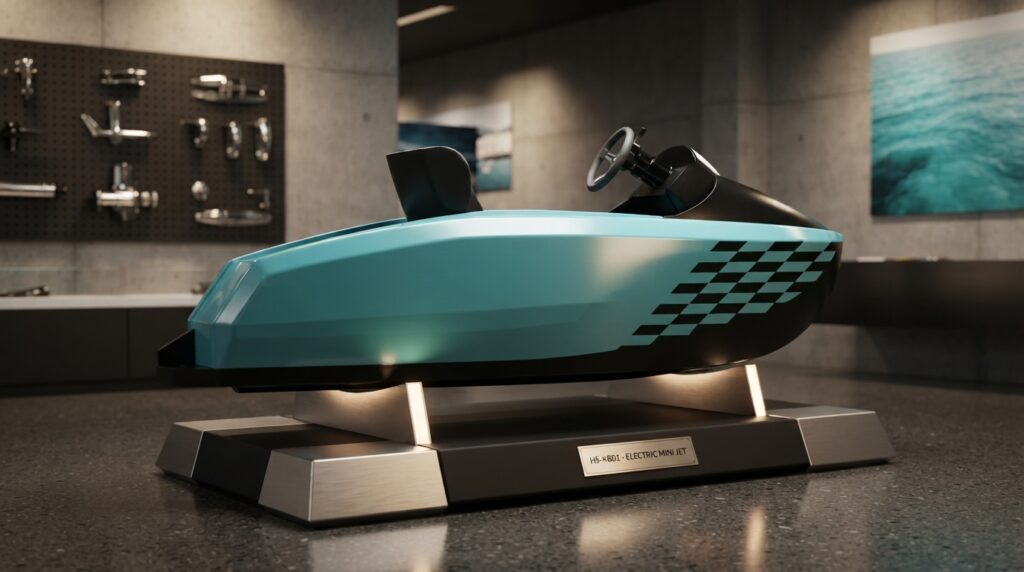
Choosing an electric mini jet boat should never come down to selecting the model with the highest speed, the largest motor or the lowest price.
The right boat is the one that suits the operator’s body size, experience, normal passenger load, intended waterways, transport arrangements and expectations. A boat that performs extremely well for a lightweight solo operator may feel cramped, sluggish or poorly balanced with a taller or heavier person aboard. A compact single-seater may be ideal for individual recreational use but completely unsuitable for a buyer who regularly wants to carry a partner, family member or friend.
Electric mini jet boats are relatively small craft. This makes the relationship between the boat and its occupants especially important. In a larger conventional boat, a difference of 30 or 40 kilograms between operators may have only a modest effect. In a lightweight mini jet boat, that same difference can influence acceleration, planing, steering response, freeboard, battery consumption and operating range.
A careful buyer should therefore consider the complete operating package rather than comparing isolated specifications.
This includes:
This guide explains how to assess these factors and select an electric mini jet boat that is comfortable, practical and appropriate for its intended use.
Before comparing individual models, write down how the boat will normally be used.
Do not base the decision on an occasional ideal situation. Base it on the most common real-world use.
Consider:
These answers should guide the selection. Buyers often make the mistake of choosing the most exciting model first and then trying to adapt their use around it. It is better to establish the intended use and then choose the boat that fits it.
A mini jet boat must displace enough water to support its complete operating weight.
That operating weight includes:
The heavier the total load, the deeper the hull generally sits in the water. Increased displacement can create greater resistance and require more power to accelerate and maintain speed.
A heavier operator may therefore experience:
This does not mean that heavier operators cannot enjoy mini jet boats. It means they should select a boat with sufficient load capacity, buoyancy, cockpit space, hull volume and power.
A boat should not merely be capable of carrying the operator. It should carry the operator comfortably while retaining a sensible margin below the maximum permitted load.
Body weight alone is not the complete figure.
A 95-kilogram operator may create a total operating load of more than 100 kilograms after allowing for:
For a two-seater, this calculation should be completed for both occupants.
For example, two adults weighing 95 kilograms and 80 kilograms may create a combined onboard load of 190 kilograms or more after equipment is included.
The boat’s maximum load should not be treated as the preferred everyday load. A reasonable margin should remain to support better handling, freeboard and performance.
A buyer planning to operate continually near the boat’s maximum rating should consider a larger or more capable model.
Maximum carrying capacity tells you whether the boat is rated to carry a particular load. It does not necessarily tell you whether the boat will provide a satisfying experience at that load.
A boat may technically accommodate a heavier operator but still have:
This is why buyers should ask not only for the maximum capacity, but also for realistic performance information at their expected operating weight.
Useful questions include:
The supplier should be able to distinguish between maximum permitted load and recommended performance load.
Height is just as important as weight.
A tall operator may be within the boat’s rated capacity but unable to sit comfortably or operate the controls properly.
Height can affect:
Photographs are not a reliable way to judge cockpit size. Wide-angle photography can make a compact cockpit appear far larger than it is.
A taller buyer should obtain exact measurements for:
A person who is 190 centimetres tall may fit into one small boat comfortably and feel badly cramped in another with similar external dimensions.
The difference often comes down to cockpit geometry rather than overall boat length.
Two operators of equal height may have very different requirements.
One may have:
The other may have:
This affects:
Buyers should therefore consider more than height and weight.
Useful personal measurements include:
This is especially important for older operators or anyone with knee, hip or back problems.
A deep cockpit may feel secure while underway but may be more difficult to enter and leave. A narrow seat may be acceptable for a brief inspection but uncomfortable during a full outing.
A single-seater electric mini jet boat can suit buyers who value:
The operator’s weight and seating position have a strong influence because there is no second occupant to alter balance.
A single-seater may be appropriate when:
A buyer should never choose a single-seater with the intention of occasionally carrying another person. Passenger limits are not suggestions. An extra person can alter stability, trim, freeboard and handling and may create a serious safety risk.
A two-seater is the better choice when the owner intends to share the boat regularly.
It should be assessed as a complete two-person operating platform rather than as a single-seater with an extra seat.
A suitable two-seater should provide:
The buyer should assess performance using the actual likely occupant combination.
If the normal operator weighs 105 kilograms and the regular passenger weighs 85 kilograms, the boat should be evaluated at that combined load. Performance figures achieved with one lightweight test rider will not provide a realistic indication.
Two-seater mini jet boats may use tandem seating or side-by-side seating.
In a tandem arrangement, one person sits behind the other.
Advantages may include:
However, front-to-rear weight distribution is critical.
Too much weight toward the stern may:
Too much forward weight may:
Side-by-side seating can provide:
The main consideration is uneven side-to-side loading.
A large weight difference between occupants can cause the boat to sit lower on one side unless the hull has adequate beam and stability.
The manufacturer should provide clear guidance on passenger position and weight distribution.
Electric mini jet boats may be offered with motors ranging from approximately 15kW to 25kW or much higher.
Power affects acceleration and potential speed, but it should not be considered alone.
Overall performance also depends on:
A 15kW model may suit a lighter solo operator who wants relaxed recreation on protected water.
A 25kW model may provide stronger acceleration and maintain performance better with a heavier operator or two occupants.
A 70kW model may deliver considerably more power, but it may also involve:
The correct question is not, “Which boat has the biggest motor?”
It is, “Which complete boat provides the performance I need with my normal load?”
High power may appeal to experienced operators, but it can be unnecessary or unsuitable for beginners.
A powerful lightweight boat may respond quickly to throttle and steering inputs. This can make it exciting, but also less forgiving.
A beginner may be better served by a model that offers:
More power may also reduce operating time when used aggressively.
A buyer who intends to cruise at moderate speeds may gain little practical benefit from paying for a very high-powered model.
Battery capacity affects operating time, but advertised range should be treated carefully.
Runtime varies according to:
A heavier boat generally requires more energy to accelerate and maintain speed.
Repeated hard acceleration can reduce runtime considerably compared with steady cruising.
Ask the supplier:
The selected boat should provide enough operating time for the intended outing while preserving a safe return margin.
A mini jet boat that suits a calm lake may not suit rougher coastal conditions.
Priorities may include:
A highly powered performance model may be unnecessary.
Additional considerations include:
The operator should allow additional battery reserve because returning against wind or current may require more power.
Coastal operation can involve:
The boat must be suitable for the conditions, and the operator must respect local rules and weather limitations.
Jet propulsion removes the exposed propeller found on many conventional boats, but it does not make the boat immune to shallow-water damage.
Sand, weed, stones and debris can enter the jet intake.
Buyers should confirm:
A beginner-friendly boat should provide:
Jet-driven boats may respond differently when throttle is reduced because steering depends on water thrust.
New operators need to understand:
Experienced operators may prefer sharper handling and stronger performance, but experience with cars, motorcycles or large boats does not remove the need to learn the characteristics of a lightweight jet boat.
A buyer must be able to do more than sit in the boat.
They should be able to:
Reboarding is particularly important.
The boat should have a practical approved method, which may include:
An operator who can drive comfortably may still struggle to climb back aboard after entering the water.
This should be considered before purchase, particularly for older owners or anyone with reduced upper-body strength.
The right boat must also suit the owner’s vehicle and handling arrangements.
Confirm:
Do not rely only on dry weight.
A boat may become substantially heavier once the battery and fittings are included.
A lighter single-seater may suit an owner who launches alone. A larger two-seater may require a trailer, winch or second person.
Where the boat is carried on a ute, the support frame must be properly designed. The hull should rest on suitable structural support areas rather than narrow improvised bars.
The vehicle must also remain within legal payload, dimension and overhang requirements.
Before choosing a boat, consider where it will be stored and charged.
Check:
A compact boat may be more attractive than a larger model if storage space is limited.
However, the smallest boat is not automatically the best choice if it compromises comfort or capacity.
The charging system should suit Australian domestic power requirements and be used strictly according to the manufacturer’s instructions.
Electric mini jet boats may use fibreglass, aluminium or high-density polyethylene.
Fibreglass can offer:
It should be protected from hard impacts, rough dragging and unsuitable support during transport.
Aluminium can offer:
Saltwater care and corrosion prevention remain essential, particularly around electrical systems and dissimilar metals.
HDPE can offer:
Buyers should still understand support, repair and storage requirements.
The quality of a boat depends on more than hull material. Design, fabrication, reinforcement, buoyancy, electrical installation and quality control are equally important.
Electric propulsion does not remove boating obligations.
Licensing, registration, safety-equipment and operating rules vary between Australian states and territories.
Requirements may depend on:
A buyer should confirm the applicable requirements with the relevant maritime authority before operating the boat.
The supplier should also provide appropriate documentation, including:
The buyer should not accept vague assurances that registration or licensing is unnecessary simply because the boat is electric.
A lifejacket must suit both the operating area and the wearer.
It should:
A tall or broad operator should try the lifejacket while sitting in the normal driving position.
A poorly fitting lifejacket can restrict movement or become ineffective in the water.
A responsible supplier should be able to answer specific questions.
Exercise caution when:
A professional supplier should be prepared to explain which model is unsuitable as well as which one is suitable.
Use the following method before making a final decision.
Record:
Record:
Record:
Check:
Compare:
The right electric mini jet boat is not necessarily the fastest, most powerful or least expensive model.
It is the boat that fits the operator physically, carries the normal load with a sensible margin, provides appropriate performance and can be transported, launched, stored and maintained safely.
A lightweight solo operator may be well suited to a compact single-seater with moderate power. A taller or heavier buyer may need a larger cockpit, greater hull volume and stronger performance. Two adults require a genuine two-seater designed for their combined load, not a boat that only accommodates them at the edge of its capacity.
Before buying, insist on clear dimensions, realistic performance figures, complete battery information, appropriate documentation and dependable after-sales support.
Vector Water Craft offers a range of electric mini jet boats designed for different operators, passenger requirements and recreational uses. Buyers should compare models according to their own weight, height, experience and intended operation rather than relying on headline speed figures alone.
A careful selection made before purchase will produce a safer, more comfortable and more enjoyable ownership experience for years to come.