
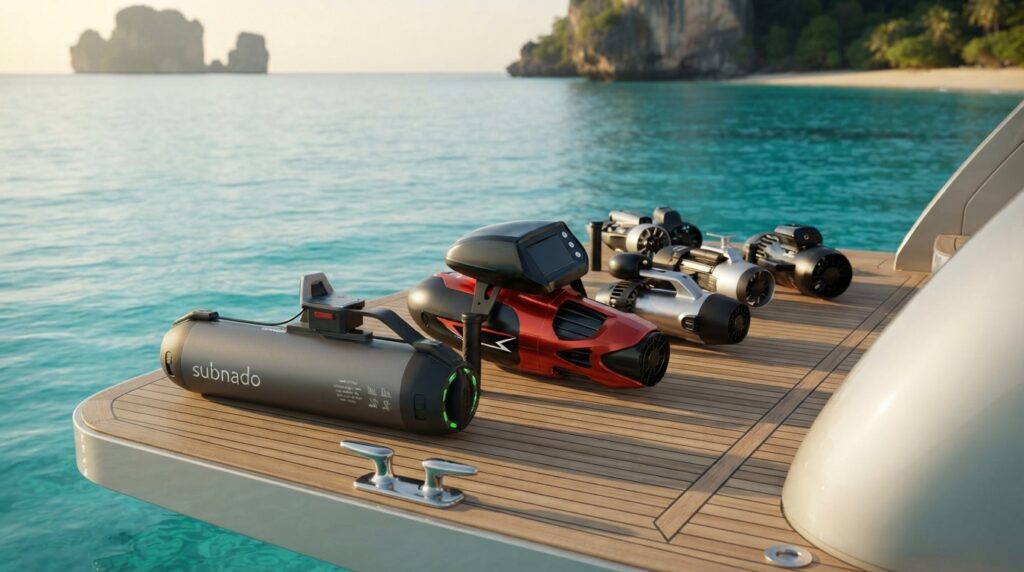
Buying an underwater scooter is quite different from buying ordinary swimming equipment.
A mask, snorkel or pair of fins can often be selected mainly according to comfort, fit and price. An underwater scooter adds electric propulsion, battery capacity, speed, depth capability, controls, waterproofing and maintenance to the decision.
That means the best underwater scooter is not necessarily the fastest, most powerful or most expensive model.
The right choice is the scooter that best matches what you actually intend to do in the water.
A person who wants a lightweight scooter for holiday snorkelling has very different requirements from an experienced diver wanting substantial propulsion and extended operating time. A boat owner may place a premium on compact storage, while an enthusiast interested in underwater photography may value controllable speeds and camera mounting.
Australia's extensive coastline, beaches, bays, lakes and recreational boating culture create many possible applications for underwater scooters. The key is to identify yours before comparing specifications.
This guide explains the major factors Australian buyers should consider and how to match an underwater scooter to their individual needs.
Before comparing motors, batteries or top speeds, answer one simple question:
The main possibilities include:
Your answer should determine the specifications that matter most.
This is one of the most important principles in buying any specialised electric watercraft.
Paying for capabilities you will never use adds unnecessary cost and sometimes unnecessary weight. Conversely, buying an entry-level model because it is inexpensive may result in disappointment if your real requirements involve higher speed, greater thrust or substantially longer runtime.
Vector Water Craft's current underwater scooter range illustrates how widely products can differ. It includes compact models such as the 1.4 kg HS-S2, intermediate recreational models such as the HS-S3 and more powerful products such as the H9 Sub Jet Pro.
Understanding those differences is the first step towards choosing correctly.
Snorkelling is one of the most natural applications for a recreational underwater scooter.
Traditional snorkelling depends upon the swimmer continuously kicking to move through the water. An electric scooter provides propulsion, allowing the user to travel while reducing the amount of effort required to create forward movement.
For most recreational snorkellers, the priorities should be:
Maximum depth is generally less important because snorkellers spend most of their time at or near the surface.
A very high-powered scooter may therefore be unnecessary.
Vector Water Craft's HS-S3 demonstrates the type of specification that can suit this application. It is currently listed at approximately 3 kg, provides three speed settings, offers a published runtime of up to 60 minutes and has a depth rating of 30 metres. It also supports underwater-camera mounting.
The value of three speeds is worth noting.
During relaxed snorkelling you may want to move slowly while looking at marine life. In another situation, you may want greater propulsion to travel between areas.
Variable speed gives the rider that flexibility.
For general recreational snorkelling, therefore, controllability and convenience will usually matter more than outright speed.
Scuba diving creates a different set of requirements.
An experienced diver may want an underwater scooter to help cover distance efficiently or reduce the effort involved in underwater movement.
The important considerations become:
A diver should never select a scooter simply because it offers a high maximum speed.
Using propulsion can allow someone to travel significantly farther than they would ordinarily swim. This makes careful planning particularly important because the diver must remain capable of dealing with a loss of propulsion.
The scooter should complement safe diving practices rather than become something upon which the diver's safe return depends.
For more demanding applications, specifications such as those published for Vector's H9 Sub Jet Pro become relevant. The model is currently listed with speeds up to 13 km/h, a maximum published depth of 40 metres and runtime of up to 100 minutes.
Those capabilities are considerably beyond what a casual surface snorkeller may require.
The comparison demonstrates why defining the application first is so important.
Some buyers are not snorkellers or divers at all.
They simply want another entertaining activity for swimming areas, holidays or days on the water.
For this group, simplicity should normally be high on the list.
Consider:
A compact scooter can provide plenty of enjoyment without extreme performance.
Vector's HS-S2, for example, weighs approximately 1.4 kg and uses an arm-mounted design with thumb control. Its published specifications include 6.5 kg of thrust and a maximum speed of approximately 1.4 metres per second.
For buyers valuing portability, a scooter of this type can offer a very different ownership experience from a heavier high-output unit.
Speed is one of the specifications most likely to attract attention.
It is also one of the easiest to misunderstand.
An underwater scooter that travels faster is not automatically better.
The appropriate speed depends on:
At lower speeds, a user may find it easier to observe marine life or maintain precise control.
Higher speeds may be attractive to more experienced riders seeking performance.
For this reason, multiple usable speed settings may be more valuable than an impressive maximum-speed figure alone.
When comparing two underwater scooters, look beyond the top speed and ask:
Can I comfortably control the scooter at low speed?
How easy is it to change settings?
Does it accelerate smoothly?
Can I stop propulsion quickly?
Will the available speed range suit my actual use?
These questions often tell you more than the headline performance figure.
Thrust describes the propulsive force available from the scooter.
It is particularly important when the scooter must move a rider carrying significant equipment.
A lightweight swimmer creates less drag than a scuba diver wearing a tank, buoyancy equipment and other gear.
This means two riders may experience the same scooter differently.
Thrust should therefore be considered alongside:
Vector's current HS-S2 specifications, for example, list 6.5 kg of thrust despite the scooter itself weighing approximately 1.4 kg.
Motor wattage can also provide useful information, but do not purchase on motor wattage alone.
The efficiency of the propulsion system, propeller or impeller design, body shape, controls and overall engineering all contribute to how the scooter performs in practice.
Battery runtime is one of the most important specifications.
It is also an area where buyers should distinguish between a manufacturer's maximum published figure and what may occur in individual real-world conditions.
Runtime can be affected by:
For example, the Vector HS-S3 has a published operating time of up to 60 minutes, while the higher-capability H9 Sub Jet Pro is listed with runtime up to 100 minutes.
Which is better?
That depends on whether you actually require the additional operating time.
For short recreational sessions close to shore or a boat, an hour of potential runtime may be ample.
For longer and more demanding use, greater capacity becomes much more valuable.
When assessing battery runtime, think about how you really use the water.
Do you normally swim for twenty minutes?
Spend several hours on a boat and enter the water repeatedly?
Undertake planned dives?
Want several family members to use the scooter during the same outing?
These practical questions help determine the battery capacity you need.
Modern electric watersports equipment commonly relies on lithium-ion battery technology.
Lithium-ion batteries provide substantial rechargeable energy in relatively compact packages, which is one reason they are so widely used in portable equipment. Australia's product safety regulator provides specific guidance on their safe use.
Buyers should look beyond battery capacity and ask:
The ACCC's Product Safety guidance advises consumers not to use lithium-ion batteries or chargers showing signs such as swelling, overheating, leaking or physical damage, and not to modify batteries or use them in products for which they were not designed.
WorkSafe Queensland also recommends using the correct charger and voltage, avoiding modification, and charging in an appropriate area while someone is present rather than routinely leaving equipment charging overnight.
Good battery management should therefore be regarded as part of normal underwater scooter ownership.
Depth ratings can be impressive on a specification sheet, but buyers should again match capability to need.
For surface swimmers and snorkellers, very substantial depth capability may offer little additional benefit.
For scuba divers, it can become essential.
Vector's current published specifications illustrate the differences available. The HS-S3 is rated to 30 metres, the H9 Sub Jet Pro to 40 metres, while the lightweight HS-S2 is published with an IP68 waterproof rating to depths of up to 60 metres.
Do not assume that a more expensive scooter automatically has the greatest depth rating.
Design objectives differ.
A manufacturer may optimise one model for speed, another for compact dimensions and another for particular diving requirements.
Choose a depth rating comfortably appropriate for your intended activity and always remain within the manufacturer's specified limits.
Weight is often underestimated during the buying process.
A scooter may feel manageable when dry in a shop or at home.
Now imagine:
Suddenly weight matters considerably.
Vector's underwater scooter range again provides useful examples.
The HS-S2 is listed at approximately 1.4 kg.
The HS-S3 is approximately 3 kg.
The dual-motor HS-S4 Bat is listed at approximately 4.3 kg.
None of those numbers is inherently good or bad.
The question is what you receive in return for additional size and weight.
If higher performance is important, you may willingly accept a heavier machine.
If the scooter is primarily for holidays and casual snorkelling, compact dimensions may be much more valuable.
Some underwater scooters use a single propulsion unit, while others use twin motors.
Vector's HS-S4 Bat, for example, uses two 500-watt motors and is currently published with speeds up to approximately 2 metres per second, equivalent to about 7.2 km/h.
A dual-motor layout can provide strong propulsion in a relatively compact format.
However, the number of motors should not be viewed as a quality rating in itself.
A well-designed single-motor scooter may be the better choice for a particular application.
Compare the complete performance package:
The correct engineering solution depends on what the scooter is intended to achieve.
Traditional underwater scooters are commonly held with both hands.
Newer models may use different arrangements.
An arm-mounted design can leave the user's hands freer. Other scooters use broad handgrips or wing-style configurations.
The HS-S2, for example, uses an arm-mounted format with thumb operation. The HS-S4 Bat is designed around a wider dual-motor arrangement and Vector lists several possible mounting styles.
Think about your preference.
For snorkelling, a simple hand-held arrangement may be entirely suitable.
For underwater photography, the ability to free a hand or attach a camera could be particularly useful.
For diving, controls should remain practical when wearing your normal equipment.
The best control system is one that feels intuitive and allows immediate reduction or stopping of propulsion.
A growing number of recreational buyers want to record their underwater experiences.
An underwater scooter can potentially help a user cover more interesting areas during a session, making it an attractive companion to an action camera.
Some scooters include or support camera mounting.
Vector's HS-S3 specifically lists support for underwater cameras among its features.
If photography or video is important to you, ask:
Remember that recording video must never distract from safe navigation.
Your first responsibility is controlling the scooter and remaining aware of your surroundings.
For Australian owners, saltwater compatibility is particularly important.
Many users will want to operate around beaches, sheltered bays or coastal boating locations.
Vector states that most underwater scooters in its range are designed for saltwater use but require appropriate rinsing and maintenance afterwards.
Salt and electrical or mechanical equipment are not a combination that should be neglected.
After saltwater use, follow the manufacturer's instructions, which may include:
A buyer unwilling to undertake routine maintenance should take that into account before purchasing any specialist electric watersports product.
The purchase decision does not end when you leave the water.
You need somewhere appropriate to store:
Battery-powered equipment should be stored according to the manufacturer's instructions.
Australian safety guidance recommends keeping lithium-ion equipment away from excessive heat and not leaving battery-powered products in hot locations such as parked vehicles.
For Australian summers, that point deserves particular attention.
Leaving expensive battery equipment permanently in the boot of a hot vehicle is not sensible storage.
An underwater scooter combines several specialist systems:
That makes after-sales support more important than it might be for ordinary recreational equipment.
Before buying, find out:
Vector Water Craft currently advertises Australian-backed warranty and support for its electric watercraft range, with its warranty page referring to a two-year Australian-backed warranty; individual product pages may contain model-specific wording, so buyers should confirm the precise warranty applying to the model they purchase.
This is an important part of evidence-based purchasing: judge the supplier as well as the specifications.
A practical way to narrow your choice is to decide which side of this comparison better describes you.
Neither approach is better universally.
It is about matching the equipment to the owner.
Families should be particularly careful not to buy purely from exciting performance claims.
An underwater scooter is powered equipment.
Suitability depends upon the user's age, size, swimming ability and experience, together with the manufacturer's operating requirements.
For family recreation, features such as:
may be substantially more important than maximum speed.
Parents should always follow the manufacturer's age and usage recommendations and supervise water activities appropriately.
Before choosing a model, answer these twelve questions.
This immediately narrows the specification required.
Be realistic rather than choosing the largest number.
Think about a normal day on the water.
Buy for your genuine operating depth.
Consider transport as well as use.
For most recreational users, variable control is valuable.
Not every model provides the same mounting possibilities.
Understand the cleaning and maintenance requirements.
Battery safety needs to be considered before purchase.
A cool, appropriate location is preferable to leaving electric equipment in a hot vehicle.
Do not wait until you have a problem to ask this question.
This final question can save considerable money and produce a more enjoyable product.
The current Vector Water Craft range provides several useful examples of how different specifications suit different applications.
A lightweight product such as the HS-S2 may appeal where compactness, ease of carrying and arm-mounted operation are major priorities. It weighs approximately 1.4 kg and is published with 6.5 kg thrust and speeds up to 1.4 m/s.
The HS-S3 offers a middle-ground approach, with approximately 3 kg weight, three speeds, up to 60 minutes published runtime and camera support.
The dual-motor HS-S4 Bat uses two 500-watt motors and provides published speeds of up to approximately 7.2 km/h while weighing around 4.3 kg.
The H9 Sub Jet Pro represents a substantial step upward, with published specifications including speeds up to 13 km/h, runtime up to 100 minutes and a depth capability of up to 40 metres.
These examples demonstrate why there is no single correct scooter for every buyer.
Price matters.
But it should be compared after you establish what you need.
Vector Water Craft's current category page lists models at different price levels, including the HS-S3 at $1,197 and HS-S4 Bat at $1,725 at the time of writing. Pricing and availability can change, so buyers should confirm current figures before ordering.
Instead of asking:
Ask:
That is a much better buying question.
Avoid these mistakes.
Performance must suit the application.
A scooter that is inconvenient to transport may stay at home.
Battery duration matters if you plan extended sessions.
A surface snorkeller does not need to select primarily on extreme depth.
Power and controls should be matched to the user.
Electric watersports equipment requires appropriate battery care.
Long-term ownership matters as much as the initial specification.
Regular coastal use requires proper post-use care.
Choosing the right underwater scooter becomes much easier when you stop looking for the universally “best” model and instead look for the best model for your own requirements.
Start with the activity.
Then work through:
A casual snorkeller may obtain far greater satisfaction from a compact, easy-to-carry scooter than from a powerful specialist model.
A serious diver may make exactly the opposite choice.
The purpose of comparing specifications is therefore not to identify which underwater scooter wins on paper.
It is to determine which scooter will work best every time you go to the water.
If you are uncertain which underwater scooter best suits your needs, speak with Vector Water Craft before purchasing.
Tell us:
We can then help you compare the relevant models rather than simply directing you towards the highest-powered option.
Explore the Vector Water Craft underwater scooter range and contact us for help selecting the scooter that best matches the way you intend to use it.
Choose according to your intended use rather than size alone. Lightweight models are attractive for travelling and recreational snorkelling, while larger or more powerful scooters may better suit demanding diving and performance applications.
A beginner generally benefits more from smooth, controllable propulsion and multiple speed settings than from extreme maximum speed. Start at the lowest practical setting while learning the scooter's controls.
It can be. Vector's approximately 1.4 kg HS-S2, for example, has a published thrust figure of 6.5 kg and maximum speed around 1.4 m/s. Whether that is sufficient depends upon the rider and intended application.
For many recreational users it may be. Buyers planning extended sessions or more demanding diving should consider models with greater battery capacity. Published runtime also represents an upper specification and actual results can vary according to use.
Only if you require that capability. A snorkeller staying close to the surface gains little practical benefit from buying primarily on maximum depth.
Not necessarily. Dual motors can provide strong propulsion, but the correct choice depends on the full package of speed, thrust, runtime, weight and handling.
Many underwater scooters are designed for saltwater operation. Always confirm the specifications of the particular model and follow the manufacturer's fresh-water rinsing and maintenance requirements after saltwater use.
Use the correct manufacturer-approved charger and follow the supplied instructions. Australian safety authorities recommend avoiding damaged batteries or chargers, not modifying them and charging lithium-ion products in an appropriate location while someone is present.
Yes. Underwater scooters combine batteries, motors, electronics, waterproofing and mechanical components, making access to warranty assistance, product knowledge and spare parts particularly valuable.
The answer depends primarily on whether you want recreational snorkelling, compact portability, regular high-performance use or more serious diving capability. Vector Water Craft can help compare the available models according to your intended use rather than simply recommending the most powerful scooter.