
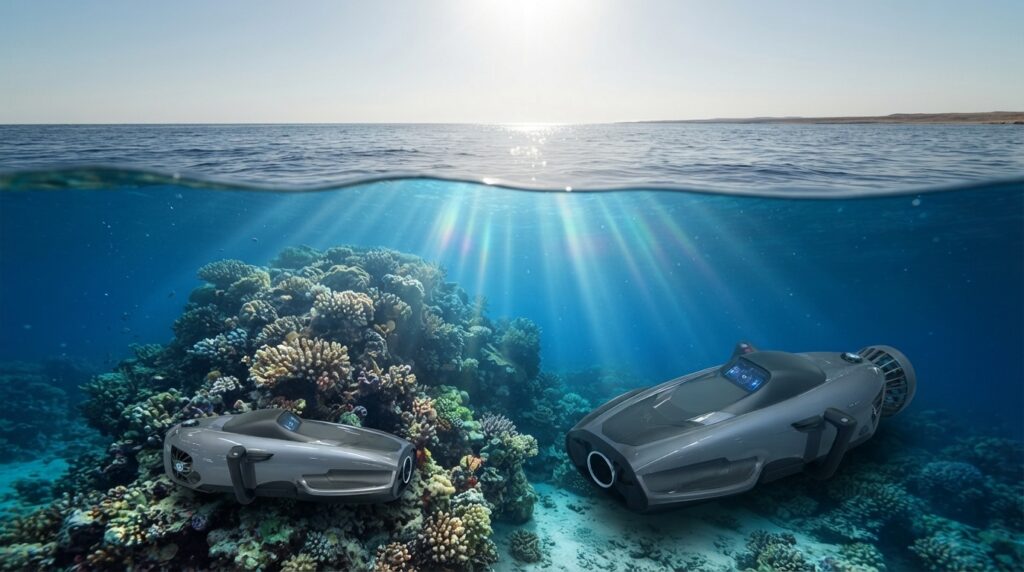
Choosing between a lightweight underwater scooter and a high-powered model is one of the most important decisions an Australian buyer will make.
At first glance, the answer can seem obvious.
More power sounds better.
A faster underwater scooter can provide stronger propulsion, move a rider more quickly and potentially support more demanding diving applications. But greater power often brings additional weight, larger batteries, higher purchase prices and more complicated transport and storage.
For many recreational users, that trade-off is unnecessary.
Vector Water Craft's current Australian range demonstrates just how different the two ends of the market have become. The lightweight HS-S2 weighs approximately 1.4 kg, while the professional H9 Sub Jet Pro weighs around 35 kg, reaches a published top speed of 13 km/h and provides up to 100 minutes runtime.
These are both underwater scooters, but they are designed around very different priorities.
The correct buying question is therefore not:
It is:
For a recreational snorkeller, traveller or boat owner, a lightweight scooter may be the better investment.
For an experienced diver or user requiring substantial propulsion, a high-powered underwater scooter may be worth the additional weight and cost.
This guide explains the trade-offs.
A lightweight underwater scooter is generally designed around portability, ease of handling and recreational versatility.
Typical applications include:
Vector currently offers several compact examples.
The HS-S2 weighs approximately 1.4 kg and uses a thumb-control design aimed at maintaining easy swimming and manoeuvrability.
The HS-S1 weighs approximately 2.5 kg including the battery, offers three speed modes and has a published depth capability of up to 40 metres.
The HS-S3 weighs approximately 3 kg, provides three speed settings, supports underwater cameras and is published with up to 60 minutes runtime and a 30-metre depth rating.
These models are small enough that portability remains a major part of the product proposition.
High-powered underwater scooters move towards the Diver Propulsion Vehicle end of the market.
They are designed for users who place greater importance on:
Vector's H9-1 Sub Runner is one example of this transition. It provides three speed gears reaching up to 2.5 m/s, a published depth rating of 40 metres and up to 60 minutes runtime.
The H9 Sub Jet Pro goes considerably further, with a published maximum speed of 13 km/h, depth capability of up to 40 metres and runtime of up to 100 minutes.
This level of equipment is aimed at buyers who genuinely need additional propulsion capability.
For many Australian owners, portability should be given much more importance than it usually receives.
A scooter is not only used underwater.
It must also be:
This is where a scooter weighing 1.4 kg can provide a major ownership advantage.
Vector's HS-S2 is specifically positioned as an ultra-lightweight scooter at approximately 1.4 kg.
That makes it particularly attractive for people who regularly travel with other watersports equipment.
Imagine a family heading to the beach carrying:
Adding a 1.4 kg scooter is relatively easy.
Adding a substantially larger professional propulsion system changes the logistics entirely.
For recreational users, this can make the lightweight scooter more practical even if it has lower maximum performance.
High-performance propulsion requires energy.
More energy generally requires larger batteries and more substantial components.
That is one reason professional underwater scooters become larger and heavier.
Vector's H9 Sub Jet Pro, for example, weighs around 35 kg.
The H9's advantage is not portability.
Its advantage is capability.
A buyer considering this type of equipment should therefore ask:
For the correct user, the answer may be yes.
For a casual snorkeller, it is likely to be unnecessary.
Usually less than buyers initially imagine.
Underwater propulsion feels very different from movement on land.
Even moderate speeds can feel fast when travelling near:
A snorkeller is generally trying to observe the underwater environment rather than cover the greatest possible distance.
The most useful characteristics may therefore be:
The HS-S3, for example, combines three speed settings with a 3 kg weight and up to 60 minutes published runtime.
For many recreational users, that balance can be more useful than substantially greater top speed.
Higher propulsion capability becomes increasingly useful as the demands placed on the scooter increase.
A scuba diver may carry:
All of this adds underwater drag.
A more powerful scooter can therefore be valuable where a lightly powered recreational unit may provide less effective propulsion.
Higher power can also make sense for:
The key is that the extra capability should solve a real problem.
It is easy to become impressed by specifications.
A buyer may compare:
5 km/h.
7 km/h.
9 km/h.
13 km/h.
The largest number naturally appears best.
But if you normally snorkel at moderate speed close to a boat, you may rarely use the additional performance.
The result can be:
without any meaningful increase in enjoyment.
For recreational buying, unused performance has little value.
Maximum speed is only one element of performance.
A good underwater scooter should also be easy to control.
Multiple speed settings can be particularly valuable.
The HS-S3 offers three speed levels, allowing the rider to adjust output to the activity.
The H9-1 also offers three gears while reaching a maximum of 2.5 m/s.
For many owners, this is preferable to treating maximum power as an all-or-nothing feature.
Lower speeds are useful for:
Higher output can then be selected when more propulsion is useful.
Travel is one of the strongest reasons to favour compact equipment.
Australians often travel substantial distances for:
Every kilogram matters when packing.
A 1.4 kg or 3 kg scooter can be far easier to include than a large professional propulsion platform.
However, travellers should also remember that lithium batteries are subject to airline transport requirements.
Battery size and airline rules should be checked before flying.
Never assume that because the scooter itself is compact it can automatically be carried on an aircraft without restrictions.
Boat owners are another group likely to appreciate compact equipment.
Storage onboard is always valuable.
A lightweight underwater scooter can be stored alongside:
without occupying the amount of space required by a larger powered watercraft.
At a suitable anchorage, the scooter can be brought out, used and stored again relatively easily.
This is one of the situations where practical convenience can outweigh additional power.
Family use also tends to favour lower weight and controllable performance.
If several people will share the scooter, a compact model is easier to:
High-performance professional equipment generally makes less sense where the main purpose is recreational family use.
The best family underwater scooter is often the one that people are comfortable taking to the water repeatedly.
For serious diving, the priorities can reverse.
Portability may become secondary to:
Vector's H9 Sub Jet Pro has a published top speed of 13 km/h and up to 100 minutes runtime, while the H9-1 offers speeds up to 2.5 m/s and up to 60 minutes runtime.
These models are aimed at substantially different use from casual surface snorkelling.
A diver who genuinely requires this capability may accept additional weight as part of the trade-off.
It is tempting to assume a larger scooter always provides dramatically longer runtime.
That is not necessarily the case.
The HS-S3 provides up to 60 minutes published runtime at a weight of approximately 3 kg.
The H9-1 also provides up to 60 minutes but supports substantially greater performance.
The H9 Sub Jet Pro increases published runtime to 100 minutes while also providing much greater propulsion capability.
This illustrates an important engineering principle.
Large batteries are often supporting more powerful motors rather than simply providing proportionally longer runtime.
Electric propulsion is always a balancing exercise.
Manufacturers need to balance:
A lightweight scooter necessarily has less room and weight allowance for very large battery packs.
A professional scooter can carry substantially more battery, but the owner must accept the physical size associated with that.
For the buyer, this is not a technical disadvantage.
It is simply a trade-off.
Depth ratings can also influence purchasing decisions, but they need to be viewed sensibly.
The compact HS-S1 is published for depths up to 40 metres, while the HS-S3 is published at up to 30 metres.
The H9-1 and H9 are both published at up to 40 metres.
This demonstrates that high power does not automatically mean a greater depth rating.
The scooter should be selected according to the intended activity rather than assuming price and depth always increase together.
Equipment depth ratings should also never be confused with diving qualifications.
For scuba diving, thrust deserves particular attention.
Top speed describes how quickly a scooter can potentially move.
Thrust relates more directly to the force available to move the rider and their equipment.
A lightly equipped snorkeller requires much less propulsion than a diver wearing substantial scuba equipment.
Therefore, higher-powered models can have a legitimate advantage for serious divers even when they do not need to travel at maximum speed.
One mistake is to assume lightweight automatically means inadequate.
Modern motors and batteries allow impressive capability from compact equipment.
The HS-S2, despite weighing approximately 1.4 kg, is marketed as a genuine underwater exploration scooter rather than simply a toy.
Similarly, the HS-S3 combines a 3 kg weight with three speeds, camera capability, up to 60 minutes runtime and a 30-metre depth rating.
For normal recreational use, these are meaningful specifications.
Power and quality should not be confused.
A compact scooter can be well engineered.
A professional scooter can also be well engineered.
The difference should be the intended duty.
Buyers should compare:
rather than assuming motor output alone determines quality.
Price is where the choice becomes particularly significant.
Vector's current underwater scooter listings include compact recreational products such as:
At the higher end, the H9-1 is currently listed at $9,950 and the H9 at $15,895.
These prices show that the decision is not simply between paying another few hundred dollars for more power.
Moving into professional underwater propulsion can represent a major jump in investment.
Prices should always be reconfirmed when ordering because product listings can change.
Yes—when the buyer requires it.
A serious diver who needs higher propulsion may obtain considerable value from a high-performance scooter.
A recreational snorkeller may obtain almost no additional practical benefit.
This is why value should be measured against use rather than specification.
A $1,400 scooter used regularly on beaches and boating trips may provide better value for one owner than a $15,000 professional machine.
For another owner, the opposite may be true.
Both lightweight and high-powered underwater scooters require maintenance.
Saltwater use means owners should pay attention to:
Vector specifically advises that underwater scooters designed for saltwater use must be properly rinsed and maintained.
The more expensive the equipment, the stronger the argument for disciplined maintenance.
A compact scooter is naturally easier to store.
A lightweight model may fit in a cupboard, equipment shelf or boat locker.
A large professional machine requires much more deliberate storage planning.
Before buying, ask:
These practical questions can help determine which size category is realistic.
Higher power increases capability but also increases responsibility.
A faster scooter can cover greater distance in less time.
This makes it easier to:
Users should match speed to visibility, environment and experience.
For serious DPV use, appropriate training is strongly advisable.
Do not assume a higher-powered scooter's additional performance means you should always travel farther.
Safe range should consider:
The best use of additional power may sometimes be maintaining efficient travel rather than increasing total distance.
Photographers frequently benefit from lighter equipment.
A compact scooter can provide propulsion while leaving more of the user's attention available for:
The HS-S3 supports underwater cameras, making it particularly relevant to this use.
For photographers, smooth low-speed control can be more useful than maximum top speed.
For ordinary recreational reef exploration, lightweight equipment usually makes more sense.
Reasons include:
The objective around reef should generally be observation rather than high-speed travel.
It depends on the dive.
For shallow recreational dives, a lightweight scooter may be adequate.
For more demanding dives where greater thrust is required, an H9-1 or H9-class product may make more sense.
The decision should be based on actual diving requirements.
Usually the lightweight scooter.
Holidays involve enough equipment already.
The ability to carry a 1.4 kg or 3 kg scooter without reorganising the entire vehicle is a strong advantage.
High-powered equipment becomes much more attractive.
If the scooter is used regularly and propulsion is a central requirement rather than occasional entertainment, additional capability can justify the investment.
The H9 Sub Jet Pro is specifically positioned for both serious divers and high-performance users.
The HS-S4 Bat is particularly interesting because it sits between the smallest scooters and professional equipment.
It weighs approximately 4.3 kg, uses dual 500 W motors and reaches a published maximum speed of 2 m/s or 7.2 km/h.
This makes it a logical option for buyers who want:
without moving into H9-level equipment.
It demonstrates that the decision is not strictly binary.
There are intermediate choices.
This distinction will resolve the decision for many buyers.
Performance is much broader than top speed.
Weight often reflects battery and propulsion capacity rather than quality.
Do not choose insufficient equipment purely to save money if the application genuinely requires higher propulsion.
Professional specifications can add cost and inconvenience without adding meaningful enjoyment.
Consider every trip between home and water.
Make sure the equipment has a suitable place to live.
More powerful equipment can carry more substantial battery systems.
A lightweight recreational scooter and professional DPV are designed for different jobs.
Many Australian buyers may find that the most sensible choice lies between the extremes.
The HS-S3 provides a lightweight 3 kg package with three speeds and up to 60 minutes runtime.
The HS-S4 provides more performance with dual motors while remaining at approximately 4.3 kg.
These models can provide substantial recreational performance without the size and cost of professional H9 equipment.
For most recreational buyers, this middle ground deserves serious consideration.
Beach, reef, boat or serious diving?
Weight matters more on land than underwater.
Do not buy a headline number you will rarely use.
Divers carrying equipment may need more than snorkellers.
Frequent serious use can justify higher investment.
Most compact models already provide useful recreational operating times.
A 1.4 kg scooter and 35 kg scooter require completely different planning.
Plan for both scooter and battery.
Shared family equipment usually favours manageable performance.
If the answer is uncertain, you probably should not automatically start at the top of the range.
The larger the investment, the more important support becomes.
Underwater scooters combine:
Vector Water Craft currently sells a range extending from $1,197 recreational models through to its $15,895 H9, allowing buyers to choose very different levels of underwater propulsion from one specialist range.
This makes it possible to discuss use first and specification second.
That is the correct order for a serious purchase.
For the majority of recreational Australian users, a lightweight or mid-powered underwater scooter is likely to provide the better overall ownership experience.
Why?
Because most recreational buyers value:
A model such as the HS-S2, HS-S3 or HS-S4 can provide significant underwater propulsion while remaining practical to carry and store.
Higher-powered equipment becomes worthwhile when there is a genuine reason for the additional performance.
The H9-1 and H9 offer substantially greater propulsion capability for users whose diving or operational requirements justify the additional size and investment.
The strongest buying principle is therefore simple:
Buy the lightest scooter that comfortably provides the performance you genuinely need.
Do not carry extra weight and pay for professional capability simply because the specification looks impressive.
But equally, do not compromise serious diving requirements by selecting an underpowered recreational scooter purely because it is easier to transport.
Match the equipment to the job.
That is how you get the best value.
If you are uncertain whether a lightweight underwater scooter will provide enough performance or whether your requirements justify moving into the H9 range, speak with Vector Water Craft.
Tell us:
Vector Water Craft's current underwater range includes compact recreational models beginning at $1,197, intermediate higher-performance products and professional H9 propulsion systems.
The aim is to help you select the scooter that gives you enough power without unnecessary weight, enough runtime without unnecessary complexity and the best overall fit for the way you actually use the water.
For many recreational users, yes. Lightweight models such as the HS-S2 and HS-S3 are designed for genuine underwater exploration, snorkelling and recreational use.
The HS-S2 weighs approximately 1.4 kg, making it the lightest model discussed here.
Vector publishes the H9 at approximately 35 kg, reflecting its much more substantial professional propulsion platform.
For most recreational snorkellers, a lightweight scooter is generally more practical because portability and controllable speed matter more than extreme propulsion.
It depends on the type of diving. Lightweight scooters may suit recreational diving, while serious applications may justify an H9-1 or H9-level system.
The HS-S4 sits between the two extremes. It weighs approximately 4.3 kg, uses dual 500 W motors and reaches up to 2 m/s or 7.2 km/h.
Generally, higher-powered equipment provides greater performance potential, but buyers should also compare thrust, runtime and motor design.
Not automatically. Larger batteries may be supporting more powerful motors. The HS-S3 and H9-1 both have published runtimes of around 60 minutes despite operating at very different performance levels.
A lightweight model is usually the most practical. The HS-S2's approximately 1.4 kg weight makes it especially attractive where portability is a priority.
For ordinary recreational family use, usually not. Manageable weight, several speed settings and ease of handling are generally more important.
Current Vector listings show compact recreational models between $1,197 and $1,725, depending on model. Prices should be checked when ordering.
Vector currently lists the H9 Sub Jet Pro at $15,895.
Not necessarily. Buy according to your actual application. Speed that you never use adds little value.
Portability. Lightweight scooters are easier to carry, transport, store and take on holidays.
Greater propulsion capability for demanding diving and high-performance applications.
The scooter that most closely matches your intended use provides the better value. For many recreational owners that will be lightweight equipment; for serious divers it may be a higher-powered system.