
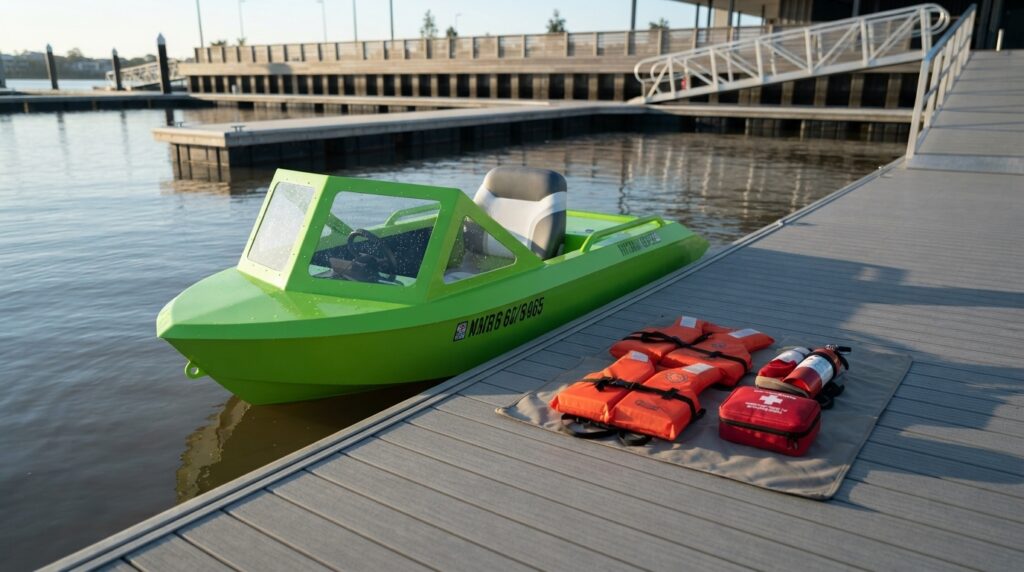
Mini jet boats are creating increasing interest among Australian recreational boaters because they combine compact dimensions, jet propulsion, strong acceleration and highly manoeuvrable performance in a package very different from a conventional runabout.
For prospective buyers, however, performance is only part of the buying decision.
Before purchasing a mini jet boat in Australia, it is important to understand how recreational boating regulations apply. Registration, licensing, safety equipment, speed restrictions and where a vessel may be operated are generally controlled at state or territory level rather than through one single Australian recreational boating system.
There is another particularly important consideration.
A mini jet boat should not automatically be assumed to be legally classified in exactly the same way as a jet ski simply because both use jet propulsion.
A conventional mini jet boat may have a hull, seats, steering wheel and cockpit arrangement resembling a small powerboat. A personal watercraft, or PWC, is defined differently by individual jurisdictions.
The exact classification of a particular craft therefore needs to be established from its design, specifications and the regulations applying in the state or territory where it will be operated.
This guide explains the main matters Australian buyers should investigate before purchasing and operating an electric mini jet boat.
Regulations and fees can change. The information below reflects information available in August 2026 and buyers should confirm requirements with their relevant state or territory maritime authority.
One of the first misconceptions surrounding the emerging mini jet boat category is that anything propelled by a water jet must be a personal watercraft.
That is not necessarily the case.
Jet propulsion describes how a vessel is propelled, rather than automatically determining its regulatory category.
A traditional jet ski generally has an enclosed hull and is controlled by a rider who sits astride, stands or kneels on the craft.
By comparison, many mini jet boats feature:
NSW, for example, defines a PWC as a vessel with a fully enclosed hull that may be driven standing, lying down, sitting astride or kneeling. NSW also specifically includes jet-powered surfboards within its PWC definition.
Western Australia similarly describes a PWC as a craft propelled by an inboard motor driving a water jet pump where the operator sits, stands or kneels and uses handlebars to steer.
These definitions demonstrate why buyers should not make their own classification simply from the words "jet boat".
A seated mini jet boat with a cockpit and steering wheel may be treated differently from a conventional PWC.
The correct approach is to establish the classification of the specific model with the relevant maritime authority.
Australia has national maritime standards in a number of areas, but recreational boating administration is predominantly state and territory based.
This means a mini jet boat owner in Queensland may face different licence requirements from an owner in New South Wales or Western Australia.
The fundamental responsibilities are nevertheless similar throughout Australia.
Depending upon the jurisdiction and the vessel, an owner may need to consider:
This is why regulations should be considered before purchase, rather than after the boat arrives.
Most powered mini jet boats are likely to fall within registration requirements because of their propulsion power.
The thresholds differ between jurisdictions.
Maritime Safety Queensland states that boats fitted with an engine of 3kW or more must be registered when used on the water.
For the 2026â27 period, Queensland recreational vessel registration for a boat up to and including 4.5 metres is listed at $104.05, plus the applicable $26.55 use-component fee.
A typical high-performance mini electric jet boat is therefore well above the propulsion threshold at which Queensland registration becomes relevant.
NSW requires vessel registration when a recreational vessel:
Again, most powered mini jet boats would exceed the 4kW threshold.
Western Australia takes a broad approach.
A recreational vessel that is or can be propelled by mechanical power generally needs to be registered for use in WA navigable waters, subject to specified exemptions. Registration is annual.
As of August 2026, WA lists annual registration for a private pleasure craft under five metres at $170.65, together with the applicable recording fee for initial registration.
These examples illustrate why a buyer should budget for registration as part of normal boat ownership rather than treating the craft as an unregulated water toy.
Generally, buyers should not assume that electric propulsion removes the normal obligations applying to powered boats.
Regulatory thresholds are frequently expressed in kilowatts of propulsion power, rather than whether the engine uses petrol, diesel or electricity.
An electric mini jet boat can therefore be subject to the same registration and operator requirements applying to other powered recreational vessels.
This is increasingly important as electric marine propulsion becomes more powerful.
Earlier generations of electric boats were often relatively low powered.
Modern electric propulsion systems can produce performance approaching or exceeding that of many combustion-powered recreational craft.
From a regulatory perspective, the important questions are more likely to include:
The fact that it is electric is important technologically, environmentally and operationally, but does not make high-performance boating regulations disappear.
Licensing requirements differ significantly around Australia.
Queensland requires a recreational marine driver licence to operate a recreational boat with an engine power greater than 4.5kW.
If a vessel is legally classified as a PWC, the operator also requires the relevant personal watercraft licence.
From 1 July 2026, Maritime Safety Queensland lists the recreational marine driver licence fee at $132.40 and the personal watercraft licence fee at $132.40.
For a mini jet boat classified as a normal recreational boat rather than a PWC, the applicable requirement would need to be determined under the ordinary boat rules.
NSW uses speed as an important licensing threshold.
A general boat driving licence is required when operating a recreational vessel at 10 knots or more, approximately 18.5km/h. Applicants must satisfy practical boating experience requirements and pass the relevant knowledge test.
A separate PWC licence exists. To obtain it, a person must hold a general boat driving licence and satisfy the additional PWC knowledge requirements.
Because many mini jet boats can travel considerably faster than 10 knots, licensing is an important matter for NSW buyers even if their particular vessel is ultimately classified as a boat rather than a PWC.
WA requires a Recreational Skipper's Ticket, or RST, to operate a recreational vessel with a motor exceeding 6 horsepower or 4.5kW.
The RST demonstrates minimum theoretical knowledge and practical powerboat skills.
An operator aged from 14 to under 16 holding an RST is restricted to daylight operation and speeds below eight knots.
Once again, a powerful electric mini jet boat is clearly capable of exceeding the power threshold.
Correct vessel classification affects more than terminology.
It can affect:
This is especially relevant because some waterways have rules specifically targeting PWC operation.
Queensland provides an excellent example.
Maritime Safety Queensland identifies specific marine zones with PWC restrictions. Tallebudgera Creek has a marine-zone prohibition on PWC operation, while sections of the Noosa River also restrict recreational PWC operation and particular high-speed activities.
Whether a specific mini jet boat falls within such a restriction depends upon how the particular vessel is classified under the applicable legislation.
That is why VWC recommends that buyers establish the applicable classification rather than relying on comparisons with another type of craft.
Prospective buyers should also become familiar with the Australian Builders Plate, commonly abbreviated to ABP.
The ABP is an important part of Australia's recreational boating safety framework.
It provides information that can include:
Transport WA explains that the ABP provides information about a recreational vessel's buoyancy performance, maximum engine power and loading capacity.
AMSA describes the ABP as a mandatory safety label fitted to recreational boats built in or imported into Australia, subject to the exclusions within the standard. The current national framework uses Edition 5 of the National Standard for the Australian Builders Plate for Recreational Boats.
The standard has been adopted through recreational boating legislation across Australian states and the Northern Territory.
For buyers, the practical lesson is simple.
Do not concentrate entirely on top speed, battery capacity and acceleration.
Also establish the vessel's documented:
A high-performance small boat must still be treated as a boat.
A Hull Identification Number, or HIN, provides a unique identity for a recreational vessel.
Requirements differ between states, particularly during initial registration, transfer and inspection.
Western Australia, for example, states that a HIN is compulsory for registered vessels and that a vessel cannot be registered or transferred without a valid HIN.
NSW's registration process can also require a HIN or Boat Code certificate.
For an imported mini jet boat, these matters should be investigated during the buying process rather than discovered after delivery.
Compact dimensions do not remove a skipper's responsibility to carry appropriate safety equipment.
The equipment required will depend upon factors including:
Equipment requirements may include items such as appropriate lifejackets, communications equipment, signalling equipment and emergency devices.
The precise list should always be checked against the relevant authority's requirements for the proposed operating area.
Western Australia, for example, states that the type and quantity of safety equipment depends upon the vessel and how far offshore it travels.
Queensland's rules also demonstrate how operating area can affect emergency equipment requirements. Maritime Safety Queensland's current guidance includes specific provisions for lightweight craft regarding EPIRBs and qualifying personal locator beacons.
The sensible approach is to equip the boat for its intended use, not simply to buy the minimum equipment without considering the environment in which it will operate.
Even where the regulations vary according to vessel, waterway and operating conditions, wearing an appropriate lifejacket is one of the most straightforward ways of reducing boating risk.
Mini jet boats are designed for exciting recreational use.
That can involve:
The smaller the craft, the more immediately occupants may be affected by water conditions and abrupt manoeuvres.
Correctly fitted approved lifejackets should therefore be regarded as an essential part of responsible mini jet boat operation.
If a craft is classified as a PWC, additional mandatory wearing requirements may apply.
For example, Western Australia currently requires every person aboard a PWC to wear at least the specified minimum lifejacket standard from launching until retrieval.
One attraction of a mini jet boat is its performance.
But maximum capability and legal operating speed are two different things.
Waterways can contain:
A boat capable of travelling at 50km/h does not have the right to travel at that speed everywhere.
Queensland rules, for example, impose six-knot restrictions within specified distances of people in the water, anchored or moored vessels, jetties, wharves, ramps and pontoons.
The skipper remains responsible for maintaining a safe speed appropriate to visibility, traffic, weather and water conditions even where a higher posted maximum might otherwise apply.
Jet propulsion has an important advantage.
Unlike a conventional propeller projecting beneath the hull, a jet-propelled vessel can potentially operate in shallower water.
That ability is one of the features that can make a mini jet boat particularly interesting for Australian recreational conditions.
However, physical capability should never be confused with legal access.
A shallow river, beach area or inlet may contain:
Responsible ownership means checking the rules applicable to a particular waterway.
It also means using common sense.
The ability to cross shallow water does not justify doing so where there is a risk to swimmers, wildlife, the boat or the marine environment.
One of the attractions of smaller craft is the number of possible launching environments.
Depending upon the boat, location and access arrangements, launching may be possible from conventional boat ramps or suitable shoreline areas.
Beach launching, however, creates additional considerations.
These can include:
Owners should therefore check the rules governing both the water and the land used to reach it.
A spectacular stretch of Australian coastline is not automatically a legal boat-launching site.
Electric mini jet boats can offer an important distinction from petrol-powered craft: substantially different propulsion noise characteristics.
That can make electric boating particularly attractive in recreational environments.
But quieter propulsion does not remove the need for considerate operation.
Excessive speed close to other water users, repeated high-speed manoeuvring in a confined location or creating unnecessary wash can still be intrusive or dangerous.
Responsible electric boating should use the technology's quieter operation as an advantage rather than treating it as permission for careless behaviour.
Australian boating law places considerable responsibility on the person operating or in charge of a vessel.
This principle remains relevant regardless of whether the boat costs $5,000, $50,000 or $500,000.
A skipper needs to consider:
Western Australia's boating guidance explicitly notes that the skipper is responsible for what happens on the boat during the voyage.
Electric propulsion adds another element to voyage planning: energy management.
Owners need to know not merely the advertised maximum operating duration but the realistic range available at the speeds and under the conditions in which the craft is being used.
Running repeatedly at maximum performance will normally consume energy considerably faster than moderate-speed cruising.
That needs to form part of responsible voyage planning.
A person purchasing a mini jet boat for private recreation faces a different regulatory environment from somebody intending to use one commercially.
Commercial operation can include activities such as:
Queensland, for example, states that vessels used in connection with commercial, government or research activities require certification under the national domestic commercial vessel framework.
AMSA administers Australia's national domestic commercial vessel safety system.
Businesses considering mini jet boats for resorts, tourism or hire operations should therefore investigate the commercial rules separately.
Do not assume that recreational registration is sufficient simply because exactly the same model can be privately owned.
Before purchasing an electric mini jet boat, an Australian buyer should be able to answer several straightforward questions.
Do not guess based on appearance or propulsion type.
For most higher-powered mini jet boats, the answer is likely to be yes, but the applicable authority should confirm it.
This depends upon the jurisdiction, vessel classification, power and in some states operating speed.
Check identification, compliance, passenger capacity and loading information.
Ocean use, sheltered bays, rivers, lakes and harbours can involve different rules and different safety-equipment requirements.
Never assume that registration provides unrestricted access to every waterway.
Check the rules for the particular vessel and operating area.
Commercial operation can create substantially different regulatory obligations.
In many circumstances, yes. Registration requirements are set by each jurisdiction and commonly depend upon motor power, vessel type or other criteria. For example, Queensland's registration threshold starts at 3kW, while NSW includes vessels with engines of 4kW or more.
Potentially yes, and for many high-powered models the applicable licensing threshold will be exceeded. Queensland requires a recreational marine driver licence above 4.5kW, NSW requires a general boat driving licence when operating at 10 knots or more, and WA requires an RST above 4.5kW.
Not automatically. Jet propulsion alone does not settle the issue. Regulatory definitions generally consider the vessel's design and operating configuration. Buyers should obtain confirmation for the particular model from their state maritime authority.
Potentially yes, subject to the rules applying to the particular river. Local marine zones, speed restrictions and exclusion areas must be observed.
That depends on the specifications of the particular boat and manufacturer requirements. From a regulatory perspective, operating in coastal or offshore waters can also change the safety equipment required. Owners should follow the manufacturer's cleaning, maintenance and battery procedures after saltwater operation.
Where the particular model has been designed, certified and rated for two occupants, yes, subject to its stated passenger and weight limits. Never exceed the manufacturer's certified capacity.
No. Electric propulsion does not create a general exemption from recreational boating laws.
No. Waterway speed limits, restricted areas and general safe-navigation requirements continue to apply regardless of the boat's top speed.
The regulatory requirements surrounding a mini jet boat should not discourage prospective owners.
Australian recreational boaters already deal with registration, licensing and safety requirements across thousands of conventional boats.
The important point is to treat a modern electric mini jet boat as a serious recreational vessel, rather than as a novelty or toy.
That means knowing:
Once those questions are answered, owners can concentrate on the reason these boats are attracting attention in the first place.
Compact electric mini jet boats offer a very different boating experience: rapid acceleration, manoeuvrability, jet propulsion, compact dimensions and access to recreational environments where owning a much larger conventional boat may make little sense.
For Australians who want excitement on the water without moving into a large trailer boat, the category deserves serious consideration.
The key is to buy the right boat, understand the rules and operate it as responsibly as any other powered recreational vessel.
Vector Water Craft Australia provides a growing range of electric mini jet boats for Australian recreational buyers.
For models, specifications, pricing and further information, visit: