
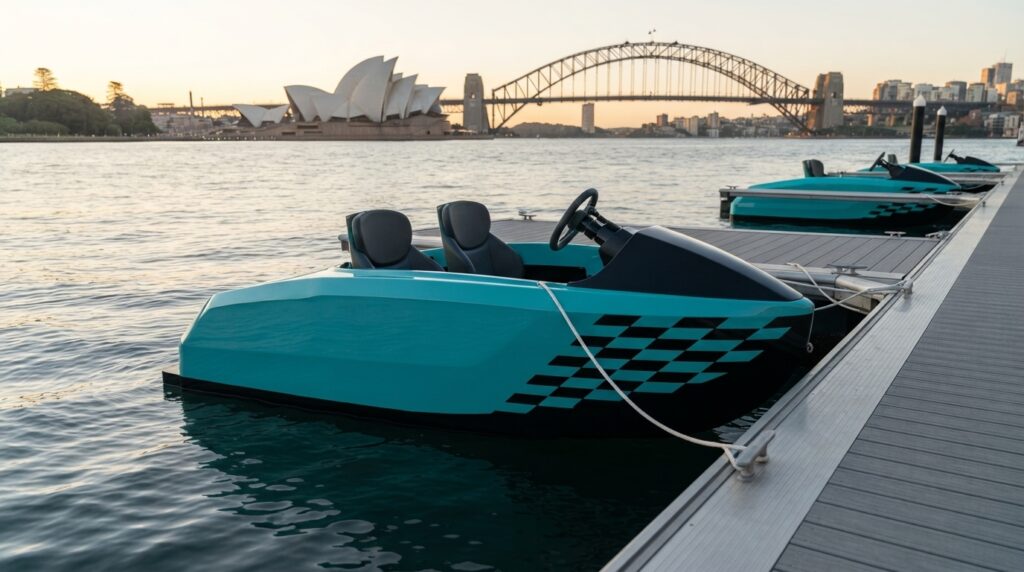
Electric Mini Jet Boats are creating a new category within Australian recreational boating.
They combine:
For Australians considering purchasing one, the challenge is no longer simply understanding what a Mini Jet Boat is.
The more important question is:
Not every Mini Jet Boat is the same.
Differences in:
can significantly affect the ownership experience.
A buyer should therefore look well beyond appearance and top speed.
The best Mini Jet Boat is the one that suits the way the owner will genuinely use it.
Before comparing specifications, decide how the craft will be used.
Possible uses include:
A buyer planning relaxed recreation has different priorities from someone primarily seeking maximum performance.
For this reason, intended use should determine the specification rather than the other way around.
Australian waterways vary dramatically.
Potential operating environments include:
The conditions of the intended waterway matter.
Consider:
A compact Mini Jet Boat may be excellent for one environment but unsuitable for another.
Buyers should always select a craft for the waters they genuinely expect to use.
Hull material is one of the most important differences between Mini Jet Boats.
Common materials include:
Each has different characteristics.
HDPE stands for High-Density Polyethylene.
It is increasingly used in marine applications because of characteristics including:
HDPE can be particularly attractive for owners who want a practical recreational craft capable of handling regular use.
It can also suit buyers who are concerned about minor impacts, beaching or general recreational wear.
Aluminium has a long history in Australian boating.
Advantages can include:
Aluminium Mini Jet Boats can appeal to buyers who prefer a traditional marine construction material.
Fibreglass remains one of the most widely used boat-building materials.
It can provide:
However, owners need to consider how and where the craft will be used because fibreglass may respond differently to impact than HDPE.
More motor power is not automatically better.
The correct motor output depends on:
A properly matched propulsion system is more important than simply selecting the largest motor.
Buyers should consider:
as a complete system.
Maximum speed is one of the most visible specifications in recreational watercraft marketing.
But it is only one element of performance.
A more complete assessment includes:
A Mini Jet Boat with a lower quoted top speed may provide a better overall experience if it has superior handling or a more appropriate hull design.
In an electric Mini Jet Boat, the battery replaces the conventional fuel tank.
Its capacity has a major effect on:
Buyers should understand what the quoted battery specification actually means.
Important questions include:
These questions are more meaningful than simply looking at a battery number in isolation.
Electric watercraft operating duration is rarely a single fixed figure.
It varies according to:
A driver using maximum power continuously will normally obtain less operating time than someone cruising at moderate speed.
Buyers should therefore ask for realistic operating guidance rather than assuming maximum quoted duration applies under all conditions.
Charging convenience is a major part of electric boat ownership.
A buyer should know:
For many recreational owners, overnight charging may be perfectly practical.
For commercial users, resorts or intensive-use operators, charging time can be much more important.
Lithium batteries have a finite service life.
Their lifespan depends on factors including:
A serious buyer should ask:
Battery replacement is part of long-term ownership planning.
Mini Jet Boat weight influences:
Buyers should confirm whether published weight includes:
A hull-only weight can be misleading when making transport decisions.
The real transport weight is the fully prepared craft.
The attraction of Mini Jet Boats often comes from compactness.
But buyers should obtain exact dimensions.
These include:
Those measurements affect:
An additional 200 or 300 millimetres can make a major difference when fitting a craft into a garage or vehicle.
Some Mini Jet Boats are transported by trailer.
Others may offer alternative transport possibilities depending on dimensions and weight.
Transport decisions must consider:
The safest transport method should always take priority over convenience.
Buyers should not assume that because a Mini Jet Boat is compact it can automatically be carried in any ute.
Many Mini Jet Boats are marketed as two-person craft.
However, buyers should look closely at seating design.
Important considerations include:
Some designs seat occupants one behind the other.
Others may use different layouts.
A buyer should choose the arrangement that best matches expected use.
The driving position can have a significant effect on enjoyment.
Consider:
A craft can have excellent performance specifications but still be uncomfortable if the cockpit is poorly suited to the user.
This is particularly important for taller drivers or people planning longer outings.
Jet propulsion provides many benefits.
These can include:
However, jet-powered craft have distinctive handling characteristics.
Operators need to understand:
New owners should take time to become familiar with their particular craft.
Electric propulsion can reduce traditional engine maintenance.
There may be no need for routine management of:
But Mini Jet Boats still require maintenance.
This may include:
Owners should follow manufacturer servicing recommendations.
Australian boating often involves saltwater.
Salt is highly corrosive.
After saltwater operation, owners may need to:
The exact procedure depends on the model.
Buyers intending regular saltwater use should confirm the manufacturer's recommended maintenance routine.
An electric Mini Jet Boat combines:
The warranty should therefore be carefully examined.
Buyers should understand warranty coverage for:
They should also understand exclusions.
A strong warranty is valuable, but access to genuine after-sales support is equally important.
Emerging product categories can create concerns about future parts availability.
Before buying, ask whether the supplier can support:
A low purchase price can become irrelevant if important replacement components are unavailable later.
The supplier should provide more than a sales transaction.
Strong support can include:
This becomes particularly important with electric watercraft because the technology may be unfamiliar to many buyers.
Mini Jet Boat pricing may include different equipment depending on the model and supplier.
Buyers should confirm whether the price includes:
Comparing advertised prices without understanding inclusions can create false comparisons.
Purchase price is only the beginning.
Long-term costs can include:
Electric Mini Jet Boats may reduce some traditional fuel and engine-servicing costs.
But buyers should still calculate the complete ownership picture.
Australian boating laws vary by state and territory.
Requirements may depend on:
Buyers should check current local regulations rather than relying on assumptions.
A compact electric craft is still a powered vessel and must be operated according to applicable laws.
Owners should carry all safety equipment required for:
This may include:
The exact requirements depend on jurisdiction and use.
The ideal Mini Jet Boat for an experienced boater may differ from the ideal craft for a first-time owner.
Factors to consider include:
Beginners may place greater importance on:
while experienced users may prioritise performance.
If the boat will frequently carry a passenger, test the specification against real-world combined weight.
Passenger load can affect:
A specification based on one lightweight operator may not represent two-person use.
Videos can reveal much more than still photography.
Useful videos should demonstrate:
Buyers should prefer genuine videos of the actual model rather than generic promotional imagery.
Actual product photographs can help confirm:
This is especially important when purchasing a relatively unfamiliar recreational product.
Mini Jet Boats can be visually striking.
But styling should never override:
A visually impressive craft that does not fit the buyer's intended use can quickly become an expensive disappointment.
Electric Mini Jet Boats are still an emerging category.
Resale values may develop as the market matures.
Factors likely to influence resale include:
Good maintenance records may become increasingly important.
A strong buying decision considers ownership over several years.
Ask:
These questions help separate short-term excitement from sensible ownership.
Potential owners can include:
Each group may value different characteristics.
This is why one specification cannot suit everyone.
For someone new to powered boating, the best Mini Jet Boat may not be the most powerful.
A practical first craft should provide:
Confidence usually produces more enjoyment than excessive performance.
Experienced recreational watercraft users may instead focus on:
Even then, practicality should not be ignored.
A high-performance craft that is difficult to transport or maintain may not deliver the best overall ownership experience.
When comparing Mini Jet Boats, create a consistent checklist.
Compare:
This prevents marketing claims from dominating the decision.
Local support can be particularly important for specialised watercraft.
An Australian supplier can potentially assist with:
This can reduce the difficulties associated with purchasing directly from an overseas manufacturer.
A buyer can become overly focused on technical specification.
But the most important question remains simple.
The best Mini Jet Boat should be:
If those conditions are met, the craft has a far better chance of becoming a regularly used part of the owner's lifestyle.
Choosing an electric Mini Jet Boat in Australia requires more than comparing speed and price.
Buyers should examine:
Electric Mini Jet Boats offer an exciting combination of performance and practicality.
But their greatest advantage comes when the craft is correctly matched to the owner.
The right Mini Jet Boat should not simply look impressive.
It should make recreational boating:
easier to organise, easier to own and enjoyable enough to use regularly.
For Australians investigating electric Mini Jet Boats, Vector Water Craft Australia provides a developing range of compact recreational craft together with information to help buyers compare models according to their intended use.
Learn more at Vector Water Craft Australia: www.vectorwatercraft.