
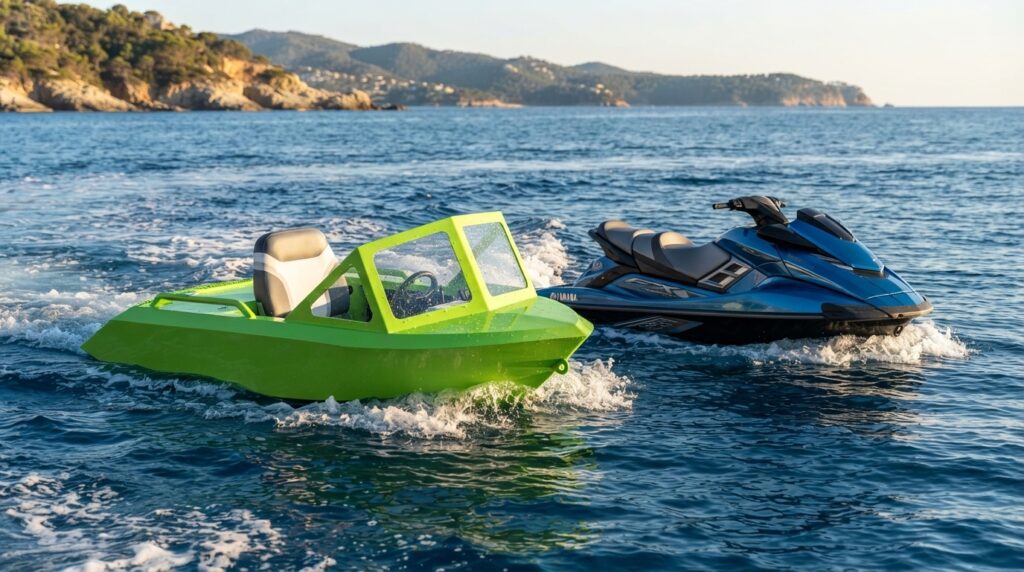
For decades, Australians looking for compact, exciting recreational watercraft have frequently considered personal watercraft such as jet skis.
They offer speed, manoeuvrability and relatively compact dimensions compared with conventional boats.
But a different type of recreational watercraft is beginning to attract attention in Australia.
The Mini Jet Boat.
Modern electric Mini Jet Boats combine many of the characteristics Australians associate with personal watercraft with some of the practical advantages traditionally associated with small boats.
They can provide:
For Australians comparing a jet ski with a compact recreational boat, the decision is therefore no longer necessarily between a jet ski and a conventional trailer boat.
The Mini Jet Boat has created a third alternative.
It occupies a fascinating position between the two.
A Mini Jet Boat is a compact recreational boat using jet propulsion rather than a conventional exposed propeller.
Modern Mini Jet Boats may be manufactured using materials including:
Electric versions replace a conventional petrol engine with:
The result is a compact craft capable of providing an exciting recreational boating experience without necessarily requiring the size, mechanical complexity or storage demands associated with a conventional powerboat.
For Australian buyers, their attraction comes from combining several characteristics within one craft.
They can be:
small enough to be practical, powerful enough to be exciting and boat-like enough to provide a very different experience from riding a jet ski.
Although both types of craft can deliver exciting water recreation, their fundamental design philosophies are different.
A jet ski is essentially a personal watercraft.
The rider generally sits astride the machine, much as a motorcyclist sits on a motorcycle.
A Mini Jet Boat provides a cockpit.
Instead of sitting astride the craft, occupants sit inside it.
That difference significantly changes the experience.
A Mini Jet Boat can feel more like driving a very small performance boat than riding a personal watercraft.
For some Australians, this distinction alone will determine which craft they prefer.
One of the most obvious differences is occupant position.
On most personal watercraft, riders are relatively exposed.
Water, wind and spray are part of the experience.
For many people, this is exactly what makes riding a jet ski enjoyable.
However, others prefer greater protection and a more conventional seating position.
Mini Jet Boats can provide:
This makes the activity feel more like boating and less like riding.
Neither arrangement is inherently better.
They are simply different.
The important development for Australian consumers is that they now have another choice.
Many Mini Jet Boats are designed for two occupants.
Depending upon model configuration, seating can be arranged with occupants seated one behind the other.
This makes Mini Jet Boats particularly interesting for:
A two-person Mini Jet Boat provides an experience where both occupants participate in essentially the same boating adventure.
They can talk, explore waterways together and enjoy the journey as occupants of one small boat.
That is somewhat different from the experience of two people riding on a personal watercraft.
Traditional boating controls remain familiar to generations of Australian boat owners.
A steering wheel creates an intuitive driving environment for people accustomed to:
Mini Jet Boats retain this familiar approach.
For some buyers, especially those who have previously owned boats, this can make the transition to a compact recreational craft more natural.
Sitting within a cockpit with:
creates the psychological and physical experience of operating a boat.
This may broaden the appeal of high-performance compact watercraft beyond traditional personal-watercraft enthusiasts.
Perhaps the most significant development in modern Mini Jet Boats is electric propulsion.
Petrol-powered recreational watercraft have dominated the market for generations.
Electric propulsion changes several aspects of ownership.
There is no conventional petrol engine requiring the same combination of:
Electric systems generally contain fewer moving mechanical components.
This can make routine ownership considerably simpler.
That does not mean electric boats require no maintenance.
Owners still need to correctly care for:
But the nature of maintenance is different from maintaining a conventional internal-combustion engine.
Noise is one of the most noticeable differences.
Traditional high-performance watercraft produce a distinct engine sound.
Some enthusiasts enjoy this.
Others increasingly value quieter recreation.
Electric Mini Jet Boats can allow occupants to experience:
without continuous petrol-engine noise.
For Australians exploring:
this quieter character can be particularly appealing.
Rather than engine noise dominating the outing, occupants can hear more of the surrounding environment.
It creates a different form of performance boating.
Electric propulsion also removes the need to carry petrol for normal operation.
This means owners are not routinely dealing with:
Instead, ownership revolves around battery charging.
For suitable users, plugging in after use can be considerably more convenient than visiting a service station or marina fuel facility.
The trade-off is that battery charge needs to be planned.
Electric boating therefore requires a different mindset.
Instead of monitoring a fuel tank and refilling it quickly, the owner needs to consider:
For recreational owners who generally know when they are going boating, this can be straightforward.
Electric Mini Jet Boats also change the cost structure of recreational boating.
There remains an electricity cost associated with charging.
Batteries ultimately have a finite service life.
Components still require inspection and maintenance.
However, owners avoid regular petrol purchases for propulsion.
Over years of recreational ownership, the difference can become meaningful, particularly for people who use their craft frequently.
Consumers should compare whole-of-life ownership costs rather than simply comparing purchase prices.
Important considerations include:
A properly considered buying decision should account for all of these factors.
Another practical difference is the ability of a boat-format craft to provide storage areas.
Depending on the Mini Jet Boat design, occupants may have capacity for items such as:
The amount of storage varies considerably between models, so buyers should examine the actual design rather than assuming every Mini Jet Boat provides the same facilities.
Nevertheless, the boat format creates possibilities that differ from the minimalist design of many personal watercraft.
For recreational touring and exploring, this can be valuable.
Buying recreational watercraft solely according to top speed can be misleading.
The enjoyment of a craft depends upon a broader combination of factors.
These include:
A Mini Jet Boat can deliver an exciting experience even where outright speed is not the sole objective.
The feeling of sitting low within a compact cockpit, accelerating across the water and executing responsive turns creates its own performance character.
For many recreational buyers, this experience matters considerably more than a specification-sheet speed comparison.
Mini Jet Boats use jet propulsion rather than a conventional exposed propeller.
Water is drawn into the propulsion system and expelled through a jet nozzle to create thrust.
Directional control is achieved by directing this water flow.
The system can provide highly responsive manoeuvrability.
This suits the compact character of Mini Jet Boats.
It allows them to provide a lively recreational driving experience within a very small boating platform.
As with all watercraft, operators need to understand the handling characteristics of the particular craft they purchase.
Jet-propelled craft do not necessarily behave exactly like propeller-driven boats.
Learning the craft properly is an important part of safe ownership.
One of the biggest barriers to traditional boat ownership is not actually buying the boat.
It is managing it.
Owners need somewhere to:
Australian urban properties have changed significantly.
Many households now have:
Compact watercraft respond directly to this problem.
Mini Jet Boats can significantly reduce the physical footprint associated with recreational boating compared with many traditional boats.
This matters because convenience directly influences use.
A boat that is easy to organise is more likely to be used frequently.
Different Mini Jet Boat models require different transport arrangements.
Some remain trailer-based.
Others are sufficiently compact and light that owners may consider alternative transport arrangements using appropriate vehicles and loading equipment.
Transport suitability must always be assessed according to:
Buyers should never assume that every Mini Jet Boat can simply be placed into a ute.
However, compact dimensions create transport possibilities that are unavailable with much larger recreational boats.
This flexibility is a significant attraction of the category.
Large recreational boats can become time-consuming assets.
An owner may have to:
If every outing becomes a major undertaking, recreational use can decline.
Compact Mini Jet Boats can reduce some of this friction.
The simpler it becomes to organise a boating trip, the easier it is to consider:
This has important implications.
The real value of recreational equipment does not come from owning it.
It comes from using it.
The market for Mini Jet Boats is not limited to people choosing between one and a jet ski.
Existing boat owners may also find them attractive as a second recreational craft.
A household could retain a larger boat for:
while using a Mini Jet Boat for:
This illustrates why the Mini Jet Boat category should not necessarily be viewed as replacing traditional boating.
It can complement it.
There is also a group of Australians who enjoy high-performance water recreation but whose preferences change over time.
A person may still want:
but increasingly prefer:
A Mini Jet Boat can potentially provide that progression.
It retains the excitement associated with small jet-propelled watercraft while presenting it through a conventional boating format.
Recreational purchases frequently need to appeal to more than one person in a household.
One partner may love personal watercraft while another is less enthusiastic about riding on one.
A Mini Jet Boat may provide a useful middle ground.
It can offer:
For couples who want to explore waterways together, these characteristics can be particularly important.
It is tempting to describe every new watercraft by comparing it with something already familiar.
Mini Jet Boats are consequently compared with:
But the category is increasingly capable of standing on its own.
An electric Mini Jet Boat combines elements of multiple recreational products without being identical to any of them.
It provides:
the compact dimensions of personal watercraft, the cockpit experience of a boat, the responsiveness of jet propulsion and the simplicity of modern electric power.
That combination is what makes the category interesting.
There is no universal answer.
A buyer who primarily wants the exposed, physical riding experience traditionally associated with personal watercraft may continue to prefer a jet ski.
Someone who wants the excitement of compact jet-powered recreation while sitting within a cockpit may strongly prefer a Mini Jet Boat.
The decision should therefore be based on intended use.
Ask:
These questions reveal far more than simply comparing top speeds.
Australia has an extraordinary variety of recreational waterways.
Depending upon local regulations and conditions, recreational boating takes place across:
Not every craft is appropriate for every waterway.
Weather, water conditions, distance from shore, local restrictions and operator experience all need to be considered.
Mini Jet Boats are particularly interesting for Australians because so much recreational boating occurs relatively close to home.
The objective may not be offshore travel.
It may simply be spending an enjoyable few hours on a local waterway.
For this type of recreation, a compact craft can make considerable sense.
Modern consumers increasingly evaluate recreational products according to convenience.
People have limited leisure time.
They want to spend that time enjoying their activities rather than preparing equipment.
This trend can be seen across:
Mini Jet Boats align strongly with this change.
Their appeal is not simply performance.
It is the combination of performance and practicality.
Marine electrification is still developing.
Future improvements are likely to continue in areas such as:
This is important because electric Mini Jet Boats sit at the intersection of two major trends:
compact recreation and transport electrification.
As battery technology improves, the possibilities available to small electric watercraft are likely to expand further.
The most important question is not whether a Mini Jet Boat is universally better than a jet ski.
It is whether it is better suited to the buyer.
For Australians who want:
a Mini Jet Boat can present a compelling alternative.
Jet skis will continue to appeal strongly to riders who love the traditional personal-watercraft experience.
Mini Jet Boats simply expand the choice.
And that is precisely why they are becoming increasingly interesting in the Australian recreational boating market.
Mini Jet Boats and jet skis share several characteristics.
Both can provide:
But the experience is fundamentally different.
Jet skis are personal watercraft that riders sit on.
Mini Jet Boats are compact boats that occupants sit inside.
Electric Mini Jet Boats add another layer through:
For Australians looking for something more substantial than a personal watercraft but considerably more manageable than a traditional trailer boat, the Mini Jet Boat occupies an increasingly attractive position.
It is not simply a smaller boat.
Nor is it simply an alternative form of jet ski.
It represents a new category of recreational watercraft designed around performance, practicality and modern electric boating.
For buyers exploring the rapidly developing Australian Mini Jet Boat market, Vector Water Craft provides a range of electric Mini Jet Boats designed for Australian recreational boating conditions and lifestyles.
Learn more at Vector Water Craft Australia: www.vectorwatercraft.com