
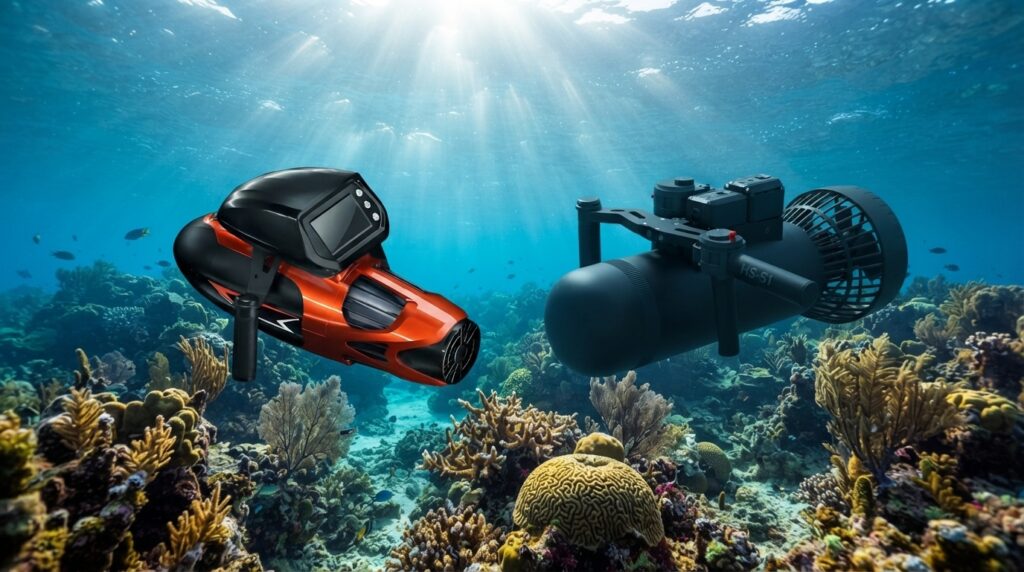
Underwater scooters now cover an extraordinarily wide range of uses.
At one end are compact electric scooters weighing only a few kilograms that can be carried to the beach, taken on a boat and used for recreational swimming, snorkelling and underwater exploration.
At the other end are substantial diver propulsion vehicles designed around larger motors, significantly greater battery capacity and much more demanding underwater applications.
Both are called underwater scooters, but they are very different pieces of equipment.
Vector Water Craft's current Australian range demonstrates the difference particularly clearly. The compact HS-S2 weighs approximately 1.4 kg, reaches a published maximum speed of 1.4 metres per second and has a battery runtime of up to 56 minutes. At the other end of the range, the H9 Sub Jet Pro weighs approximately 35 kg, uses a 3.3 kW motor, carries a 923.52 Wh battery, reaches a published 13 km/h and provides up to 100 minutes runtime.
Clearly, the person buying the HS-S2 and the person buying the H9 may have completely different requirements.
This raises the central question:
The answer depends far more on how you intend to use it than on how much performance you can afford.
A recreational underwater scooter is generally designed to make powered underwater movement accessible, portable and enjoyable.
Typical applications include:
The emphasis tends to be on portability, manageable weight, straightforward controls and enough battery capacity for normal recreational sessions.
Within Vector Water Craft's range, the HS-series models fall broadly into this type of use.
For example, the HS-S2 weighs only 1.4 kg, offers three speed settings, 6.5 kg maximum thrust, a maximum published speed of 1.4 m/s and up to 56 minutes battery life.
A scooter with specifications like these can be taken to the water without the transport and handling requirements associated with a much larger professional propulsion system.
At the higher end of the market are machines more accurately viewed as substantial underwater propulsion platforms or Diver Propulsion Vehicles.
These may be selected by:
Vector's H9 Sub Jet Pro illustrates this end of the category.
The H9 currently weighs 35 kg and uses a 3.3 kW electric motor with a 923.52 Wh lithium battery. Vector publishes a maximum depth of 40 metres, maximum speed of 13 km/h and runtime of up to 100 minutes.
Those specifications make the H9 fundamentally different from a compact recreational scooter.
The buyer is not simply paying for “a faster version” of the same product.
The entire scale of the equipment changes.
The easiest way to decide between recreational and professional equipment is to forget about specifications temporarily and consider what you actually intend to do.
Ask yourself:
If you expect to spend weekends snorkelling from beaches or boats, a compact recreational scooter may provide everything required.
If you have a demanding diving application where thrust, battery capacity and sustained propulsion are major priorities, higher-performance equipment becomes more relevant.
The mistake is buying according to aspiration rather than actual use.
A person can easily look at a 13 km/h professional scooter and think:
“That must be better.”
Technically, it may offer substantially more performance.
Practically, it could be far less convenient for someone who simply wants to put a scooter in the car and go snorkelling.
One of the clearest differences is weight.
The Vector HS-S2 weighs approximately 1.4 kg.
The H9 weighs approximately 35 kg.
That is not a minor difference.
It changes the entire ownership experience.
A recreational scooter can potentially be:
A 35 kg propulsion system requires considerably more thought.
The owner needs to consider:
Neither approach is wrong.
But a buyer should understand that additional capability frequently means sacrificing some portability.
Many buyers compare underwater scooters while sitting at a computer.
Weight can look like a secondary specification.
Once you begin using the equipment, it can become one of the most important.
Imagine a typical Australian beach outing.
You may already be carrying:
Adding a compact scooter can be relatively straightforward.
Adding a large professional propulsion platform is a completely different proposition.
For a recreational buyer, the best scooter may therefore be the one that is used most often—not the one with the greatest specifications.
Performance is the major attraction of professional equipment.
But performance needs to be viewed in context.
The HS-S2 has a published maximum speed of 1.4 m/s, while the H9 reaches a published 13 km/h.
For an experienced diver or specialist user, the higher performance may be valuable.
For someone slowly exploring a reef while snorkelling, it may be completely unnecessary.
The important question becomes:
You are unlikely to spend every underwater session travelling at maximum speed.
Factors including visibility, obstacles, marine life, other swimmers and the type of activity determine what speed is appropriate.
Therefore, controllable usable performance matters more than buying according to the largest possible number.
Professional and higher-performance users should pay particular attention to thrust.
A recreational swimmer creates relatively little drag.
A scuba diver may carry:
Moving that equipment through water requires considerably more propulsion than moving a lightly equipped snorkeller.
This is one reason specialist underwater propulsion equipment exists.
A buyer intending genuine diving use should therefore compare the propulsion requirements of the complete diver-and-equipment package rather than simply looking at the scooter's top speed.
Battery capacity is another area where recreational and professional products can differ dramatically.
The H9 Sub Jet Pro carries a published battery capacity of 923.52 Wh.
Vector's HS-S2, by comparison, is designed as a highly compact scooter and provides up to 56 minutes published battery life while maintaining its 1.4 kg overall weight.
Large battery systems support higher motor demands and longer operating capability, but they also contribute to:
This is why more battery is not automatically better for every purchaser.
A recreational scooter needs enough battery for its intended use.
A professional propulsion vehicle may need much more.
Vector publishes runtime of up to 100 minutes for the H9 Sub Jet Pro.
That is substantial underwater operating capability.
But many recreational users will never require anything close to that amount of continuous propulsion.
A normal recreational session may involve:
In these circumstances, a lighter scooter providing approximately an hour of potential battery operation may be entirely adequate.
A serious diver planning longer-distance underwater travel has a different requirement.
Again, intended use determines value.
The choice is not necessarily between a tiny recreational scooter and the largest product available.
Vector also offers the H9-1 Sub Runner, which sits between the compact HS models and the flagship H9 in capability.
Vector currently publishes three speed gears for the H9-1 reaching up to 2.5 m/s, a maximum depth of 40 metres and runtime of 60 minutes.
This illustrates an important point for buyers.
Underwater scooters are not simply divided into “cheap recreational” and “professional”.
There is a progression of capability.
A more experienced user may need substantially more performance than a recreational snorkeller without requiring the full size and output of the H9.
Depth ratings can be misleading during a buying decision because a larger number naturally looks better.
The HS-S2, despite weighing only around 1.4 kg, carries a published maximum depth specification of 60 metres.
The much larger H9 has a published maximum depth of 40 metres.
That example demonstrates why buyers should not assume every specification rises in a straight line with price, size or professional capability.
Each model is engineered around a different combination of objectives.
More importantly, equipment depth capability must never be confused with the user's diving qualification.
A scooter rated to a particular depth does not make its owner qualified to dive to that depth.
For a normal Australian recreational user, compact underwater scooters offer several practical advantages.
This is perhaps the biggest advantage.
Compact scooters are relatively easy to take to beaches, boats and holiday destinations.
Smaller equipment generally takes less storage space and can be easier to manage between uses.
Vector's compact HS range currently includes models priced from approximately $1,197 through the recreational range, whereas the larger H9 family moves into a substantially different price category.
Current prices should always be checked at the time of purchase because listings can change.
Most recreational users do not require professional propulsion.
A compact machine can still provide a significant change from normal swimming.
One scooter may be useful for:
That versatility can make a compact scooter particularly good value.
The professional end of the market offers a different set of strengths.
Higher-output motors provide performance suited to more demanding applications.
Professional equipment can support substantial stored energy and operating capability.
The H9's published 100-minute runtime demonstrates what becomes possible with a much larger propulsion platform.
Experienced users may need sustained propulsion rather than occasional recreational assistance.
Higher-capability equipment may also be considered by appropriately qualified commercial or professional users where the particular operational requirements justify it.
This distinction is important.
A recreational underwater scooter can still be sophisticated electric equipment.
Vector describes its HS-S1 as a compact electric diver propulsion vehicle, and the HS-S2 includes three speeds, a 60-metre published depth rating and 6.5 kg maximum thrust.
Therefore, “recreational” should not be interpreted as disposable or trivial equipment.
It describes the likely application and level of practicality.
A quality recreational scooter can still incorporate substantial engineering.
Similarly, a professional scooter should not automatically be considered “better” for every buyer.
Consider two purchasers.
Uses a boat several weekends each summer.
Enjoys snorkelling.
Wants something compact.
Usually spends 30–45 minutes in the water.
Needs to lift the scooter in and out of the boat personally.
For this person, a 35 kg professional machine may be less suitable despite offering enormously greater performance.
Is an experienced diver.
Uses propulsion regularly.
Carries substantial diving equipment.
Needs greater battery capacity and sustained underwater capability.
Weight is secondary to performance.
For this buyer, the professional platform may make far more sense.
The correct product is determined by fit, not hierarchy.
Frequency of use should influence how much equipment you buy.
If you expect an underwater scooter to be used:
then portability and ease of ownership deserve priority.
If the equipment will be used:
then paying for greater capability may become easier to justify.
Frequency is one of the simplest ways to determine whether you are genuinely a professional-level buyer or merely attracted to professional specifications.
Think carefully about how the scooter will physically reach the water.
For a compact recreational model, this may mean simply putting it into the car with your other equipment.
For larger high-performance equipment, transport may need more planning.
A 35 kg H9, for example, has published dimensions of approximately 91 × 53 × 32 cm.
That is a substantial item.
Before buying professional equipment, consider:
The answer to those questions can be more important than another few kilometres per hour of performance.
Both recreational and professional scooters require correct battery care.
But the consequences of moving to a large battery system become increasingly important.
The H9 uses a 923.52 Wh lithium battery and 44.4 V system.
That is a substantial battery and should be treated accordingly.
Owners should follow the manufacturer's requirements for:
Never improvise with chargers or battery systems.
Electric watercraft performance depends heavily on the quality and condition of its battery system.
Whether you buy recreational or professional equipment, saltwater demands good maintenance.
A small scooter is not exempt simply because it costs less.
Likewise, a professional unit should not be assumed to be maintenance-free because it is more expensive.
After use, follow the manufacturer's procedures for:
Regular maintenance protects performance and helps preserve the equipment over time.
Greater performance requires greater judgement.
A compact recreational scooter can still move a swimmer faster than normal swimming.
A professional propulsion vehicle can create a much more substantial change in travel speed and distance.
Higher performance can mean:
Therefore, buying professional equipment should be accompanied by professional-level thinking about its operation.
Underwater scooters contain motors, batteries, electronics, controllers, waterproof housings and propulsion systems.
That makes after-sales support particularly important.
Vector's current warranty information states that its underwater scooters fall within its 12-month comprehensive warranty category, including specified manufacturing, electrical and propulsion-system faults subject to the warranty conditions and exclusions.
Buyers should always check the warranty applying at the time of purchase.
Australian support becomes even more important as the value and complexity of the equipment increase.
If you are investing in a substantial professional underwater propulsion system, you should know who stands behind it.
For most snorkellers, start with the recreational range.
Prioritise:
Extreme professional performance is unlikely to be necessary for ordinary reef or coastal exploration.
This requires more careful consideration.
Some recreational divers may find a compact scooter perfectly adequate.
Others may want greater thrust, speed or battery capacity.
Consider:
This is where the middle ground represented by equipment such as the H9-1 can become relevant. Its published three-speed system, 2.5 m/s maximum speed, 40-metre depth rating and 60-minute runtime provide considerably different capability from the smallest recreational scooters.
If underwater propulsion is an integral part of the activity rather than simply an enjoyable addition, the higher-performance range deserves consideration.
The H9 Sub Jet Pro provides the clearest example within Vector's current range, with its 3.3 kW motor, 923.52 Wh battery, 13 km/h published maximum speed, 40-metre depth rating and 100-minute runtime.
These buyers should place particular emphasis on:
Price inevitably influences the decision.
Vector's compact models currently sit around the low-thousands price level, including the HS-S3 at $1,197, HS-S1 at $1,628 and HS-S4 at $1,725 on current listings. The H9 is currently listed at $15,895.
Current prices should always be checked before ordering.
The price difference reflects the fact that these are fundamentally different types of equipment.
A recreational purchaser should not feel that buying the H9 means getting “ten times the scooter”.
It means buying equipment designed around a different level of use.
Ask these before purchasing.
Snorkelling generally points towards compact recreational equipment.
Frequent intensive use can justify higher investment.
Most recreational users do not require extreme performance.
Divers carrying substantial equipment need more than lightly equipped swimmers.
Compare realistic use with published runtime.
A few kilograms and 35 kg provide entirely different ownership experiences.
Portability becomes increasingly important for holidays and boating.
Buy capability appropriate to genuine use.
This may be the single best distinction between recreational and serious professional applications.
Warranty, parts and technical assistance matter with specialist electric equipment.
Specifications have value only when they serve a genuine purpose.
A professional application should not be compromised purely to reduce purchase price.
The largest performance jump may bring a substantial weight increase.
Battery, runtime, thrust, controls and portability also matter.
Vector's compact HS-S2 has a published 60-metre depth rating, demonstrating that product specifications do not progress in a simple price hierarchy.
More sophisticated equipment makes access to specialist assistance increasingly worthwhile.
For ordinary Australian recreational use, begin by examining the compact range.
There is a strong argument for buying the smallest and simplest scooter that comfortably provides the performance you require.
That can mean:
If your requirements subsequently point towards higher thrust, greater battery capacity and more serious diving capability, then move upward through the range deliberately.
Do not begin at the top simply because it exists.
Professional-level equipment makes sense when you can clearly explain why you require it.
Good reasons might include:
“I like the specification” is not the same as “I need the capability.”
The stronger the reason, the easier it becomes to justify the cost, weight and complexity.
The distinction ultimately comes down to one word:
Purpose.
Choose a recreational underwater scooter when your priorities are:
Move towards a professional or high-performance underwater scooter when your priorities include:
Neither type is automatically better.
A 1.4 kg scooter can be the perfect piece of equipment for one Australian buyer.
A 35 kg, 3.3 kW professional propulsion platform can be exactly the right purchase for another.
The best buying decision is the one where the equipment closely matches how it will actually be used.
The difference between recreational and professional underwater propulsion equipment is large enough that it makes sense to discuss your requirements before purchasing.
Tell Vector Water Craft:
Vector Water Craft's present underwater range extends from lightweight HS-series scooters through the intermediate H9-1 to the 3.3 kW H9 professional platform, giving buyers several different levels of capability rather than one solution for every user.
Contact Vector Water Craft and let us help identify the underwater scooter that matches what you will actually do in the water—not simply the largest specification sheet.
Recreational scooters generally prioritise compact size, low weight, portability and convenient everyday use. Professional or higher-performance machines place greater emphasis on propulsion capability, battery capacity, runtime and demanding diving applications.
For most recreational snorkelling, no. A compact scooter with appropriate performance, runtime and controls is generally a more practical starting point.
Vector's HS-S2 is currently listed at approximately 1.4 kg, with three speed settings and up to 56 minutes battery life.
Vector's H9 Sub Jet Pro weighs approximately 35 kg, illustrating how substantially the equipment can grow when moving into the high-performance end of the category.
Vector currently publishes a maximum speed of 13 km/h for the H9 Sub Jet Pro.
The H9 has a published maximum runtime of 100 minutes under its stated specifications. Actual operating duration can depend on how the equipment is used.
No. The correct scooter depends on intended use. A lightweight recreational model may be far more practical for a snorkeller, while a high-performance model may be justified for a serious diver.
Yes. Vector's H9-1 Sub Runner provides an intermediate level, with three speed settings reaching up to 2.5 m/s, a 40-metre published depth rating and up to 60 minutes runtime.
Vector's current warranty information lists underwater scooters within its 12-month comprehensive warranty category, subject to the published terms, conditions and exclusions.
Start with your intended activity. Recreational users should generally prioritise portability and convenient usable performance. Serious or professional users should place greater weight on propulsion, battery capacity, runtime and operational requirements.