
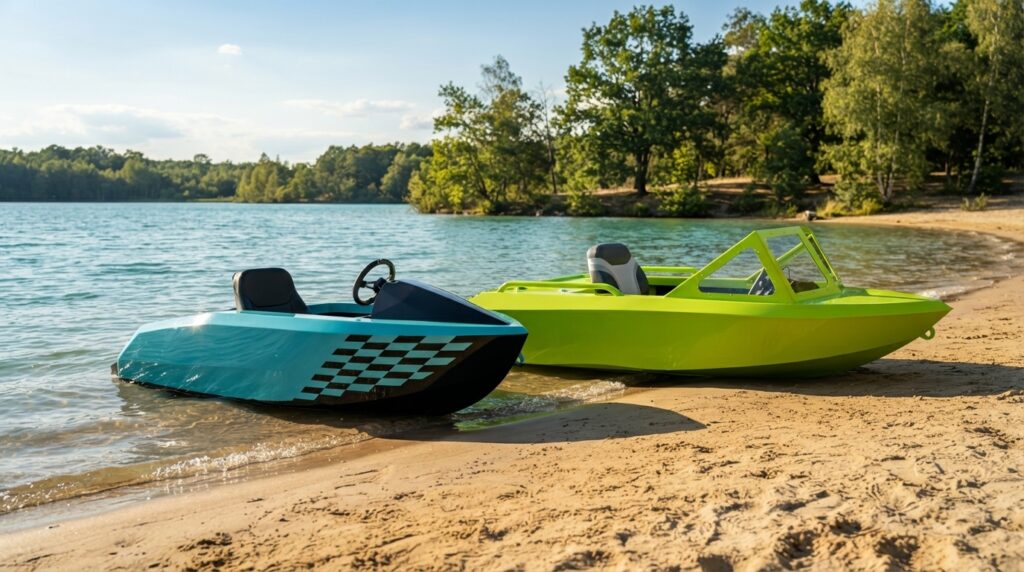
One of the first decisions any prospective mini jet boat buyer faces has nothing to do with power, range or hull material — it's whether to choose a single-seat or two-seat configuration. It seems like a simple question, but it shapes almost every other aspect of ownership, from how the boat performs and feels on the water, to how it's transported, stored and used day-to-day. This article works through the practical differences between single- and two-seater electric mini jet boats, so you can weigh the decision against how you actually intend to use the boat rather than against a generic recommendation.
At first glance, the difference between the two configurations might seem to come down to little more than an extra seat. In practice, a genuine two-seat mini jet boat is a meaningfully different design exercise, not simply a single-seater with an additional cushion bolted on.
Adding a second seated position changes the hull's weight distribution requirements, since the boat needs to remain stable and predictable whether it's carrying one person or two, and whether that second person is seated forward, alongside, or behind the primary operator depending on the specific layout. It also has direct consequences for range and acceleration, because carrying an additional passenger meaningfully increases the boat's overall weight — often by 60 to 100+ kilograms depending on the passenger — which the motor and battery system need to work against.
Cockpit dimensions typically grow as well, not just in length but sometimes in width, to accommodate two people without either rider feeling cramped or without the passenger interfering with the operator's control reach. All of this means a two-seater is generally a larger, heavier boat overall, even before a second person actually climbs aboard.
A single-seater, carrying only the operator's weight, will generally accelerate more briskly and reach a higher effective top speed for a given motor output than the same power system fitted to a two-seat hull carrying a passenger. This isn't a flaw in two-seat designs — it's simply a consequence of physics, since more weight requires more energy to accelerate and to maintain at a given speed.
Manufacturers who offer both configurations from the same platform will often specify a higher-output motor for the two-seat version, precisely to help close this performance gap when the boat is carrying two people. It's worth checking, when comparing models, whether quoted performance figures assume a single rider or account for a typical two-up load — the difference can be substantial, and a two-seater's "with passenger" performance is the number that actually matters for how the boat will be used most of the time.
Carrying a passenger reduces range for the same reason it reduces acceleration — more weight requires more energy per kilometre travelled. The size of this effect varies depending on the boat's power-to-weight ratio and riding style, but a meaningful reduction in effective range when riding two-up compared with solo is a normal and expected characteristic of any mini jet boat, not a sign of a fault. Buyers planning to use a two-seater primarily with a passenger aboard should weigh advertised range figures with this in mind, ideally seeking out real-world range figures for two-up use specifically, rather than relying solely on single-rider range claims.
Two-seat configurations generally offer greater stability at rest and at low speed, simply because the wider or longer hull typically required to accommodate two riders tends to increase the boat's overall footprint on the water. At speed, the picture is more mixed — a well-designed two-seater can feel just as agile and responsive as a single-seater, while a poorly balanced one can feel comparatively sluggish or less eager to turn, particularly when carrying a passenger whose weight isn't well distributed relative to the hull's design centre of balance.
A two-seat mini jet boat is, in almost every case, physically larger and heavier than a single-seat model from the same range — longer, often wider, and with a higher unladen weight due to the larger hull, larger battery (fitted by many manufacturers to help offset the range and performance impact of extra weight), and additional structural components needed to support two riders safely.
This has direct, practical consequences. A two-seater may require a larger trailer or a higher-capacity tow vehicle, may not fit in a garage or storage space sized around a single-seat model's dimensions, and may sit closer to — or even at — the payload limits of some utes or trays once the boat's own weight, plus a cradle or transport frame, is accounted for. These are genuinely important considerations for buyers with limited storage space or a smaller tow vehicle, and worth checking carefully against a two-seat model's actual specifications before assuming it will be a simple drop-in replacement for a single-seat boat.
For many buyers, the real deciding factor isn't performance at all — it's simply how the boat will be used most weekends. A rider who almost always heads out solo, whether for fitness, quiet exploration or simply personal downtime, is likely to find a single-seater a more efficient, better-performing match for that use case, without paying a performance or storage penalty for passenger capacity that goes largely unused.
Conversely, a buyer who wants to regularly share the experience with a partner, older child, or friend will generally find a two-seater far more practical than repeated solo trips or awkward attempts to double up on a single-seat hull not designed for it. It's worth being honest about how the boat will actually be used most of the time, rather than choosing based on an occasional best-case scenario — a two-seater bought primarily for the rare occasion a second person tags along may spend most of its life carrying the performance and storage penalties of two-seat capacity without the benefit.
Single-seater buyers are typically riders who prioritise performance, want the most efficient use of a given battery and motor package, have more limited storage or towing capacity, or use the boat primarily as a solo activity — for fitness, relaxation, fishing access, or simply enjoying time on the water alone.
Two-seater buyers are typically couples, families with older children, or anyone who sees the boat as a shared activity first and foremost. They're often willing to accept a moderate performance and range trade-off in exchange for the ability to bring someone along, and they typically have, or are prepared to arrange, storage and transport suited to a larger hull.
There's also a middle group worth mentioning: buyers who occasionally want to bring a passenger but don't want to fully commit to a two-seat platform's size and weight trade-offs. For this group, it's worth checking whether a given single-seat model has any rated passenger capacity for short, low-speed trips — some do, within limits — rather than assuming the choice is strictly binary.
There's no universally "better" choice between a single-seat and two-seat mini jet boat — the right configuration depends entirely on how the boat will actually be used. A single-seater delivers better solo performance, easier storage and transport, and a more efficient use of a given battery and motor package. A two-seater trades some of that efficiency for the ability to genuinely share the experience with another person, at the cost of a larger footprint, heavier transport requirements, and a real, expected reduction in performance and range when carrying a passenger.
Being clear-eyed about actual usage patterns — rather than buying for an occasional best case — is the single most useful thing a prospective buyer can do before deciding between the two configurations.
Vector Watercraft supplies fully assembled electric mini jet boats to the Australian market across both single- and two-seat configurations, engineered so that each platform delivers genuine, well-balanced performance for its intended use rather than compromising one configuration to accommodate the other. Backed by a 2-year warranty and dedicated after-sales support, Vector Watercraft helps Australian buyers choose the configuration that genuinely matches how they plan to spend their time on the water.