
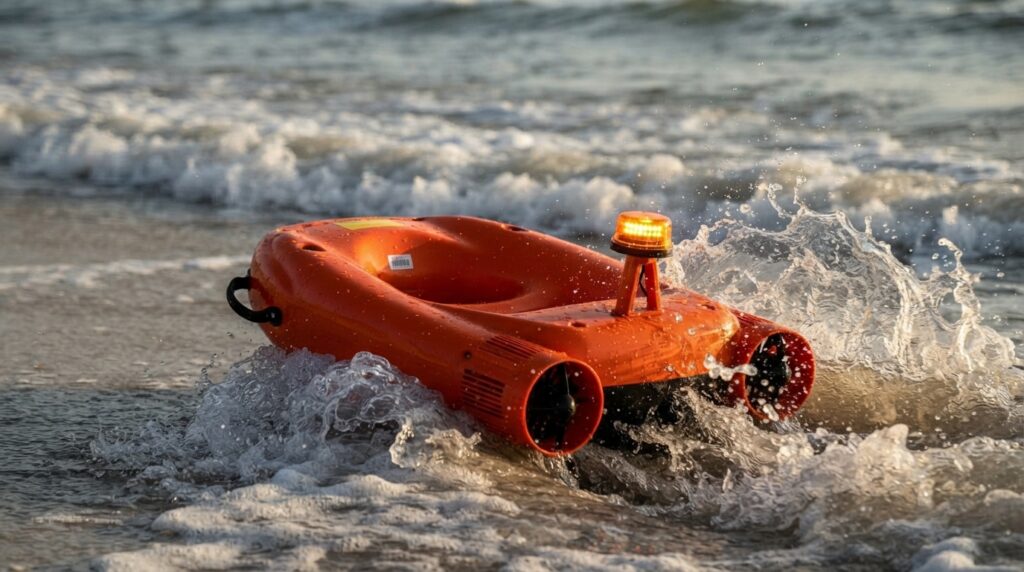
Emergency services and volunteer rescue organisations operating on Australia's waterways face a genuine, recurring challenge: many incidents occur in exactly the kind of shallow, narrow, or congested waterways that larger rescue vessels struggle to access quickly and safely. Compact electric mini jet boats are increasingly being recognised as a genuinely useful complementary tool within a broader rescue fleet, suited to a specific but important category of incidents that larger vessels aren't well positioned to respond to efficiently.
Conventional rescue and emergency response vessels are generally sized and equipped for open-water capability, carrying the equipment, crew and stability needed for more demanding conditions and more serious incidents. This appropriately prioritised capability comes with a genuine trade-off: these vessels are often poorly suited to quickly accessing shallow water, narrow channels, or the kind of confined residential canal and river environments discussed throughout this series, where a significant proportion of minor incidents — a capsized kayak, a swimmer in difficulty close to shore, a stranded paddleboarder — actually occur.
As discussed in the article on why some mini jet boats plane more quickly than others, a well-matched, lightweight hull can achieve a fast, efficient response time for nearby incidents, while the shallow-water access discussed in the fishing suitability article allows genuinely close approach to incidents occurring in water too shallow for larger vessels to safely enter. For the specific category of near-shore, shallow-water incidents that represent a meaningful proportion of recreational waterway emergencies, this combination of quick response and shallow-water access offers genuine operational value.
The tight turning radius and responsive handling discussed in the article on hull length and turning support precise positioning during an active rescue — approaching a person in the water from a controlled angle, manoeuvring within a confined space among moored vessels or structures, or navigating a narrow waterway to reach an incident location that a larger vessel would need to approach more cautiously or from a greater distance.
As discussed in the article on man-overboard procedures, jet propulsion's lack of an exposed, spinning propeller offers a genuine safety advantage specifically relevant to rescue operations, where a vessel may need to approach very close to a person in the water. This reduces one significant source of risk during exactly the kind of close-approach manoeuvring that rescue operations frequently require.
Compact electric watercraft are best understood as a complementary tool within a broader emergency response capability, rather than a replacement for larger, more capable rescue vessels:
Organisations considering incorporating this category of watercraft into their response capability should think through:
Beyond formal emergency services, volunteer marine rescue organisations and community-based water safety groups operating in sheltered river, canal and estuary environments may find this category of watercraft a genuinely accessible, lower-cost addition to their response capability, particularly relevant for smaller volunteer organisations without the budget for additional larger vessels, but who regularly encounter the kind of near-shore, shallow-water incidents this category of craft is genuinely well suited to addressing.
It's worth being clear that compact electric mini jet boats are not a substitute for larger, more capable rescue vessels where genuine open-water capability, greater equipment capacity, or more serious incident response is required. Their genuine value lies in complementing existing capability for a specific, meaningful category of incidents — near-shore, shallow-water, and confined-waterway situations — where their particular characteristics offer real, practical advantages that larger vessels can't easily replicate.
Compact electric mini jet boats offer emergency services, volunteer marine rescue organisations and community water safety groups a genuinely useful complementary capability for near-shore and shallow-water incident response, drawing on the same core characteristics — rapid response, shallow-water access, tight manoeuvrability, and reduced risk during close approach — discussed throughout this series in recreational and commercial contexts. For organisations regularly encountering this specific category of waterway incident, thoughtfully incorporating this category of watercraft into a broader response fleet represents a genuine, practical opportunity to improve response capability for exactly the kind of incidents that larger vessels are least well equipped to address quickly and safely.