
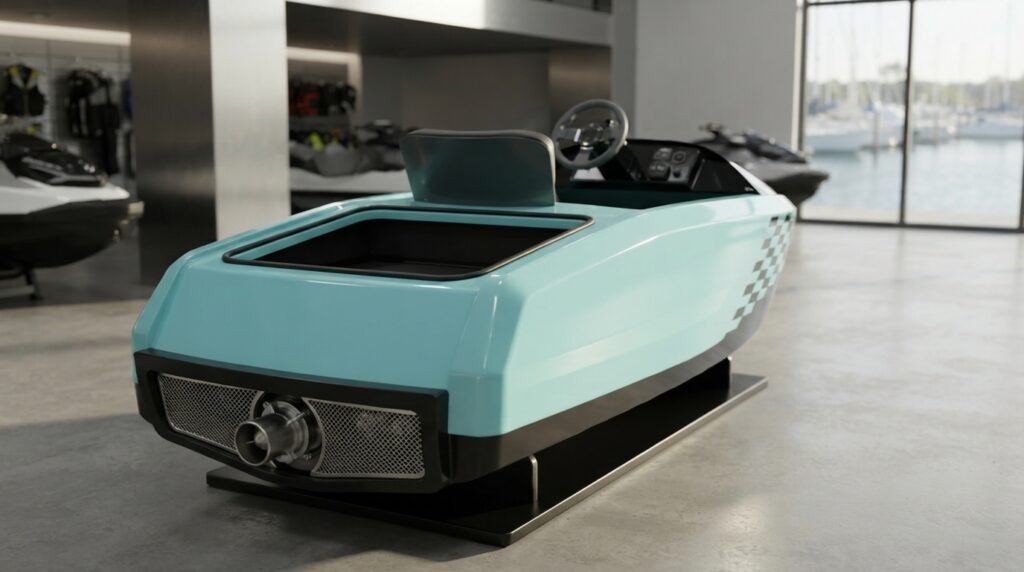
Buying an electric mini jet boat is a significant decision. The boat may be compact, but the purchase involves far more than choosing a colour, comparing top-speed claims and arranging delivery.
An electric mini jet boat combines:
- A specialised hull
- Electric propulsion
- A jet-pump system
- A high-value lithium battery
- A motor controller
- Charging equipment
- Marine electrical connections
- Steering and safety systems
- Transport and storage requirements
- Registration, licensing and insurance considerations
A buyer who concentrates only on advertised performance may overlook important questions about capacity, battery replacement, charging, compliance, warranty, freight and long-term support.
The safest approach is to use a structured checklist before paying a substantial deposit or signing a final purchase agreement.
This guide provides a complete Australian pre-purchase checklist covering:
- Intended use
- Boat selection
- Capacity and performance
- Battery and charging
- Hull construction
- Safety systems
- Australian documentation
- Registration and licensing
- Transport
- Warranty
- Insurance
- Delivery
- After-sales support
The objective is not to make the purchasing process unnecessarily complicated. It is to ensure that the buyer understands exactly what is being ordered, what it can do and what will be required to own it responsibly.
Define the intended use before comparing boats
The first step is to describe how the boat will normally be used.
Write down:
- Solo or two-person use
- Typical operator weight
- Likely passenger weight
- Preferred waterways
- Desired speed and acceleration
- Expected outing duration
- Launching method
- Transport arrangement
- Storage location
- Recreational or commercial purpose
This should be based on likely day-to-day use rather than occasional possibilities.
A buyer who will almost always operate alone may value compact dimensions and easier transport more than passenger capacity.
A buyer who regularly wants to carry a partner or adult passenger should examine genuine two-seater models rather than selecting a single-seater and attempting to create additional seating later.
The intended operating area also matters. Calm lakes, sheltered rivers, tidal estuaries and protected coastal waters present different demands involving:
- Wind
- Current
- Wake
- Saltwater exposure
- Floating debris
- Shallow water
- Distance from shore
- Rescue access
A small boat with adequate performance on a calm lake may not be suitable for more exposed water.
Confirm that the boat suits the occupants
Before discussing speed, establish whether the boat can carry its normal occupants safely and comfortably.
Ask for:
- Maximum number of persons
- Maximum person weight
- Maximum total load
- Cockpit dimensions
- Seat width
- Legroom
- Recommended operator height
- Passenger seating arrangement
- Passenger handholds
- Reboarding method
The total load includes more than body weight. It can include:
- Lifejackets
- Clothing
- Safety equipment
- Drinking water
- Mobile phones
- Dry bags
- Mooring equipment
- Small tools
- Other permitted items
Passengers are part of the vessel’s load, and both the amount and distribution of load can affect stability, particularly in smaller boats. Overloading can reduce stability and freeboard.
Do not choose a boat that only narrowly accommodates the expected load. A practical margin can support better acceleration, handling, freeboard and battery performance.
Check whether the seating configuration is genuine
A single-seater should be designed and documented for one person.
A two-seater should provide:
- Two approved seating positions
- Adequate structural support
- Suitable buoyancy
- Secure passenger handholds
- Foot support
- Appropriate weight distribution
- A documented two-person capacity
A cushion placed behind the operator does not automatically turn a single-seater into a safe two-seater.
Ask the supplier to show where the passenger is intended to sit and how that person should remain secure during acceleration and turning.
For tandem seating, confirm how front-to-rear weight should be distributed.
For side-by-side seating, ask how the boat behaves when the occupants have significantly different body weights.
Verify the exact model specification
Request a written specification for the boat being purchased.
It should identify:
- Manufacturer
- Brand
- Model
- Model year or production version
- Hull material
- Hull length
- Hull width
- Hull height
- Dry weight
- Battery weight
- Ready-to-operate weight
- Seating capacity
- Maximum load
- Motor rating
- Battery voltage
- Battery capacity
- Charger type
- Claimed maximum speed
- Claimed runtime
- Included accessories
- Warranty periods
Do not rely on a general website page if several versions of the same boat are available.
A model may be offered with different:
- Motors
- Batteries
- Controllers
- Displays
- Chargers
- Seats
- Hull finishes
- Steering systems
The quotation and invoice should identify the actual configuration being supplied.
Establish whether motor power is continuous or peak
An advertised motor rating may refer to continuous power, peak power or controller output.
Ask:
- Is the figure continuous or peak?
- How long can peak power be maintained?
- What is the normal sustained output?
- Does the controller reduce power when hot?
- Does power reduce at a low state of charge?
- Is the hull approved for the installed motor?
A headline figure such as 25kW or 70kW does not by itself establish the boat’s speed, runtime or suitability.
Performance also depends on:
- Complete weight
- Hull efficiency
- Jet-pump design
- Impeller
- Battery discharge capability
- Controller programming
- Cooling
- Water conditions
- Occupant load
Do not accept a power upgrade unless the hull, electrical system, jet drive and documentation are designed for it.
Demand realistic performance information
Maximum-speed claims should be supported by meaningful test conditions.
Ask the seller to state:
- Operator weight
- Passenger load
- Battery state of charge
- Water conditions
- Wind conditions
- Test direction
- Battery condition
- Whether the figure was measured or estimated
- Whether the speed was sustained or momentary
A speed obtained with one lightweight test operator on calm water and a fully charged new battery may not represent the experience of a heavier owner carrying a passenger.
Ask what speed can reasonably be expected with your actual load.
Also ask about acceleration, not only maximum speed. For many owners, the ability to plane efficiently and respond under load is more important than the final few kilometres per hour.
Examine runtime claims carefully
A statement such as “up to two hours” is incomplete unless the operating conditions are explained.
Runtime can change with:
- Speed
- Throttle use
- Operator weight
- Passenger weight
- Wind
- Current
- Water conditions
- Battery temperature
- Battery age
- Hull condition
- Intake condition
Ask for estimated runtime at:
- Low-speed cruising
- Moderate recreational speed
- Mixed operation
- Repeated high-power use
- Maximum power
Also ask how much battery reserve remained at the end of the test.
A responsible owner should not plan an outing that depends on using the final portion of charge to return.
Confirm battery capacity in usable terms
Battery information should include:
- Nominal voltage
- Amp-hour capacity
- Total kilowatt-hour capacity
- Usable capacity
- Maximum continuous discharge
- Peak discharge
- Battery chemistry
- Battery-management system
- Battery weight
- Expected cycle life
- Operating-temperature range
Total capacity and usable capacity are not necessarily the same.
Part of the battery may be reserved by the management system to reduce the risk of overcharging or excessive discharge.
Ask whether the displayed charge percentage represents:
- Total stored energy
- Usable energy
- An estimate based on voltage
- A calculation by the battery-management system
The supplier should be able to explain the low-charge behaviour of the boat.
Investigate battery replacement before buying
The battery may be one of the most expensive replacement components.
Ask:
- What is the current replacement price?
- Is the replacement stocked in Australia?
- How long does delivery normally take?
- Can individual modules be replaced?
- Must the entire battery be replaced?
- Is programming required?
- Can an independent qualified technician service it?
- What happens if the original manufacturer stops producing it?
- Is dangerous-goods freight required?
- Who pays freight for warranty assessment?
A low initial boat price can become less attractive if the battery is proprietary, unavailable or extremely expensive to replace.
Ask the supplier to provide replacement support information in writing.
Review the battery warranty carefully
Battery warranties may contain separate conditions from the general boat warranty.
Check:
- Warranty duration
- Cycle limit
- Capacity-retention threshold
- Commercial-use exclusions
- Temperature exclusions
- Storage requirements
- Charging requirements
- Approved charger requirement
- Water-ingress exclusions
- Impact exclusions
- Freight responsibility
- Assessment process
A warranty may cover complete failure but not ordinary gradual capacity reduction.
Ask how battery health is measured and who determines whether capacity loss qualifies for a claim.
Australian consumer guarantees are automatic and separate from voluntary warranties. A warranty cannot remove those underlying rights, although the precise remedy in an individual case depends on the circumstances.
Confirm the charger is suitable for Australian use
The supplied charger should match the battery and be suitable for the intended Australian power supply.
Check:
- Input voltage
- Input frequency
- Maximum input current
- Output voltage
- Output current
- Plug type
- Cable length
- Ventilation requirements
- Indoor or outdoor rating
- Water protection
- Certification markings
- Charging time
Do not assume that a charger supplied with an imported boat is automatically appropriate.
Ask whether charging requires:
- A standard power outlet
- A dedicated circuit
- A higher-current outlet
- A licensed electrical installation
- Specific ventilation
- Removal of the battery
- Opening of compartments
In Queensland, mains-voltage electrical work on regulated ships must be performed by appropriately licensed electrical workers.
Owners should not modify plugs, chargers or wiring themselves.
Check the charging sequence
Ask for a written charging procedure covering:
- Correct connection order
- Correct disconnection order
- Whether the boat must be switched off
- Whether the battery can remain installed
- Acceptable charging temperature
- Required ventilation
- Indicator-light meanings
- Expected charging time
- What to do if charging stops
- Long-term storage charging
Ask whether the charger stops automatically and whether cell balancing occurs during charging.
Clarify whether the battery should be allowed to cool after operation before charging begins.
Examine the battery installation
The battery should be held securely and protected from:
- Movement
- Impact
- Water
- Abrasion
- Accidental short circuit
- Passenger interference
Ask to see:
- Battery tray
- Restraints
- Locking system
- Connectors
- Protective caps
- Drainage
- Ventilation
- High-voltage warnings
If the battery is removable, ask the supplier to demonstrate removal.
Confirm:
- Battery weight
- Number of people required
- Approved lifting points
- Storage orientation
- Suitable trolley or lifting equipment
A technically removable battery may still be too heavy for safe manual handling by one person.
Evaluate hull construction
Electric mini jet boats may be made from:
- Fibreglass
- Aluminium
- High-density polyethylene
Each material can be suitable when properly designed and manufactured.
Ask about:
- Hull thickness
- Reinforcement
- Internal structure
- Buoyancy
- Manufacturing method
- Repair method
- Approved support points
- Beaching limitations
- Saltwater suitability
- Corrosion protection
- Warranty exclusions
Fibreglass
Ask about:
- Gelcoat thickness
- Structural reinforcement
- Osmosis coverage
- Repair availability
- Suitable transport supports
Aluminium
Ask about:
- Aluminium grade
- Weld quality
- Coating system
- Dissimilar-metal isolation
- Corrosion prevention
- Sacrificial protection, where relevant
HDPE
Ask about:
- Material grade
- Weld construction
- Thermal movement
- Support requirements
- Repair facilities
- Deformation under storage load
Do not select hull material on reputation alone. Design and workmanship are equally important.
Confirm buoyancy and capacity documentation
Where applicable, an Australian Builders Plate communicates important information such as maximum persons, maximum load, maximum power and buoyancy type.
AMSA states that the Australian Builders Plate is a mandatory safety label for recreational boats built in or imported into Australia, subject to specified exclusions. The current national standard applies to recreational boats up to 24 metres and has been adopted through state and territory marine legislation.
Ask:
- Is an Australian Builders Plate required for this boat?
- If so, who issued it?
- Where is it fitted?
- What maximum load is shown?
- What maximum power is shown?
- What buoyancy type is identified?
- What vessel types or exemptions affect this model?
Do not accept a general statement that the boat “meets Australian standards” without identifying the relevant documentation.
The plate is intended for recreational craft and should not be treated as evidence that a vessel satisfies commercial-vessel requirements.
Identify the Hull Identification Number
Ask whether the boat has a Hull Identification Number or other required vessel identification.
Record:
- Number
- Location
- Manufacturer
- Model
- Production date
- Corresponding invoice details
Confirm that the number on the boat will match registration and ownership documents.
A missing, altered or inconsistent identification number should be resolved before payment or delivery.
Confirm state registration requirements
Registration requirements differ between Australian jurisdictions.
Check the rules in the state or territory where the boat will normally be operated.
For example, Queensland requires boats with an engine of 3kW or more to be registered when used on the water. A 15kW, 25kW or 70kW mini jet boat therefore exceeds that Queensland threshold.
Ask the supplier:
- Is the boat registrable in your state?
- What documents will be supplied?
- Who completes the initial registration?
- Is stamp duty or another charge payable?
- Is a capacity plate needed?
- What proof of ownership is required?
- Will a receipt identifying the hull and battery serial numbers be supplied?
Never assume that electric propulsion creates a registration exemption.
Confirm licensing and vessel classification
Licensing may depend on:
- Engine power
- Speed capability
- Vessel type
- Operator age
- Operating jurisdiction
The boat may be classified as a conventional powered boat, a personal watercraft or another category depending on its design and local legislation.
Ask the applicable maritime authority rather than relying only on a salesperson’s interpretation.
Classification can affect:
- Licence type
- Safety equipment
- Distance restrictions
- Speed rules
- Lifejacket requirements
- Registration
- Operating zones
Request the supplier’s view in writing, but independently verify it with the relevant authority.
Determine required safety equipment
Safety-equipment rules vary according to:
- State or territory
- Vessel classification
- Distance from shore
- Protected or open water
- Day or night operation
- Number of occupants
Before buying, determine whether the boat has adequate storage for the required equipment.
Possible items may include:
- Approved lifejackets
- Sound signal
- Waterproof communication
- Mooring line
- Anchor
- Torch
- Bailer or pump
- Distress equipment
- Emergency contact information
- First-aid equipment
Do not purchase safety equipment based on a generic interstate list. Confirm the current requirements for the intended operating area.
Inspect steering and control design
Ask how the steering system operates and how it is inspected.
Check:
- Steering wheel or handlebars
- Linkage
- Nozzle movement
- Throttle
- Forward and reverse, where fitted
- Neutral behaviour
- Emergency stop
- Display
- Warning indicators
- Power modes
Jet-propelled craft rely on water thrust for steering. Steering response may change considerably when throttle is reduced.
Ask:
- What happens when the throttle is released?
- Is there any off-throttle steering assistance?
- How does reverse operate?
- What stopping distance should be expected?
- What training is provided?
- Can power be limited for beginners?
A high-powered boat should not be purchased without understanding its control behaviour.
Confirm emergency shutdown arrangements
The boat should have a clearly understood emergency-stop system.
Ask:
- Is a lanyard used?
- Does it stop the motor immediately?
- Is a secondary shut-off available?
- How is the battery isolated?
- What happens after a controller fault?
- Can the system restart unexpectedly?
- Are spare lanyards available?
The operator should be able to activate the shutdown system from the normal seating position.
Review cooling and water-ingress protection
Ask how the motor, controller and battery are cooled.
Confirm:
- Air or liquid cooling
- Water intake location
- Water outlet location
- Flow indicators
- Over-temperature warnings
- Automatic power reduction
- Maintenance requirements
- Flushing requirements
Ask what “waterproof” means for each component.
A component may have a water-resistance rating without being designed for continuous immersion.
Clarify:
- Battery-compartment drainage
- Connector protection
- Bilge drainage
- Seal inspection
- Water-ingress alarm
- Approved washing method
- Saltwater flushing procedure
Check the jet intake and impeller arrangements
Ask about:
- Minimum operating depth
- Intake grate
- Impeller material
- Wear ring
- Debris clearing
- Weed removal
- Inspection access
- Replacement cost
- Warranty exclusions
Jet propulsion avoids an exposed propeller, but sand, stones, weed and floating debris can still damage the intake and impeller.
Ask whether the propulsion system can be damaged by accelerating in very shallow water or while resting on sand.
The operating manual should explain the correct clearing procedure. Owners should never reach into a connected intake.
Confirm saltwater suitability
A boat advertised for marine use should still have a specific saltwater-care procedure.
Ask:
- Is saltwater operation approved?
- What must be flushed?
- How soon after use?
- What fresh water pressure is permitted?
- Which products are recommended?
- What corrosion inspections are required?
- What warranty exclusions apply?
- Are connectors marine-rated?
- Are dissimilar metals isolated?
A buyer who expects coastal use should ensure that the ongoing maintenance burden is practical.
Examine transport requirements
Ask for the boat’s complete transport dimensions and weight.
Include:
- Hull
- Battery
- Cradle
- Trolley
- Trailer
- Covers
- Accessories
Confirm:
- Approved support points
- Tie-down points
- Lifting points
- Loading method
- Number of people required
- Ute-frame compatibility
- Trailer requirements
- Vehicle payload
- Overall dimensions
- Legal projections
Do not assume that a compact boat can simply be placed in a ute tray.
The support structure should distribute the load correctly and avoid hull deformation.
Vehicle payload includes the support frame, boat, battery, passengers, fuel and other equipment.
Assess launching and retrieval
Before purchasing, visit the likely launch location.
Consider:
- Ramp access
- Beach access
- Slope
- Surface
- Tide
- Water depth
- Distance from parking
- Turning space
- Ability to use a trailer
- Availability of assistance
Ask whether the boat can be launched using:
- Trailer
- Trolley
- Winch
- Crane
- Ute frame
- Manual handling
A boat that is difficult to launch may be used much less often than expected.
Confirm home storage suitability
Measure the intended storage area.
Allow for:
- Boat length
- Boat width
- Cradle or trailer
- Charger
- Battery
- Cover
- Maintenance access
- Ventilation
- Security
Ask whether the boat can be stored:
- Outdoors
- On a trailer
- On a cradle
- With the battery installed
- At a particular battery charge level
Clarify whether tyres, hull supports or suspension need attention during long-term storage.
Investigate warranty support in Australia
Ask who is legally supplying the boat.
Record:
- Business name
- Australian Business Number
- Street address
- Telephone
- Warranty contact
- Parts contact
- Service location
Ask:
- Who assesses warranty claims?
- Are repairs performed locally?
- Are parts stocked in Australia?
- How long do parts take to arrive?
- Who pays freight?
- Is mobile technical support available?
- Are diagnostic tools required?
- Can independent technicians work on the boat?
- Is remote troubleshooting available?
After-sales support may be more valuable than a small saving in purchase price.
Australian Consumer Law provides automatic consumer guarantees, including expectations that products be of acceptable quality, fit for disclosed purposes and consistent with their description. These guarantees cannot be removed by a seller’s warranty wording.
Read exclusions before paying a deposit
Common exclusions may involve:
- Commercial use
- Racing
- Overloading
- Impact
- Shallow-water operation
- Sand or stone ingestion
- Corrosion
- Incorrect charging
- Unapproved modifications
- Improper storage
- Water ingress
- Failure to complete maintenance
- Unauthorised repairs
Ask for the complete warranty before ordering, not after delivery.
Clarify any wording that appears broad or uncertain.
Check insurance availability
Before committing to the boat, contact insurers or a marine broker.
Provide accurate details including:
- Hull material
- Length
- Motor power
- Maximum speed
- Purchase price
- Battery value
- Transport method
- Storage address
- Operating area
- Private or commercial use
Ask whether the policy covers:
- Theft
- Collision
- Battery damage
- Water ingress
- Transport
- Trailer or cradle
- Salvage
- Third-party liability
- Agreed value
- Accessories
A buyer should know whether suitable cover is available before the boat is delivered.
Clarify total landed and ready-to-use cost
The advertised boat price may not be the final ownership cost.
Request a written total including:
- Boat
- Battery
- Charger
- Freight
- Import charges
- Customs costs
- Australian taxes
- Delivery
- Crate disposal
- Pre-delivery inspection
- Registration
- Trailer or frame
- Safety equipment
- Cover
- Insurance
- Initial service items
Determine whether the quotation is:
- Inclusive or exclusive of GST
- Delivered or ex-factory
- Subject to currency movement
- Subject to port charges
- Subject to additional remote-delivery fees
Do not pay a deposit until the payment schedule and refund conditions are clear.
Establish the delivery and acceptance process
Ask how the boat will arrive.
Confirm:
- Crated or uncrated
- Assembled or partly assembled
- Battery installed or separate
- Charger packed separately
- Delivery vehicle requirements
- Unloading responsibility
- Inspection period
- Damage-reporting deadline
- Pre-delivery testing
- Handover procedure
Request written confirmation that significant transport damage can be recorded before unconditional acceptance.
Ask whether the boat will receive a pre-delivery inspection covering:
- Hull
- Battery
- Charger
- Steering
- Throttle
- Emergency stop
- Jet unit
- Electrical system
- Software
- Accessories
- Documentation
Obtain all promised documents
Before final payment, confirm that the following will be supplied where applicable:
- Tax invoice
- Proof of ownership
- Hull Identification Number
- Australian Builders Plate information
- Capacity information
- Registration documents
- Boat operating manual
- Battery manual
- Charger manual
- Maintenance schedule
- Warranty terms
- Parts list
- Wiring information
- Emergency procedure
- Pre-delivery inspection report
The documentation should match the exact model and components supplied.
Final pre-purchase decision test
Before proceeding, the buyer should be able to answer yes to the following:
- The boat suits the normal number of occupants.
- The expected load is comfortably within the documented capacity.
- The cockpit is large enough.
- The performance claims have meaningful test conditions.
- The battery capacity is clearly stated.
- Replacement battery cost and supply are understood.
- The charger suits Australian use.
- The boat can be registered in the intended jurisdiction.
- Licensing requirements are understood.
- Required safety equipment can be carried.
- The boat can be transported legally and safely.
- The boat can be launched and retrieved practically.
- Suitable storage and charging are available.
- Warranty terms have been received.
- Australian after-sales support is clear.
- Insurance has been investigated.
- Total delivered cost is understood.
- Delivery inspection arrangements are agreed.
- The seller and supplied product are clearly identified.
Any unanswered major question should be resolved before the deposit becomes non-refundable.
Final assessment
A well-chosen electric mini jet boat can provide an exciting, quiet and highly distinctive form of recreational boating.
However, the purchase should be made on the basis of verified capacity, realistic performance, proper battery support, Australian documentation and practical ownership arrangements.
The strongest buyers are not those who ask only how fast the boat will go. They also ask:
- How was the speed measured?
- How long will the battery last in my use?
- What happens when the battery eventually needs replacement?
- Can the boat carry my normal load comfortably?
- Can I register and insure it?
- Can I transport, launch and store it properly?
- Who will support me after the purchase?
Vector Water Craft buyers should complete this checklist before placing an order. A disciplined pre-purchase review reduces uncertainty, prevents costly misunderstandings and helps ensure that the selected electric mini jet boat remains practical long after the excitement of the initial purchase has passed