
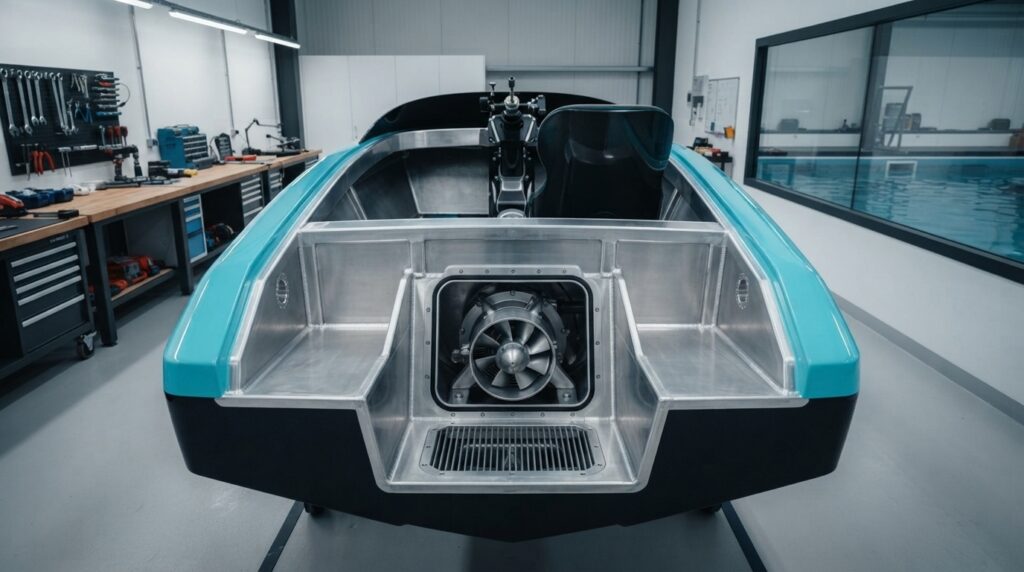
Every hull has a story written into its shape long before it ever touches water. The deadrise angle, the chine design, the length-to-beam ratio, and the distribution of buoyancy along its length are not arbitrary choices. They are the result of calculations that assume a specific weight, a specific centre of gravity, and a specific range of power delivered in a specific way. When a hull is paired with the engine or motor it was actually designed around, all of those calculations hold true. When it is paired with something else, even something that seems broadly similar on paper, they quietly stop holding true, and the boat’s behaviour on the water starts to diverge from what its shape was meant to guarantee.
This is the hidden engineering risk at the centre of the mini jet boat category: the assumption that a hull is a neutral platform that can safely accept whatever motor is available, affordable, or appealing, rather than a precisely tuned system that only performs as intended with the power source it was engineered for. It is a risk that is easy to overlook because it rarely announces itself clearly. A mismatched hull and motor combination does not usually fail in an obvious, dramatic way the first time it hits the water. It fails gradually, in the form of handling quirks, reduced margins, and behaviour that only becomes genuinely dangerous under the wrong combination of speed, wave, and driver reaction time.
This matters for a straightforward reason: buyers rarely have the engineering background to evaluate a hull-and-motor pairing for themselves, and the marketing around small watercraft rarely draws attention to the distinction. A boat can look complete, sound powerful, and perform well enough on a calm test run to seem entirely safe, while still carrying a mismatch that only becomes apparent under the specific combination of conditions that turns a manageable boat into an unpredictable one. Understanding how this mismatch arises, and why it is so easy to miss, is the first step toward asking manufacturers and sellers the right questions before committing to a purchase.
It is tempting to think of a boat’s hull as the “body” and the motor as an accessory that can be upgraded, downgraded, or substituted much like swapping a car battery. Small jet boats do not work that way. A hull’s planing surface, transom strength, buoyancy distribution, and structural stiffening are all calculated around an expected thrust curve and an expected weight, including the weight of the propulsion system itself.
Change the motor and you change several of these variables at once, whether or not the new unit fits physically into the same space. A heavier battery pack shifts the centre of gravity aft or lowers it in ways the hull’s designed trim angle never accounted for. A motor with a different thrust curve changes how quickly the bow rises during acceleration, which changes how much of the hull’s planing surface is actually in contact with the water at any given speed. A lighter, more powerful drivetrain can push the hull into a speed range where its chines, spray rails, or transom were never tested to perform.
None of this means every substitution is automatically dangerous. It means every substitution changes the engineering assumptions the hull was built around, and unless someone has gone back and re-verified those assumptions for the new combination, nobody actually knows whether the resulting boat behaves safely across its full speed range.
One of the most common, and most underestimated, consequences of mismatching an engine to a hull is a change in trim behaviour, particularly bow rise during the hole shot, the critical few seconds as a boat accelerates from a standing start onto plane. A hull designed around a particular thrust curve and weight will have a predictable, manageable bow rise during this phase, giving the driver clear visibility and stable handling as the boat comes up to speed.
Fit a motor with significantly more low-end thrust than the hull was designed for, and the bow can rise higher and faster than intended, briefly reducing the driver’s forward visibility at exactly the moment precise control matters most. Fit a heavier power source than intended, and the opposite problem can occur: sluggish, bow-heavy acceleration that keeps the hull ploughing through the water rather than rising cleanly onto plane, increasing drag, reducing efficiency, and changing how the boat responds to a sudden throttle input.
Neither of these outcomes is visible by inspecting a stationary boat. They only appear in the water, under load, and they are precisely the kind of handling change that a hull’s original engineering was meant to prevent.
A significant part of this hidden risk comes from how power is often compared in casual conversation: by a single headline number, whether that is horsepower, kilowatts, or top speed. Hull designers do not work from a single number. They work from a thrust curve, the way power is delivered across the full range of throttle input and speed, because that curve determines how the boat accelerates, how it holds a turn, and how predictably it responds when the driver backs off or reapplies power.
Two propulsion systems can share an identical peak power figure and produce completely different thrust curves, one delivering power smoothly and progressively, the other delivering it in a way that is aggressive at low speed and flatter at higher speed, or vice versa. A hull tuned around a smooth, progressive curve can behave unpredictably when paired with a motor that delivers thrust in a sharper, more front-loaded way, even though the peak numbers on a spec sheet look interchangeable.
This is why comparing engines or electric drive units purely by their top-line power rating, without reference to how that power is actually delivered and without reference to what the hull was engineered around, is one of the most common ways a mismatch is created without anyone involved realising it has happened.
Beyond handling, there is a structural dimension to this risk that matters just as much, if not more. Transoms, motor mounts, and jet drive housings are engineered to absorb a specific range of thrust and vibration loads over the lifespan of the boat. A more powerful or differently balanced propulsion system does not just change how the boat feels to drive. It changes the physical stress placed on the structure holding that system in place.
Over time, a mismatched combination can accelerate fatigue in mounting points, increase the chance of fasteners loosening, or place recurring stress on a transom that was never reinforced for that load profile. These are not failures that typically show up on the first outing. They accumulate, quietly, across dozens of hours on the water, and they are exactly the kind of long-term structural risk that factory engineering, and factory testing, exists to catch before a boat ever reaches a customer.
Australian conditions add a further layer to this. Saltwater exposure, higher ambient temperatures in many boating regions, and the UV load on hull materials all interact with structural fatigue over time. A mounting structure operating close to its designed load limit because of a power mismatch will generally show the effects of that extra stress sooner in a harsh coastal environment than it would in milder, freshwater conditions. This is one more reason why the margin built into a properly matched hull and motor combination is not just a theoretical safety buffer. It is a practical allowance for the real conditions Australian boats are actually used in.
The rise of electric propulsion has, in some ways, made this risk more common rather than less, because it has made it easier for well-meaning owners and small workshops to attempt a “drop-in” replacement of a petrol engine with an electric motor and battery pack, without necessarily re-running the engineering calculations the original hull depended on. Electric drive units bring their own weight distribution challenges, since battery packs are often the heaviest single component in the entire boat and their placement has an outsized effect on trim and centre of gravity.
A conversion that focuses on “will the motor and battery physically fit in the available space” while treating the resulting handling and structural implications as a secondary concern is treating a hull as a neutral shell rather than as the finely tuned engineering system it actually is. This is precisely the gap that fully engineered electric mini jet boats are designed to close: the hull, motor, and battery are specified together from the outset, so the thrust curve, the weight distribution, and the structural loading are all part of one integrated design rather than a retrofit built around whatever motor happened to be available.
Getting this right is not a matter of intuition or trial and error. It typically involves a structured process: calculating the boat’s fully loaded weight, including passengers, fuel or battery mass, and gear, then determining the thrust curve needed to achieve safe, predictable planing behaviour across the intended speed range. It involves assessing the hull’s chine and spray rail design to understand how it manages lateral stability at different speeds, and confirming the transom and mounting structure are rated for the vibration and load profile of the specific propulsion unit being fitted.
It also involves in-water testing, not as a formality but as a genuine verification step, checking hole shot behaviour, top speed handling, turning stability, and response to sudden throttle changes across a range of conditions, not just calm, flat water on a single test day. This is the process that separates a hull-and-motor combination that has been engineered from one that has simply been assembled, and it is a process that is very difficult, and in many cases practically impossible, for an individual buyer or small workshop to replicate to the same standard as a manufacturer with dedicated testing resources.
Because a mismatched hull and motor combination rarely announces itself with a single obvious failure, it helps to know what the early warning signs actually look like in practice. A boat that lists slightly to one side at rest, before the motor is even engaged, can indicate that battery or motor placement has shifted the centre of gravity further than the hull’s design tolerates. A hole shot that feels noticeably harsher or more sluggish than expected, compared with how the same hull is described performing in the manufacturer’s own literature, is often the first practical clue that the thrust curve does not match what the hull was designed around.
Unusual vibration through the hull at cruising speed, particularly vibration that changes character as speed increases rather than simply growing louder, can point to a thrust curve interacting poorly with the hull’s designed resonant behaviour. A boat that requires constant small steering corrections to hold a straight line, rather than tracking predictably, can indicate that trim and weight distribution have shifted enough to affect directional stability. None of these signs are dramatic on their own, and that is exactly the problem. Each one, in isolation, can be dismissed as a quirk of a particular boat. Together, across a fleet of similarly mismatched builds, they form a pattern that experienced marine surveyors and engineers recognise immediately, but that an individual first-time owner has little reason to notice, let alone act on.
Manufacturers who take hull-to-motor matching seriously do not rely on a single calculation and call the job done. The process is iterative. Initial thrust and weight targets are established from naval architecture calculations, prototypes are built to those targets, and the resulting boat is tested on the water across a deliberately wide range of conditions: light load and full load, flat water and chop, gentle throttle application and sudden full-throttle acceleration.
Where a prototype’s behaviour does not match the predicted performance, whether that shows up as excessive bow rise, an unexpected turning characteristic, or vibration at a particular speed, the design is revisited. That might mean adjusting battery placement, revising the jet drive’s nozzle geometry, or in some cases returning to the hull design itself before the combination is finalised. This loop between calculation, prototype, and real-world testing is what actually produces a hull and motor pairing that behaves predictably across its full operating range, and it is fundamentally different from a single build-and-launch approach where the first time a combination meets open water is also the first time anyone finds out how it behaves.
This iterative process is also where documentation becomes valuable well beyond the initial sale. A manufacturer who has been through several rounds of prototype testing has a record of what was tried, what did not work, and why the final combination was chosen. That record is the foundation of ongoing quality control as boats move into production, and it is precisely the kind of institutional knowledge that a one-off home build, however carefully executed, has no way of replicating.
Larger boats have more hull volume, more freeboard, and more inherent stability to absorb a mismatch between power and design intent. Mini jet boats do not have this margin. Their smaller size means changes in trim, weight distribution, and thrust delivery have a proportionally larger effect on handling, and their proximity to the waterline means less time and less physical buffer exists between a handling surprise and a genuine loss of control.
This is exactly why hull-to-motor matching deserves more scrutiny in this category, not less, and why the manufacturers who take it seriously, treating the hull and propulsion system as a single engineered product rather than two separately sourced components, are offering something meaningfully different from a hull that has simply had a motor bolted to it.
For anyone evaluating a mini jet boat, the most useful question is rarely “how powerful is the motor.” It is “was this specific motor, at this specific weight, engineered and tested together with this specific hull, by the people who designed the hull in the first place.” A fully assembled boat from a manufacturer that controls both the hull design and the propulsion system can answer that question directly, with engineering data and test results to support it.
A boat built from separately sourced components, however well-intentioned the build, usually cannot answer that question with the same confidence, because the calculations and testing that would answer it were never formally carried out. Understanding this distinction is one of the most practical pieces of due diligence a prospective buyer can do before choosing a mini jet boat, electric or otherwise.
It is a question worth asking directly, and worth being wary of vague answers to. A manufacturer who has genuinely engineered a hull and motor together will typically be able to describe the process without hesitation: the target weight range, the thrust curve, the testing conditions, and the iterations that led to the final specification. A hesitant or generic answer to that same question is itself useful information, and often the clearest signal available to a buyer who does not have an engineering background of their own to fall back on.
Can I safely upgrade the motor on my mini jet boat later? Only if the new combination is re-assessed against the hull’s original design limits, ideally by someone with access to the hull’s engineering data. A physical fit is not the same as a safe, verified match.
Does more power always mean a more dangerous boat? Not necessarily. The danger comes from a mismatch between the hull’s design assumptions and the actual thrust curve and weight of the propulsion system, not from power alone. A well-matched, more powerful system can be entirely safe; a poorly matched, less powerful one can still create handling problems.
Why does battery weight matter more than fuel weight in this context? Battery packs are typically heavier for the energy they store than liquid fuel, and that weight does not reduce as it is used, unlike a fuel tank emptying over a trip. This makes battery placement and total weight a more constant, and more significant, factor in trim and centre of gravity throughout the entire outing.
How would a buyer know if a hull and motor were properly matched? Ask whether the manufacturer designed the hull and propulsion system together, and whether documented in-water testing was carried out on that exact combination. A manufacturer that controls both sides of this equation, and can point to a testing process, is offering a meaningfully different level of assurance than a hull and motor sourced independently.
Vector Watercraft designs its electric mini jet boats as a single integrated system, calculating hull loading, thrust curves, and weight distribution together from the earliest stages of development, rather than fitting a motor to a hull designed around different assumptions. Every combination we sell has been engineered and water tested as a matched pair before it reaches a customer. If you are comparing mini jet boats and want to understand how hull-to-motor matching was handled for a particular model, our team is happy to walk through the engineering behind it.