
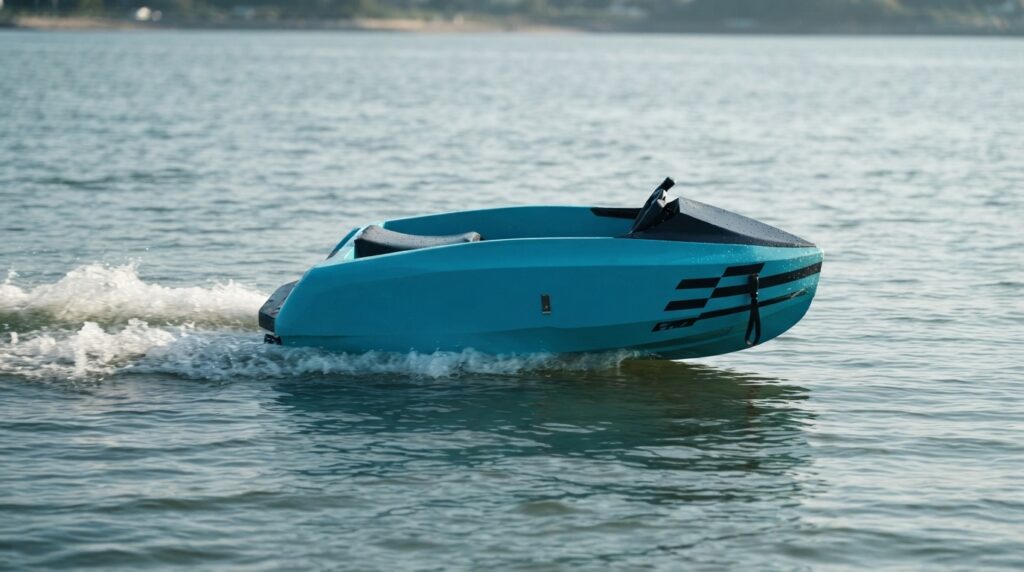
If you've ever compared two mini jet boats with near-identical motor specifications and found they perform completely differently on the water, power-to-weight ratio is almost always the reason. It's one of the least-marketed figures in the category, yet it explains more about real-world acceleration, load-carrying performance and throttle response than the motor's kilowatt rating ever will on its own.
A motor's power output is a fixed number — it tells you how much work the motor is capable of doing, full stop. What it doesn't tell you is how much resistance that power is working against. A 6kW motor moving a 90kg hull has a very different job to the same 6kW motor moving a 140kg hull. The first setup is going to feel noticeably livelier, quicker off the mark, and more eager to climb onto the plane, despite having exactly the same motor spec on paper.
This is the core idea behind power-to-weight ratio: motor output divided by total weight, usually expressed as kilowatts per kilogram. It reframes the comparison from "how strong is the motor" to "how much motor is available for every kilogram it has to shift" — which is a far more accurate proxy for how the boat will actually behave.
Power-to-weight ratio isn't a background statistic — it shows up in specific, easily noticed moments on the water:
Getting onto the plane. This is the phase where a hull has to overcome the most resistance, transitioning from pushing through the water to riding on top of it. A strong power-to-weight ratio shortens this transition noticeably; a weak one can make it feel like the boat is labouring before it finally breaks free onto the plane.
Recovering speed after a turn. Every time the throttle is eased through a corner, the boat sheds speed. How quickly it regains that speed coming out of the turn is a direct function of power-to-weight ratio — a boat with more power relative to its mass snaps back up to cruising speed; one with less takes a more gradual run-up.
Coping with a headwind or chop. Extra drag from wind or waves effectively raises the bar the motor has to clear. A generous power-to-weight ratio absorbs this with little noticeable change in performance; a marginal one can feel meaningfully slower the moment conditions turn less than ideal.
Carrying a passenger. This is where the ratio matters most for everyday ownership, and it's covered in more detail below.
Almost every published performance figure for a mini jet boat — top speed, acceleration, time-to-plane — is measured with a single rider and minimal gear. The moment a second adult and their gear come aboard, total weight can climb by a meaningful percentage of the boat's own weight, and that shift directly erodes the power-to-weight ratio for that outing.
A boat that feels genuinely sporty solo can feel noticeably flatter with two aboard, purely because the same motor is now working against a heavier load. This isn't a flaw in the boat or a case of misleading marketing — it's simply physics — but it is something worth actively asking about (or test-riding two-up, if at all possible) if carrying a passenger regularly is part of your plan. A boat with a modest but genuinely generous power-to-weight margin solo will tend to hold onto its character two-up far better than one that was only ever "adequate" with one rider aboard.
It's tempting to assume the fix for a sluggish power-to-weight ratio is simply a bigger motor, and sometimes it is. But there are two distinct routes to a better ratio, and they don't have the same knock-on effects:
In other words, two mini jet boats can arrive at an identical power-to-weight figure by very different paths, and those paths have different consequences for how much time you'll spend recharging. A lighter, moderately powered boat and a heavier boat with a bigger motor might feel similarly quick off the line, but they won't necessarily deliver the same range — the lighter boat has a genuine efficiency advantage baked in.
Motor power figures on their own are close to meaningless without a weight to measure them against. When comparing mini jet boats, it's worth specifically asking or checking:
Power-to-weight ratio is the figure that actually predicts how a mini jet boat will feel to ride — not the motor's power rating in isolation, and not the hull's weight in isolation, but the relationship between the two. It explains why boats with similar motor specs can feel worlds apart, why performance often drops more than expected with a second passenger aboard, and why the path taken to achieve a given ratio matters just as much as the ratio itself when range is part of the equation. Buyers who look at this relationship, rather than the motor spec alone, end up with a far more accurate sense of how a boat will actually perform once it's loaded and out on the water.