
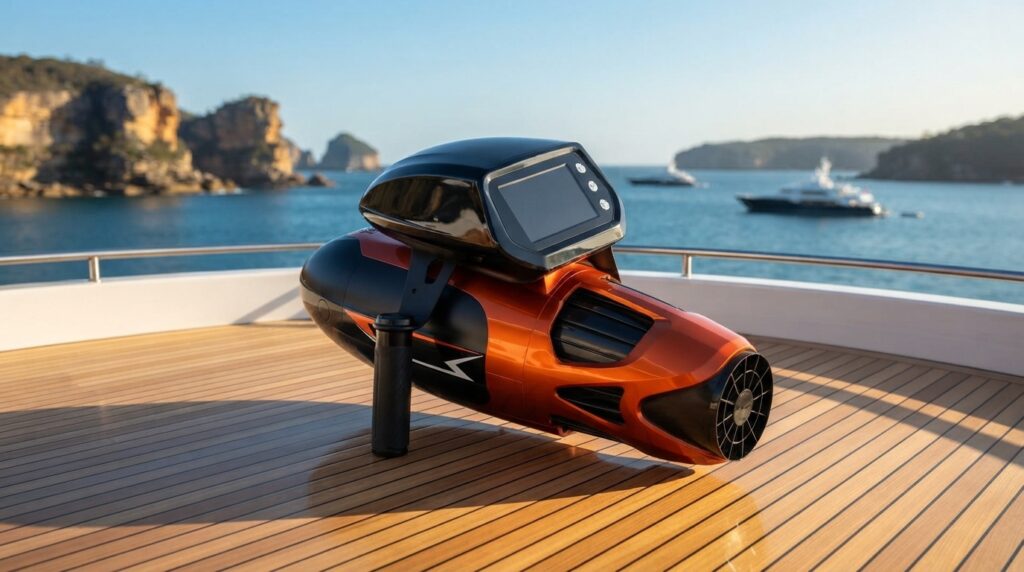
Underwater scooters have moved well beyond being novelty water toys.
Today, Australian buyers can choose from compact recreational scooters suitable for swimming and snorkelling through to substantial professional-grade diver propulsion vehicles capable of travelling faster, operating for longer periods and carrying much larger battery systems.
That creates an enormous price range.
At the time of writing in 2026, Vector Water Craft's Australian underwater scooter range extends from the HS-S3 at $1,197 including GST through to the professional H9 Sub Jet Pro at $15,895 including GST. Between those two extremes are several distinctly different levels of equipment designed for different types of users.
Understanding why one underwater scooter might cost around $1,200 while another approaches $16,000 is far more useful than simply asking which is cheapest.
The main differences involve power, construction, battery capacity, thrust, operating time, maximum depth, speed, weight and the intended type of user.
For an Australian buyer, the objective should therefore be to find the right level of underwater scooter for the intended use—not simply the lowest price.
This guide explains what Australians should expect to pay for an underwater scooter in 2026, what different price levels provide, and which specifications are worth paying more for.
There is no single correct price because the term “underwater scooter” covers equipment with vastly different capabilities.
A useful way to understand the market is to divide it into three broad groups.
Approximately $1,200 to $1,750 within the current Vector Water Craft range.
These are compact products intended primarily for recreational users, snorkellers, travellers and enthusiasts wanting useful underwater propulsion without the size and cost of professional diving equipment.
Around $9,950 for Vector's current H9-1 Sub Runner.
This represents a substantial jump in battery capacity, weight and overall underwater propulsion capability compared with compact recreational scooters.
Around $15,895 for the Vector H9 Sub Jet Pro.
This is a 35 kg, 3.3 kW underwater propulsion vehicle with a 923.52 Wh battery, published 100-minute runtime and maximum speed of 13 km/h. It is fundamentally different equipment from a 2.5 or 3 kg recreational scooter.
The size of this price range makes one point very clear:
You should decide what you need before deciding what you want to spend.
At the time of writing, Vector Water Craft lists the following models in Australia:
These are current published prices and should always be reconfirmed when ordering because pricing, specifications and availability can change.
The important factor is that the progression is not simply a case of paying more for a slightly faster scooter.
Different models serve quite different purposes.
Vector's HS-S3 currently sits at the lower end of its Australian range at $1,197 including GST.
That price buys a scooter weighing approximately 3 kg with:
Those specifications demonstrate just how capable today's relatively compact recreational scooters have become.
A recreational buyer does not necessarily need to spend many thousands of dollars to obtain useful propulsion, variable speeds and enough runtime for normal snorkelling and recreational exploration.
For many Australians, this price bracket could therefore represent the most sensible starting point.
A scooter around this level can make sense for:
What it does not provide is the extreme battery capacity or propulsion capability of a professional diver propulsion vehicle.
For many buyers, however, that is precisely why it makes sense.
Vector's HS-S2 is currently listed at $1,397 including GST.
Price alone does not tell the story, because the HS-S2 takes a different design approach from the HS-S3.
The HS-S2 is particularly lightweight at approximately 1.4 kg, making portability one of its important characteristics.
This demonstrates an important point when comparing underwater scooter prices:
A more expensive model is not necessarily being purchased simply for greater speed.
You may instead be paying for:
For travellers or owners carrying multiple pieces of watersports equipment, a difference of even 1.5 kg can matter.
The more useful question is therefore not simply:
“Why does this cost more?”
It is:
“What does the different design give me that is useful for my application?”
The HS-S1 is currently listed at $1,628 including GST.
It weighs approximately 2.5 kg including its battery and has three speed modes, a maximum published depth of 40 metres and an operating-time range listed at approximately 35 to 70 minutes depending upon operation.
Its specifications include:
Again, this shows that buyers should compare the complete product rather than simply ranking scooters by price.
Someone wanting a compact unit with a 40-metre published depth capability may make a different choice from a snorkeller mainly concerned with price.
The HS-S4 Vector Bat is currently priced at $1,725 including GST.
This product introduces a substantially different feature: dual 500-watt motors.
The HS-S4 is listed with:
The substantial increase in thrust compared with the lighter recreational models is particularly notable.
For a buyer who wants more performance while remaining within the compact recreational range, the difference between spending around $1,200 and around $1,700 may therefore be justified.
The extra $500 is not simply buying a brand badge or cosmetic upgrade.
It can mean a materially different propulsion configuration.
The Vector H9-1 Sub Runner is currently listed at $9,950 including GST.
This is where buyers move away from compact recreational scooters towards significantly larger underwater propulsion equipment.
The H9-1 weighs approximately 14.6 kg, compared with 3 kg for the HS-S3 and 4.3 kg for the HS-S4.
Its battery capacity is approximately 384.8 Wh, around four times the energy capacity of the smaller HS-series products.
It offers:
These differences explain why price comparisons based only on maximum speed can be misleading.
The purchaser is buying a much larger propulsion platform with substantially greater battery capacity and a different intended purpose.
At the top of Vector Water Craft's current range is the H9 Sub Jet Pro at $15,895 including GST.
This is not aimed at someone simply wanting an occasional holiday scooter.
Its published specifications include:
Vector positions the H9 as a professional long-range diver propulsion platform intended for demanding recreational and professional uses.
Compare the battery alone.
The HS-S3 uses a 99.36 Wh battery.
The H9 uses a 923.52 Wh battery.
That is more than nine times the nominal stored energy.
The H9 also weighs 35 kg rather than 3 kg.
These are not two directly interchangeable products.
They occupy completely different ends of the underwater propulsion market.
Several major factors influence the price.
More powerful motors generally require larger batteries, stronger propulsion components and more substantial construction.
The difference between a compact recreational unit and a 3.3 kW professional scooter is considerable.
More power can provide:
But increased motor power is only useful if you need it.
Battery systems are one of the most expensive components in modern electric watercraft.
Greater energy capacity can contribute to:
The difference between approximately 95–100 Wh in compact Vector scooters and 923.52 Wh in the H9 demonstrates how widely battery systems can vary.
A buyer should therefore look at battery capacity as well as headline runtime.
Underwater equipment must operate in an environment that is particularly demanding on mechanical and electrical systems.
A scooter requires:
Professional products must often deal with greater loads, longer operating periods and more demanding usage than small recreational scooters.
That adds cost.
Engineering equipment for underwater operation requires careful pressure management and sealing.
A snorkelling scooter primarily used near the surface and a unit intended to operate repeatedly at substantial depths are different engineering propositions.
Depth rating should therefore form part of any serious price comparison.
Thrust becomes especially important for divers carrying equipment.
A recreational swimmer in light gear does not generate the same drag as a diver carrying scuba equipment.
Greater thrust requires more substantial propulsion capability and usually contributes to increased cost.
Some buyers may need more sophisticated controls, mounting configurations or accessories.
These can include:
The usefulness of these features depends upon the individual buyer.
Not necessarily.
There is an important distinction between price and value.
Imagine Buyer A purchases a very inexpensive scooter but soon discovers that:
The initial purchase price was low, but value was poor.
Buyer B spends more but receives a scooter that suits the application and remains useful for years.
That can represent better value.
The reverse can also apply.
A recreational snorkeller who spends $15,895 on a professional underwater propulsion platform when a $1,200–$1,700 scooter would comfortably meet the intended use has not necessarily obtained better value simply because the equipment is more powerful.
Value means matching expenditure to purpose.
For most first-time recreational buyers, the $1,200 to $1,750 category within Vector's range deserves serious consideration before moving towards the larger professional models.
This price range provides access to products offering combinations of:
A first-time buyer should only move dramatically beyond this level when there is a clear reason for doing so.
That reason may include:
For normal recreational snorkelling, spending around $1,200 to $1,700 can provide a substantial level of capability within the current Vector range.
A snorkeller should prioritise:
There is usually little reason for a surface snorkeller to buy a 35 kg professional propulsion vehicle unless there are highly unusual requirements.
The answer varies much more widely.
A recreational diver may find that one of the compact scooters provides sufficient propulsion and depth capability.
A serious or professional user may require an H9-1 or H9-level product.
The decision should be based upon:
A diver should never select propulsion purely because a scooter allows them to travel farther.
Greater range introduces additional planning responsibilities.
Often, but not always in a simple progression.
For example, the HS-S4 has a published maximum speed of approximately 7.2 km/h at a current price of $1,725, whereas the H9 reaches a published 13 km/h at $15,895.
But speed is only part of the reason for the enormous price difference.
The H9 also includes:
This is why comparing “dollars per kilometre per hour” makes little sense with underwater scooters.
Purchase price is only one part of ownership.
Buyers should also consider:
Electric underwater scooters do not require petrol, but battery condition and correct maintenance remain important.
Owners should follow the manufacturer's charging, storage, cleaning and inspection instructions.
Lithium batteries gradually lose capacity through age and use.
Battery life is influenced by factors including:
For this reason, purchasing from a supplier able to assist with batteries and replacement components can become important over the longer term.
Do not compare scooters only by today's purchase price.
Consider how you expect to own and use the equipment over several years.
The internet makes it easy to find cheap electric equipment from overseas.
But the headline price does not tell you what happens after the purchase.
Before buying, determine:
Vector Water Craft is an Australian electric-watercraft specialist supplying underwater scooters as part of a broader range of electric watercraft. Its current underwater range extends from compact HS-series scooters through to the professional H9 platform.
For specialist battery-powered marine equipment, this support forms part of the value of the purchase.
Underwater scooter freight requirements vary enormously.
Sending a 3 kg recreational scooter is very different from transporting a 35 kg professional propulsion system with a 923.52 Wh lithium battery.
Vector advises customers to contact its team before ordering specialist equipment so that appropriate freight arrangements can be confirmed.
Large lithium batteries can require specialised transport arrangements.
Therefore, for higher-performance models particularly, buyers should establish the complete delivered cost rather than relying only on the advertised product price.
Before choosing your budget, answer these five questions.
Recreational snorkelling and professional diving require very different equipment.
A frequent user may justify spending more for greater capability.
Do not confuse “nice to have” specifications with requirements.
Greater power can mean greater weight and larger batteries.
Price, warranty, support, maintenance and parts should all be considered.
For a large proportion of recreational Australian buyers, the current $1,197 to $1,725 Vector range offers an attractive combination of performance and affordability.
There are four different models within or close to this bracket, allowing the buyer to prioritise different combinations of:
For buyers requiring substantially greater underwater propulsion, the H9-1 at $9,950 represents the next major step, while the $15,895 H9 sits at the professional end of the range.
This is a much more useful way of looking at pricing than trying to identify one universal “best buy”.
Make sure it can actually perform the intended job.
Professional capability may be unnecessary.
Battery, weight, thrust and runtime can be equally important.
Battery capacity is a major component of both cost and performance.
A low-priced product can become expensive if parts or assistance are difficult to obtain.
Large batteries and heavier equipment may have specialised transport requirements.
A recreational snorkeller may not need professional underwater propulsion.
For Australians buying an underwater scooter in 2026, there is no meaningful single “average” price.
Within Vector Water Craft's current range, buyers can spend approximately:
$1,200–$1,750 for compact recreational and higher-performance portable underwater scooters.
Around $10,000 for substantial higher-level underwater propulsion.
Around $16,000 for a flagship professional long-range underwater scooter.
The huge difference reflects the diversity of equipment.
The most important advice is simple:
Do not decide what to spend until you have decided what you need.
A $1,197 scooter could be the perfect purchase for one person.
A $15,895 scooter could be entirely justified for another.
The correct decision depends on:
The best value underwater scooter is the one that provides the capabilities you will actually use without making you pay unnecessarily for those you will not.
If you are unsure whether you need a compact recreational scooter, a more powerful dual-motor unit or one of Vector's professional underwater propulsion systems, contact Vector Water Craft before purchasing.
Tell us what you want to do with the scooter rather than simply telling us your budget.
That allows us to help you compare the models according to your actual needs.
For many buyers, that may mean recommending a relatively modest recreational scooter rather than encouraging unnecessary expenditure.
For a serious diver or commercial user, it may mean identifying where the extra investment in a higher-capability model is justified.
Explore the Vector Water Craft underwater scooter range and contact the team for help selecting the right combination of price, performance and capability.
Within Vector Water Craft's current Australian range, prices extend from $1,197 for the HS-S3 to $15,895 for the H9 Sub Jet Pro, including GST.
For a first recreational purchase, Vector currently offers several models between approximately $1,200 and $1,750. The correct amount depends on required weight, speed, thrust, depth and other features.
High-end units can be much larger professional propulsion platforms with substantially larger batteries, motors and operating capabilities. Vector's H9, for example, uses a 923.52 Wh battery and 3.3 kW motor and weighs approximately 35 kg.
It can be for many recreational applications. Vector's $1,197 HS-S3 has three speed settings, maximum published speed of 6.48 km/h, 8 kgf thrust and up to 60 minutes runtime.
Vector's current HS-S4 Bat is listed at $1,725 including GST and uses two 500-watt motors producing published maximum thrust of 15 kg.
At the time of writing, the H9 Sub Jet Pro is listed at $15,895 including GST.
No. Runtime is influenced by design, battery capacity, power demand and intended application. Buyers should compare the individual specifications rather than assuming price alone determines operating time.
Normally there is little reason for an ordinary recreational snorkeller to purchase professional equipment unless there are specific performance requirements. Compact recreational models are generally more practical for portability and casual use.
The current Vector Water Craft product listings state that published prices are inclusive of GST.
There is no universal answer. The best-value scooter is the one that meets the buyer's requirements for speed, thrust, depth, battery runtime and portability without adding unnecessary cost for capabilities that will rarely be use