
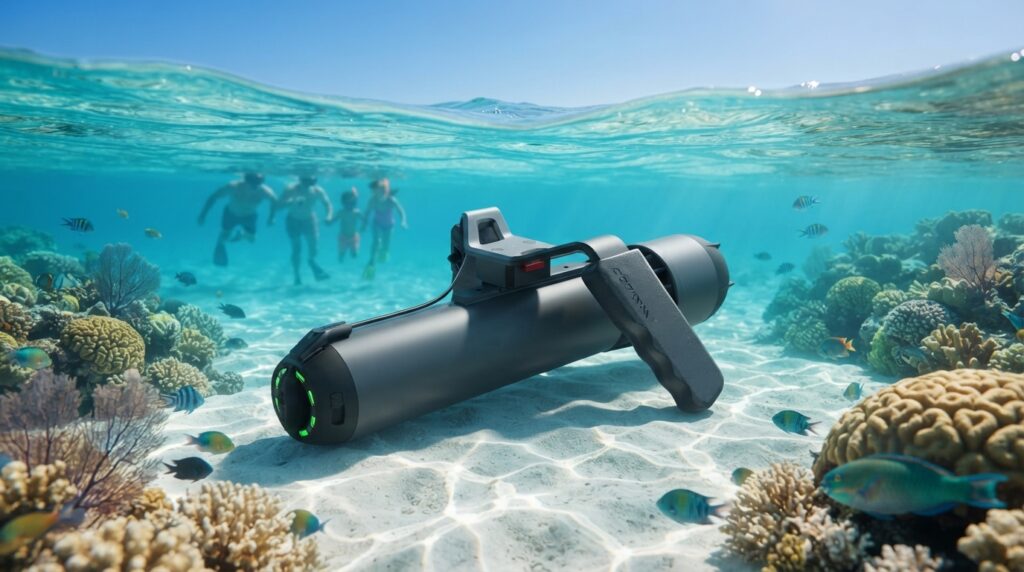
Underwater scooters can add a completely new activity to family holidays, boating weekends and days spent around the water.
For many Australians, that is one of their strongest attractions.
You do not need to be a serious scuba diver to enjoy powered underwater movement. Modern recreational underwater scooters are compact enough to carry to the beach, load into a boat or take on a coastal holiday, while still providing enough propulsion to make snorkelling and swimming feel very different from ordinary fin-powered movement.
Within Vector Water Craft's current range, models such as the HS-S2, HS-S3 and HS-S4 Bat are aimed at recreational use and combine relatively manageable size with useful speed, battery runtime and underwater capability. (vectorwatercraft.com.au)
For families, however, choosing an underwater scooter involves more than simply asking which one is fastest.
The right questions are:
This guide explains what Australian families should consider before buying an underwater scooter for recreational and holiday use.
A good family holiday activity usually needs to satisfy several practical requirements.
It should be:
A compact underwater scooter can meet many of those requirements.
It can be used during:
Unlike larger powered watercraft, a compact scooter does not need a trailer, launching ramp or large storage area.
That portability can be a major advantage for families already carrying considerable holiday equipment.
One of the best ways to think about an underwater scooter is not as another item of swimming equipment, but as another family activity.
A normal beach day may involve:
Adding an underwater scooter creates something different.
A family member can use the scooter for a short powered session, return it, recharge it if necessary and allow someone else to use it later.
That shared-use potential can make the purchase more useful than equipment designed for only one person.
Before choosing a model, identify the likely users.
For example:
The greater the number of users, the more important features such as manageable controls and battery runtime become.
A high-performance scooter selected for one experienced adult may be inappropriate for general family sharing.
Similarly, a very lightweight scooter may be ideal when different people need to carry and use it.
Parents should approach powered underwater equipment responsibly.
An underwater scooter should not automatically be treated as a children's toy simply because it is compact.
Suitability depends on:
Close adult supervision is essential for young or inexperienced users.
The scooter should never be used as a substitute for swimming ability or proper water supervision.
A child who cannot safely manage in the water without powered propulsion should not be made dependent on the scooter.
For family use, controllable speed is more valuable than maximum speed.
A first-time user should begin at the lowest available setting.
This allows them to learn:
Only once the rider is comfortable should higher settings be considered.
This is one reason multiple-speed scooters are particularly attractive for shared recreational use.
Vector's HS-S2 and HS-S3 both provide several speed settings, allowing users to match propulsion to ability and conditions. (vectorwatercraft.com.au)
Weight can become one of the most important specifications on a holiday.
A product might look impressive online, but ask who will actually carry it from:
Vector's HS-S2 weighs approximately 1.4 kg, making it one of the lightest examples in the current range. (vectorwatercraft.com.au)
For family and holiday use, this kind of weight can be a substantial advantage.
A heavier model may provide more power, but the question is whether that extra performance is worth carrying throughout the trip.
Holiday storage is often limited.
A family may already have:
A compact underwater scooter needs to fit into this environment.
Before buying, consider:
A scooter that is convenient to live with will generally be used more often.
Battery life becomes more important when several people use the same scooter.
Imagine four family members each wanting 15 minutes.
That can use around an hour of total propulsion time.
Vector's recreational models generally provide useful maximum runtimes in this region.
For example, the HS-S2 is published at up to 56 minutes, while the HS-S3 provides up to 60 minutes. (vectorwatercraft.com.au)
For one person, that may be plenty.
For a whole family, it may represent one round of use before recharging becomes necessary.
Families should therefore think about total daily usage rather than only individual session length.
Charging convenience is easy to overlook before buying.
Ask:
The HS-S2 has a published charging time of approximately 1.2 hours, while the HS-S3 is listed at approximately 1.5 hours. (vectorwatercraft.com.au)
Relatively short charging times can make these types of scooters practical for repeated holiday use.
For example, a morning session could potentially be followed by recharging during lunch before another afternoon session, subject to correct battery procedures.
After swimming, the scooter may be:
Follow the manufacturer's post-use and charging procedure before connecting the charger.
This usually means completing the required cleaning and drying first.
Do not rush battery charging simply because someone wants another turn.
Correct battery care is part of responsible family use.
Australian holidays often involve high temperatures.
That creates an important battery-management issue.
Australia's Product Safety regulator advises consumers not to expose lithium-ion battery products to excessive heat and specifically warns against leaving them in hot vehicles. (productsafety.gov.au)
This is particularly relevant for holiday equipment.
It is easy to finish at the beach, throw everything into the boot and leave it there.
An underwater scooter containing a lithium battery should not simply remain in a very hot parked vehicle for extended periods.
Move it to an appropriate storage location in accordance with the manufacturer's instructions.
Underwater scooters are particularly well suited to snorkelling-oriented holidays.
The scooter can reduce continuous kicking and make it easier to move between nearby areas of interest.
For example, it may be used to:
However, the scooter should not encourage users to travel farther than they could manage safely without propulsion.
The family rule should remain simple:
Stay within the agreed area and return with plenty of battery remaining.
Boat owners may get particularly strong value from a recreational underwater scooter.
A compact scooter is much easier to store than many other powered water activities.
It can be used at suitable anchorages alongside:
For boat-based use, consider:
Never use an underwater scooter around operating boat propellers.
A family staying at a coastal resort may want equipment that can move easily between accommodation and the water.
Low weight and simplicity become particularly important.
A highly specialised 35 kg professional DPV makes little sense for the average family resort holiday.
A compact scooter is far more practical where the main use is:
The equipment should fit the holiday rather than dominate it.
Underwater scooters are not limited to the ocean.
They may also be used in suitable freshwater environments where local rules permit.
Potential applications include:
Freshwater use can reduce some of the salt-related maintenance issues, but owners still need to clean, dry and maintain equipment correctly.
Local restrictions should always be checked before using powered equipment in managed swimming or recreational areas.
Probably less than many buyers initially imagine.
Vector's HS-S2 reaches a published maximum speed of 1.4 m/s, equivalent to roughly 5 km/h. (vectorwatercraft.com.au)
The HS-S4 Bat reaches approximately 7.2 km/h. (vectorwatercraft.com.au)
Underwater, these speeds can feel considerably faster than the numbers suggest.
For ordinary family recreation, control, enjoyment and confidence are more important than maximum performance.
Not automatically.
The HS-S4 Bat uses dual motors and offers stronger recreational propulsion. (vectorwatercraft.com.au)
This may appeal to experienced adults wanting more performance.
However, a lighter scooter may be easier for general family use.
Choose a dual-motor model because the additional thrust is genuinely usefulânot simply because two motors sound better than one.
Many family holidays are heavily photographed.
An action-camera-compatible underwater scooter can add another dimension.
Vector's HS-S3 supports underwater-camera mounting. (vectorwatercraft.com.au)
This can be useful for recording:
However, riders should not become so focused on filming that they stop watching where they are going.
The camera should record the activity, not distract from it.
Users should follow the intended design and manufacturer instructions for each model.
Do not assume that because a scooter has strong thrust it is designed to tow multiple people.
For normal family use, one rider at a time is the simplest and most manageable approach unless the product is specifically designed and approved for another arrangement.
Shared equipment works better when everyone understands the boundaries.
Useful rules include:
These are easy rules to understand and can prevent most avoidable problems.
Battery management should generally remain the responsibility of an adult.
Lithium batteries should not be treated casually.
Australia's Product Safety guidance advises consumers to stop using batteries showing signs of swelling, overheating, leakage or other damage and to use appropriate charging equipment. (productsafety.gov.au)
Parents should supervise:
Do not allow children to experiment with charging systems.
Holiday use often means consecutive days in saltwater.
This makes routine rinsing especially important.
If a scooter is used Monday, Tuesday, Wednesday and Thursday without proper care between sessions, salt and sand can accumulate.
After each saltwater use, follow the manufacturer's cleaning procedure.
This may include:
Do not wait until the end of the holiday.
Good maintenance should occur after each day's use.
Sand is one of the most common beach hazards for equipment.
Try not to place the scooter directly into loose dry sand.
Use:
where practical.
If sand enters accessible areas, rinse according to the manufacturer's instructions.
Air travel creates additional considerations.
Lithium batteries are subject to airline and aviation requirements.
The exact rules depend on battery size, configuration and airline.
Do not simply arrive at the airport assuming the scooter can be checked in as ordinary luggage.
Before flying:
This is particularly important with higher-capacity batteries.
For many families taking driving holidays, the issue is simpler, but appropriate temperature and storage conditions still matter.
An underwater scooter can represent a meaningful investment.
Families taking expensive equipment away from home may also wish to check whether their existing insurance arrangements cover:
Insurance conditions vary, so this should be checked directly with the insurer.
Do not assume specialist electric watersports equipment is automatically covered under every household or travel policy.
Australia does not have one simple national rule covering every possible use of an underwater scooter.
Waterways can fall under different state, marine park, council or local management arrangements.
Restrictions may apply around:
Before taking the scooter on holiday, check the rules applying to the location.
This is especially worthwhile if visiting an unfamiliar state or territory.
Different family circumstances point towards different models.
The HS-S2 weighs approximately 1.4 kg, making it particularly attractive when easy carrying is a priority.
It also offers several speed settings and up to 56 minutes published battery life. (vectorwatercraft.com.au)
This makes it worth considering for:
The HS-S3 weighs approximately 3 kg, offers three speeds, up to 60 minutes runtime and supports underwater camera mounting. (vectorwatercraft.com.au)
This combination can suit families wanting a versatile scooter for several types of recreation.
The HS-S4 Bat uses dual motors and reaches a published maximum speed of approximately 7.2 km/h. (vectorwatercraft.com.au)
This is more relevant where experienced family members want stronger propulsion.
For general beginner use, the lighter models may be easier starting points.
For ordinary family holiday use, generally no.
Vector's H9 Sub Jet Pro weighs approximately 35 kg, uses a 3.3 kW motor and provides professional-level underwater propulsion. (vectorwatercraft.com.au)
It is designed around a different level of requirement.
A family primarily interested in snorkelling and holiday recreation is more likely to value:
rather than professional endurance.
Within Vector's current range, compact recreational underwater scooters occupy the low-thousands price bracket, while professional equipment costs considerably more. (vectorwatercraft.com.au)
For a family purchase, value should be assessed according to:
If the scooter is used regularly across multiple family members, the cost per outing can become relatively modest over time.
For boat-owning families, an underwater scooter can make particularly good sense.
It adds another activity without requiring:
A compact model can simply be included with the normal recreational equipment.
That can make it one of the easiest powered watersports products to incorporate into a boating lifestyle.
This is perhaps the most important practical test.
If equipment takes too much effort to:
families often stop using it.
For holiday buyers, simplicity deserves a high ranking.
The most powerful underwater scooter is not necessarily the one that delivers the most enjoyment.
The one everyone actually wants to take to the beach may provide far better value.
An underwater scooter may not be appropriate for someone who:
Powered equipment should complement ability, not substitute for it.
General family recreation rarely requires professional performance.
Holiday equipment gets carried much more than many buyers expect.
Total use can be much higher than one individual's session.
Australian heat and lithium batteries are a poor combination. (productsafety.gov.au)
Start conservatively.
It is propulsion equipment, not a substitute for swimming or lifesaving equipment.
Maintenance should continue every day the scooter is used.
Extra performance can mean unnecessary weight, cost and complexity.
Before purchasing, ask:
Adults, teenagers or several family members?
Beach, boat, resort or lake?
Weight matters.
Consider shared use.
Holiday convenience matters.
Variable control is valuable.
Check mounting options.
Especially during Australian summer.
Saltwater equipment requires care.
Specialist electric equipment benefits from local assistance.
Families often want equipment that works without turning into a technical project.
An underwater scooter combines:
If a question arises, access to an Australian supplier is valuable.
Vector Water Craft specialises in electric watercraft and currently offers several underwater scooter models aimed at different recreational and performance levels. (vectorwatercraft.com.au)
That allows buyers to select according to their actual family requirements rather than simply ordering an unfamiliar product solely on price.
For the right family, yes.
A compact underwater scooter can be one of the more practical ways to add powered recreation to a beach, boating or snorkelling holiday.
The strongest family advantages are:
The best family model is usually not the most powerful underwater scooter available.
Instead, look for the right combination of:
For many families, a compact model such as the HS-S2 or HS-S3 is likely to make more practical sense than professional DPV equipment because it is easier to carry, store and share. (vectorwatercraft.com.au)
The equipment should make the holiday easier and more enjoyableânot create another major logistical exercise.
If you are considering an underwater scooter for family holidays, boating or recreational snorkelling, speak with Vector Water Craft before choosing a model.
Tell us:
We can then help you compare the recreational Vector models according to your family's real requirements.
The objective is not to sell you more performance than you need.
It is to help you choose an underwater scooter that is easy enough to take everywhere, capable enough to remain exciting and practical enough to become a regular part of your family holidays.
Yes. Compact models can be easy to transport, rechargeable and suitable for activities such as snorkelling, boating and recreational swimming.
Suitability depends on the manufacturer's requirements, the child's age, swimming ability, physical size and the scooter's power. Close adult supervision is essential.
For most families, a lightweight recreational model with several speed settings and useful battery life is generally more practical than professional high-performance equipment.
The HS-S2 weighs approximately 1.4 kg, making it particularly attractive for travel and recreational use. (vectorwatercraft.com.au)
The HS-S2 provides up to approximately 56 minutes, while the HS-S3 provides up to 60 minutes of published runtime. Actual operating time can vary with speed, rider and conditions. (vectorwatercraft.com.au)
Yes, provided each person is an appropriate user and follows the manufacturer's requirements. Remember that shared use increases total battery consumption.
Compact recreational scooters can be well suited to boats because they require relatively little storage compared with larger powered watercraft. Keep the scooter clear of operating propellers and fishing lines.
Lithium batteries are subject to airline rules. Check the scooter's battery specification and confirm requirements directly with the airline before travelling.
Avoid leaving lithium-powered equipment in hot parked vehicles. Australian Product Safety guidance specifically warns against excessive heat exposure. (productsafety.gov.au)
If used in saltwater, follow the manufacturer's cleaning procedure after each use. Regular fresh-water rinsing and correct drying help protect the equipment.
The HS-S4 is a stronger dual-motor recreational option and may appeal to experienced users wanting more performance. For beginners and portability-focused families, lighter models may be more practical. (vectorwatercraft.com.au)
Usually not for ordinary holiday or snorkelling use. The H9 is a much larger professional-level propulsion platform intended for users who genuinely require its performance and endurance.
They represent a meaningful purchase, but if one scooter is used regularly by several family members across multiple holidays, the long-term value can be attractive compared with many larger powered watersports products.
For many families, portability and controllability are more important than maximum speed.
Vector Water Craft supplies a specialist Australian range of underwater scooters, from lightweight recreational models through to higher-performance underwater propulsion equipment. (vectorwatercraft.c