
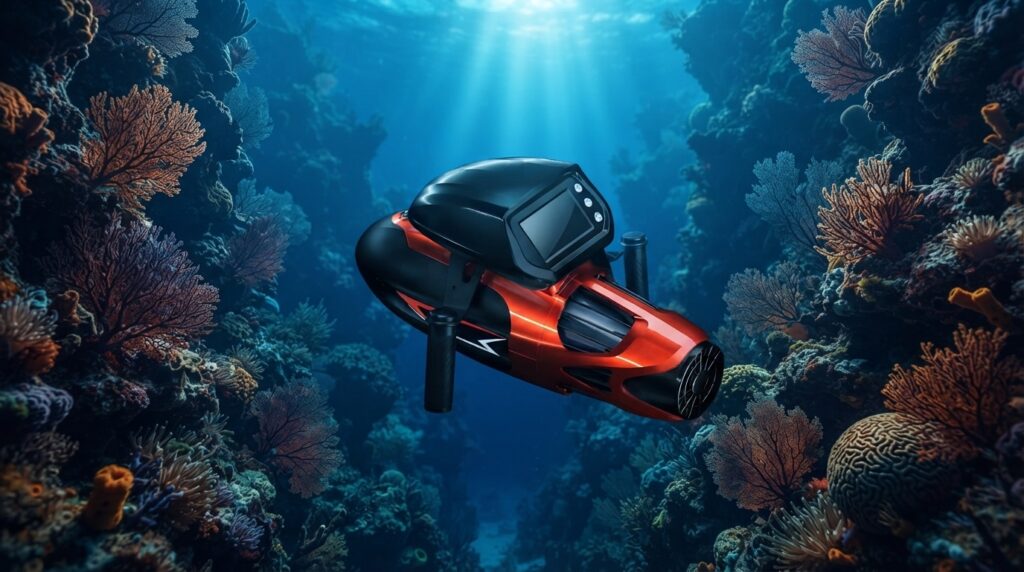
Underwater scooters can transform the way a scuba diver moves through the water.
Known within diving as Diver Propulsion Vehicles (DPVs), these battery-powered devices provide forward propulsion so a diver does not have to rely entirely on finning. They can make it possible to cover more underwater territory, reduce physical effort and reach points of interest more efficiently.
But scuba diving places very different demands on an underwater scooter from recreational swimming or surface snorkelling.
A diver may be carrying a cylinder, buoyancy-control device, regulators, weights, exposure protection, gauges, lights, cameras and other equipment. The additional drag means that thrust, battery capacity, reliability and control become increasingly important.
More importantly, a DPV allows a diver to travel farther and faster than normal swimming. That brings additional planning responsibilities.
Divers Alert Network notes that DPVs can reduce workload during a dive and may consequently reduce gas consumption, but it also emphasises that increased performance introduces additional risks that need appropriate knowledge and training.
This guide examines the major performance, range and safety considerations Australian scuba divers should understand when considering an underwater scooter.
A Diver Propulsion Vehicle is essentially an underwater electric propulsion system designed to tow or propel a diver.
The diver activates the motor and holds or controls the vehicle while the propulsion system provides forward thrust.
Depending upon the design, a DPV may offer:
The category extends from relatively compact underwater scooters suitable for shallow recreational diving through to much larger specialist machines.
Vector Water Craft's current Australian range demonstrates this difference clearly. Its 3 kg HS-S3 has a published depth rating of 30 metres and runtime up to 60 minutes, while the considerably larger H9 Sub Jet Pro is published at up to 40 metres depth, 13 km/h maximum speed and 100 minutes runtime.
Those products serve very different users.
There are several reasons.
A diver's normal travel distance is limited partly by swimming speed, physical effort, gas consumption and planned dive time.
Propulsion can increase the amount of underwater territory that can potentially be explored.
That may be useful for:
PADI describes DPVs as equipment that can enable divers to see more underwater territory within a relatively short period.
Instead of continuously finning, the diver can allow the scooter to provide much of the forward propulsion.
DAN notes that reduced workload during the bottom phase of a dive may contribute to lower gas consumption and leave more reserve gas available.
This does not mean a diver should automatically extend a dive simply because propulsion has reduced effort.
Normal gas management, decompression limits and conservative dive planning still apply.
Underwater photographers and other divers carrying additional equipment can experience substantial drag.
Adequate DPV thrust may help compensate for that resistance.
For experienced divers, operating a properly selected underwater scooter can itself become an enjoyable aspect of diving.
There is a distinct difference between slowly finning across a site and travelling efficiently under electric propulsion.
This is fundamental.
An underwater scooter should be considered additional diving equipment, not an alternative to competent diving skills.
A diver should still be capable of:
A DPV can stop.
A battery can become depleted.
A propeller can become obstructed.
Controls can potentially malfunction.
A diver can become separated from the unit.
Therefore, the dive should not depend on the scooter functioning perfectly throughout the entire route.
A diver who has never operated a DPV should not assume that ordinary scuba certification automatically provides all the skills required for powered underwater travel.
PADI offers dedicated Diver Propulsion Vehicle training that includes safe handling and maintenance, reflecting the additional knowledge involved in using this equipment.
Training can cover areas such as:
For a serious scuba diver intending regular DPV use, appropriate training is a sensible investment.
The answer depends on the diver and the application.
A snorkeller wearing minimal equipment creates relatively little drag.
A scuba diver may be carrying substantial equipment and consequently requires more propulsion to achieve the same speed.
Factors affecting required performance include:
This is why the most appropriate scuba scooter cannot be selected from top-speed figures alone.
Thrust describes the propulsive force generated by the scooter.
For scuba diving, thrust is often more meaningful than simply knowing maximum speed.
A scooter that provides effective thrust at a comfortable cruising speed may be more useful than a lightweight recreational product designed primarily for swimmers.
The objective should be adequate, predictable propulsion rather than simply the highest possible velocity.
Speed receives considerable attention in underwater scooter advertising because it is easy to understand.
However, scuba diving introduces factors that make controlled speed particularly important.
A diver must simultaneously monitor:
Travelling rapidly increases the distance covered while all these responsibilities remain.
High speed can also make obstacles appear more quickly.
Good DPV performance should therefore include controllability, not just top-end output.
The Vector H9-1 Sub Runner currently provides three speed levels reaching up to 2.5 metres per second, while Vector's professional H9 Sub Jet Pro has a published maximum of 13 km/h. Both carry a published 40-metre maximum depth rating.
For many dives, maximum speed would not be the appropriate cruising speed.
One of the biggest mistakes a new DPV user can make is confusing battery runtime with safe operating range.
Suppose a scooter has a published runtime of 60 minutes.
That does not mean a diver should travel away from the starting point under power for 30 minutes and assume another 30 minutes will always be available for the return journey.
Real operating time can be affected by:
More importantly, conservative planning must allow for the possibility that propulsion becomes unavailable.
Powered travel can take a diver much farther from the exit point than finning alone.
This is one of the central safety considerations of DPV diving.
Imagine travelling rapidly away from a boat or shore entry point.
Everything is easy under power.
Then the scooter stops.
The relevant question is no longer:
“How far can the scooter travel?”
It becomes:
That distinction should influence every DPV dive plan.
Runtime becomes particularly important for scuba diving because propulsion may form part of the planned route.
Vector's current models illustrate the difference in capability.
The HS-S3 has a published runtime of up to 60 minutes and a 30-metre depth rating.
The H9-1 Sub Runner is published at 60 minutes, with three speed levels and a 40-metre depth rating.
The larger H9 Sub Jet Pro is published at 100 minutes runtime, maximum speed of 13 km/h and maximum depth of 40 metres.
The correct scooter therefore depends partly upon what type of diving is planned.
A casual shallow recreational dive has very different propulsion requirements from a long-distance specialist application.
Snorkellers may rarely need to think seriously about depth ratings.
Scuba divers must.
The scooter's manufacturer-specified maximum depth should be comfortably appropriate for the planned dive.
Vector currently publishes:
A diver should never assume that because a scooter continues to function near its published limit, it is acceptable to take it deeper.
Manufacturer limitations exist for a reason.
A scooter moves the diver horizontally, but the diver must continue controlling vertical position.
Poor buoyancy technique combined with powered propulsion can create problems.
The user should be able to maintain depth while:
The scooter should not be used to compensate for poor trim or buoyancy.
Good diving technique comes first.
Propulsion is added afterwards.
Powered equipment should not be used casually to drive a diver rapidly toward the surface.
Normal ascent procedures remain essential.
Rapid ascent is a recognised diving hazard. PADI's safety material on diving accidents specifically identifies uncontrolled or excessively rapid ascents as situations divers must avoid.
A DPV's ability to create strong vertical propulsion does not change the physiological principles governing safe ascent.
Maintain controlled depth and ascent rates according to your training and dive computer.
A scooter may reduce physical workload, and DAN notes that lower effort can sometimes contribute to lower gas consumption.
However, it would be dangerous to assume that the scooter automatically makes gas planning less important.
In fact, travelling farther can make gas management even more important.
A diver may reach a location that would normally have required considerable finning.
If propulsion then fails, substantially more physical effort may be needed to return.
Gas reserves should therefore reflect the complete dive plan and possible contingencies.
DPV diving should not result in a diver disappearing into the distance while the buddy struggles to keep up.
Before the dive, discuss:
Both divers should understand the plan.
A fast underwater scooter increases the distance that can open between buddies very quickly.
Good communication therefore becomes particularly important.
Diving equipment often includes:
These should be managed carefully around any powered propulsion system.
Keep loose items properly secured and away from propulsion openings.
Before using the scooter, inspect your equipment configuration and remove unnecessary dangling items.
Clear tropical water and low-visibility coastal conditions require different operating techniques.
At high speed, reduced visibility gives the diver less time to react to:
Adjust speed to the distance you can see ahead.
This is one of those situations where the highest speed available may be completely irrelevant to the best speed for the dive.
Underwater scooters are often associated with wreck and cave exploration because they can cover considerable distance.
These environments also introduce serious hazards and require specialised training.
The fact that a scooter is physically capable of entering an overhead environment does not mean a recreational diver is qualified to do so.
Vector describes its H9-1 as suitable for demanding recreational exploration, but equipment capability and diver qualification are separate issues.
Never treat owning a high-performance DPV as a substitute for the appropriate level of diving training.
The current Vector range illustrates two distinct approaches.
A model such as the HS-S3 may make sense for a diver who wants:
The HS-S3 weighs approximately 3 kg and is rated to 30 metres.
The H9-1 Sub Runner represents a significant move towards specialist propulsion.
It offers three speed levels up to 2.5 m/s, 60 minutes published runtime and a 40-metre depth rating.
The H9 Sub Jet Pro sits at the upper end of the Vector range.
Its current published performance includes:
This type of equipment becomes relevant when performance and range matter considerably more than portability.
Underwater scooters rely on substantial rechargeable battery systems.
That makes correct charging, transportation and storage essential.
PADI has specifically reminded divers that some battery types present fire risks and recommends following manufacturer, airline and boat policies, monitoring charging and using manufacturer-designated chargers.
For an Australian underwater scooter owner, sensible battery practice includes:
This becomes increasingly important as battery capacity increases.
A large professional DPV battery is not something to treat casually.
Many Australian divers travel domestically and internationally.
Lithium batteries can be subject to airline and transport requirements that differ according to battery size and configuration.
Do not assume that because the scooter physically fits in luggage it can automatically travel as ordinary baggage.
Before flying:
PADI's current battery guidance specifically advises divers to follow airline, boat and manufacturer requirements when transporting rechargeable batteries.
Scuba scooters are frequently used in saltwater, making maintenance extremely important.
After diving, follow the manufacturer's prescribed routine.
That can include:
A professional DPV represents a significant investment.
Routine maintenance should therefore be treated as part of normal diving procedure.
Before entering the water, include the scooter in your equipment check.
Confirm:
Do not discover an obvious equipment issue after beginning the dive.
A battery indicator is useful only if the diver pays attention to it.
Do not continue extending the dive simply because the scooter is still running.
Your turning point should be based on the entire dive plan, not on waiting for a low-battery indication.
Again, safe range and maximum possible range are not the same thing.
Higher-performance underwater scooters are most relevant to experienced users who have a genuine reason for requiring the capability.
They may include:
A casual diver completing relatively short dives around a boat may find a much lighter product entirely adequate.
Before purchasing, compare these areas carefully.
It must be appropriate for your intended diving.
Consider your body size and complete equipment configuration.
Look beyond the headline number and plan conservatively.
Multiple speeds can improve control.
A high-performance DPV can become a substantial piece of equipment to transport.
This becomes important on multi-dive days.
Larger batteries may provide greater capability but can complicate transportation.
They should remain intuitive while wearing diving equipment.
Specialist underwater propulsion equipment benefits greatly from access to knowledgeable assistance.
Scuba equipment operates in an unforgiving environment.
An underwater scooter combines:
Australian-based product support therefore has genuine value.
Vector Water Craft supplies underwater scooters ranging from compact recreational models through to its higher-performance H9 platforms. Its current H9 and HS-S3 listings state that the products are backed by a 12-month Peace of Mind Warranty.
Buyers should confirm the warranty and service arrangements applying to the particular model before purchasing.
Powered outward travel can create a difficult unpowered return.
Control and awareness are more important than headline performance.
DPV operation adds skills and planning considerations to normal diving.
The scooter should not control your depth.
Reduced finning effort does not remove the need for conservative gas management.
High speed can increase separation rapidly.
Keep hoses, straps and lines managed.
Use approved charging equipment and follow correct storage and transport procedures.
A 40-metre depth rating does not qualify someone to dive to 40 metres.
For the right diver, yes.
A DPV can materially change the diving experience.
It can allow you to:
DAN notes that DPVs can provide meaningful performance benefits, including reduced workload, while also warning that increased capability comes with increased risks.
That is perhaps the best way to view the category.
A DPV provides capability.
The diver must provide the judgement.
When buying an underwater scooter for scuba diving, do not begin by asking which model is fastest.
Begin with:
Then consider:
A compact 3 kg scooter may be ideal for one diver.
A significantly more powerful H9-series machine may be appropriate for another.
Neither is universally superior.
The correct DPV is the one that fits your diving objectives without encouraging you to operate beyond your training, experience or properly planned limits.
If you are considering an underwater scooter for scuba diving, speak with Vector Water Craft about the type of diving you intend to undertake.
Tell us:
We can then help you compare Vector's compact underwater scooters with the higher-capability H9 range.
The objective is to match the scooter to the diver and the application rather than simply selecting the machine with the largest performance figures.
DPV stands for Diver Propulsion Vehicle. It is a battery-powered underwater vehicle used to tow or propel a diver through the water.
Yes, models with appropriate performance and depth ratings can be used for scuba diving. The chosen model should suit the diver's intended depth, equipment, required thrust and operating time.
Dedicated training is strongly worthwhile, particularly for regular or higher-performance DPV use. PADI offers specific Diver Propulsion Vehicle training covering safe handling and maintenance.
Current published ratings vary. The HS-S3 is rated to 30 metres, while the HS-S1, H9-1 and H9 are published with maximum depth ratings of 40 metres.
It depends on the model. Vector currently publishes up to 60 minutes for the HS-S3 and H9-1 and up to 100 minutes for the H9 Sub Jet Pro. Actual operating duration can vary with conditions and use.
Vector currently publishes a maximum speed of 13 km/h for its H9 Sub Jet Pro.
It can reduce physical workload. DAN notes that less work during the bottom phase of a dive may result in lower gas consumption, but divers must still follow proper gas-management procedures.
You should not plan a recreational dive on the assumption that powered propulsion can never fail. Range, gas and contingency planning should account for equipment problems.
No. Appropriate thrust, control, runtime, depth capability, weight and reliability are generally more important than maximum speed alone.
That depends upon the type of diving. The HS-S3 provides a lightweight option for shallower recreational use, while the H9-1 and H9 provide considerably greater propulsion capability for users whose diving profile demands higher thrust, deeper operational limits and extended runtime.