
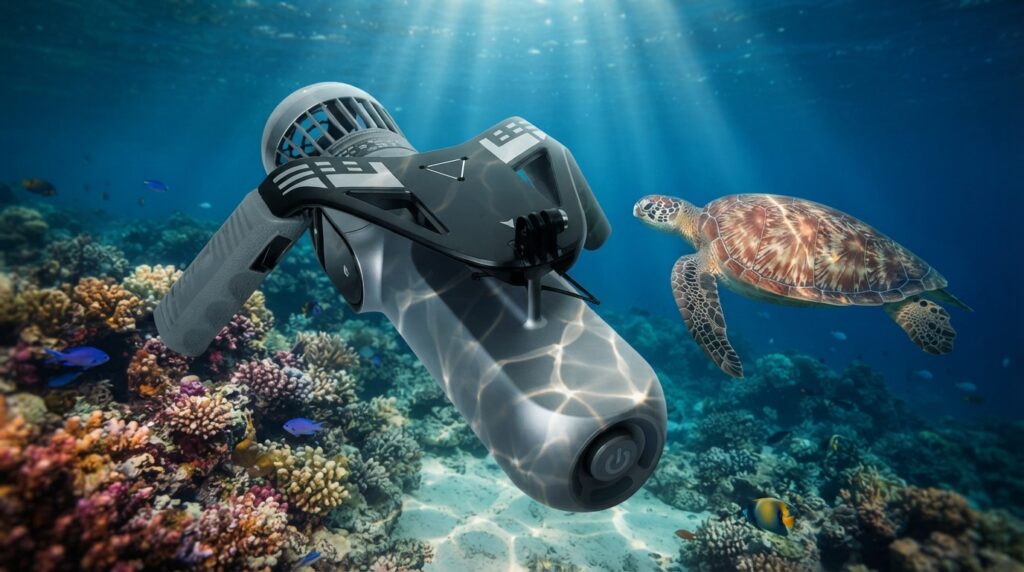
Snorkelling has always been one of the simplest ways to explore Australia's underwater environment.
A mask, snorkel and fins can open up an entirely different world beneath the surface, from sheltered bays and rocky shorelines to tropical reefs and clear coastal waters. However, traditional snorkelling still relies almost entirely on the swimmer's own effort.
An underwater scooter changes that experience.
Sometimes called a sea scooter or underwater propulsion device, an underwater scooter uses battery-powered electric propulsion to pull or propel a snorkeller through the water. Instead of constantly kicking to make progress, the user can allow the scooter to provide much of the forward movement.
For recreational snorkellers, that can mean less fatigue, a greater area explored during a session and a completely different feeling of moving through the water.
Modern underwater scooters have also become much smaller and more accessible than the traditional diver propulsion vehicles many people associate with professional scuba diving.
Vector Water Craft's current Australian range includes recreational models weighing from approximately 1.4 kg through to more powerful dual-motor equipment, as well as substantially larger professional underwater propulsion systems.
The result is that Australian buyers now have considerable choice.
But that creates another problem:
This guide explains what Australian buyers should consider before purchasing an underwater scooter specifically for snorkelling.
Traditional snorkelling is already enjoyable, so why add electric propulsion?
The main advantage is simple: the scooter supplies the forward thrust.
You still need swimming ability and appropriate water skills, but you no longer need to generate all of your movement by continuously kicking.
This can make snorkelling feel significantly different.
An underwater scooter may allow you to:
Vector Water Craft specifically describes several of its compact scooters as suitable for snorkelling and reef exploration, including the HS-S1, HS-S2, HS-S3 and HS-S4.
For many buyers, this recreational use is where underwater scooters make the most sense.
Yes.
An underwater scooter should never be treated as a replacement for swimming ability.
The scooter is equipment.
Equipment can stop operating.
A battery can become depleted.
The user can accidentally release the scooter.
Conditions can change.
For those reasons, snorkellers should remain capable of safely managing themselves in the water without relying upon powered propulsion.
That principle becomes especially important because a scooter can allow someone to travel farther than they would ordinarily choose to swim.
The fact that the scooter makes outward travel easy does not mean a snorkeller should travel so far that returning without power would become difficult.
A sensible recreational user should always operate conservatively and remain within personal swimming ability.
For most recreational snorkellers, the ideal scooter is not necessarily the fastest or most powerful model available.
Instead, look for a good balance between:
A compact scooter with several speeds may be much more enjoyable for normal snorkelling than an extremely powerful professional propulsion vehicle.
This is an important distinction.
Experienced divers may need substantial thrust because they are travelling underwater wearing scuba equipment.
A recreational snorkeller may be wearing little more than:
The propulsion requirements are therefore very different.
Weight should be one of the first specifications a snorkeller considers.
It affects far more than what happens in the water.
You may need to carry your scooter:
This is why lightweight underwater scooters can be particularly attractive for snorkelling.
Vector's HS-S2, for example, weighs approximately 1.4 kg and is specifically promoted for snorkelling and reef exploration.
That is a very different proposition from carrying a large professional diver propulsion system.
For someone who expects to use the scooter while travelling or boating, a few kilograms can make a meaningful difference.
A product that is easy to carry tends to be easier to use frequently.
This is one area where buyers can easily become distracted by specifications.
High speed sounds exciting.
But snorkelling is generally about seeing what is around you.
Travelling very quickly can sometimes work against that objective.
In clear water over an interesting reef or seabed, a moderate speed may make it easier to:
For this reason, variable speed can be more important than maximum speed.
Vector's HS-S3, for example, provides three speed settings and is promoted for snorkelling and shallow diving. The current product information lists a depth rating of 30 metres and runtime of up to 60 minutes.
Three settings allow the rider to choose propulsion to suit the situation rather than using one fixed output.
For a beginner, the lowest setting should generally be the sensible place to start.
A first-time user should become comfortable with an underwater scooter in calm, controlled water.
Learn:
Do this before trying to cover significant distances.
Vector's HS-S4 guidance similarly recommends that beginners start conservatively in calm, shallow water and build confidence gradually.
This is sensible advice regardless of model.
Being comfortable with the controls is more important than reaching maximum speed quickly.
Runtime requirements vary according to the user.
Consider what a typical outing looks like.
One person may snorkel continuously for 20 or 30 minutes.
Another may spend an entire day on a boat and enter the water several times.
A family might want several people to use the same scooter.
These situations create different battery requirements.
The Vector HS-S3 currently has a published runtime of up to 60 minutes.
For many recreational users, this type of figure provides substantial scope for normal snorkelling sessions.
However, maximum published runtime should not automatically be treated as guaranteed real-world operating time.
Actual battery duration can vary with factors such as:
If runtime is particularly important, ask the supplier how different speed settings affect expected operating time.
Normally, maximum depth should not be the primary specification for an ordinary snorkeller.
Snorkelling takes place predominantly close to the surface.
Some users may duck-dive beneath the surface temporarily, but they are not normally operating at scuba-diving depths.
The Vector HS-S3, for example, has a published depth rating of 30 metres even though it is promoted as suitable for snorkelling and shallow diving.
This illustrates why snorkellers should not automatically select the product with the greatest possible depth rating.
A depth capability well beyond your normal use may offer no practical advantage.
Instead, concentrate on the characteristics you will notice during every outing:
Australian buyers can also choose between different propulsion configurations.
Vector's HS-S4 Bat is a dual-motor underwater scooter and is currently listed at $1,725. Vector describes the model as suitable for snorkelling and says its propulsion can reduce fatigue and extend exploration range.
A dual-motor arrangement can provide greater thrust.
For some buyers, this extra performance may be attractive.
However, more motors do not automatically make a scooter more suitable for every snorkeller.
A lighter single-motor model may be preferable where portability is the main concern.
A buyer should compare:
rather than selecting by motor count alone.
Australia offers remarkable opportunities for reef and marine exploration.
An underwater scooter can add considerably to that experience, but powered movement creates an additional responsibility to protect the environment being explored.
A snorkeller should avoid:
A powered scooter allows you to approach objects faster than normal swimming.
That means you should leave adequate distance between yourself and reefs, rocks, swimmers and marine life.
The purpose of using a scooter around a reef should be to observe more—not interfere more.
One of the strongest reasons to combine an underwater scooter with snorkelling is underwater photography and video.
Modern action cameras have made underwater filming relatively accessible.
Some scooters support direct camera mounting.
Vector's HS-S3, for example, includes support for underwater cameras.
This can help record:
However, camera use should never interfere with controlling the scooter.
A common mistake is concentrating on the screen or camera direction instead of what is ahead.
Powered movement means conditions can change quickly.
Record the experience, but continue to prioritise navigation.
Yes, depending upon the model and the user's abilities.
A beginner does not need to be an experienced scuba diver to enjoy an appropriately selected recreational underwater scooter.
However, a beginner should be:
Vector specifically describes the HS-S4 as usable by beginners when operated sensibly, recommending calm shallow-water practice and gradual confidence building.
That approach should apply to any beginner.
Family use is another attractive application.
An underwater scooter can become part of a day's activities at the beach, a sheltered swimming area or during a boating holiday.
Vector states that its HS-S1 can be used for family coastal trips with appropriate supervision.
Parents should nevertheless remember that an underwater scooter is powered equipment.
Suitability will depend on:
Close adult supervision remains important.
Children should not be encouraged to use the scooter to travel beyond a distance they could safely manage without propulsion.
Boat owners may find compact underwater scooters particularly attractive.
Compared with many powered recreational watercraft, a small underwater scooter occupies relatively little storage space.
It can be carried onboard alongside:
At an appropriate anchorage or swimming location, the scooter creates another activity without requiring a trailer or substantial storage arrangements.
Weight again becomes important.
If you regularly move equipment between home, vehicle and boat, a compact scooter may be more useful in practice than a larger high-performance unit.
Many Australian snorkellers will primarily use their scooters in saltwater.
Saltwater is demanding on equipment.
After coastal use, proper maintenance is essential.
Owners should follow the manufacturer's specific procedure, which will normally involve paying attention to cleaning, drying and inspection.
A good routine can include:
Do not allow salt and sand to accumulate simply because the exterior looks clean.
Specialist electric watersports equipment rewards consistent maintenance.
Beaches create another challenge: sand.
Fine sand can enter openings and collect around moving areas.
Try to avoid placing your underwater scooter directly in dry loose sand.
Where possible:
A few minutes of care after a beach outing is preferable to ignoring contamination.
Most modern rechargeable watersports equipment relies on lithium battery technology.
This offers major benefits in energy storage and portability, but the battery should be treated as a sophisticated component rather than something to be ignored.
Australia's ACCC Product Safety guidance warns consumers not to use lithium-ion batteries or chargers showing signs such as swelling, overheating, leaking or physical damage. It also advises against modifying batteries or leaving lithium-ion products in very hot places such as parked vehicles.
For underwater scooter owners, good practice includes:
Australian summers can produce extremely high temperatures inside parked cars, making the ACCC's warning particularly relevant to watersports equipment that might otherwise be left in a vehicle after a beach trip.
An underwater scooter can make covering distance feel easy.
This can create one of its greatest risks.
A snorkeller may travel outward comfortably under power and then discover that:
The safest approach is conservative.
Do not use your full available battery capacity simply travelling away from your starting point.
Remain aware of:
A scooter should increase enjoyment, not encourage dependence upon its motor.
For recreational scooter snorkelling, calm and clear conditions are preferable.
Strong currents, large waves, poor visibility and heavy boat traffic increase difficulty and risk.
Before entering the water, assess:
Beginners should choose particularly conservative conditions.
Remember that an underwater scooter does not make difficult water safe.
Snorkellers can be difficult for boat operators to see.
Powered movement can also allow a snorkeller to cover more territory than expected.
Avoid busy boating areas wherever possible and follow the rules applying to the waterway in which you are operating.
Local requirements can differ across Australian states, territories, marine parks and managed waterways.
Check current local rules before using powered equipment in unfamiliar locations.
For ordinary recreational snorkelling, a buyer does not necessarily need a professional underwater propulsion vehicle.
Vector Water Craft's current compact underwater scooter range includes:
Current prices should always be reconfirmed before purchase because they can change.
This means a buyer can currently enter Vector's recreational underwater scooter range for around $1,200.
The right model depends on which specification you value most.
Use this checklist.
Will you carry it to beaches, boats or holiday locations?
Can you operate slowly enough for relaxed exploration?
Will the battery last through the type of snorkelling sessions you expect?
Can you start, stop and change speed comfortably?
Does the scooter provide suitable performance for your size and use?
Is it more than adequate for the way you actually snorkel?
Will most use occur in coastal environments?
Is the correct charger supplied and are instructions clear?
Can you contact an Australian supplier if you have questions?
There is no single answer, but the current Vector range illustrates several logical choices.
At approximately 1.4 kg, the HS-S2 can appeal to buyers for whom low weight is a major priority. It is specifically positioned for snorkelling and reef exploration.
This type of scooter can make sense for travellers, boat owners and users who do not want to carry heavy equipment.
The HS-S3 weighs approximately 3 kg, offers three speed settings, supports an underwater camera and provides published runtime of up to 60 minutes.
Vector specifically describes it as suitable for snorkelling and shallow diving.
This combination makes it a strong general-purpose option.
Vector positions the HS-S1 as a scooter that can reduce fatigue during snorkelling and make longer sessions more enjoyable. The product page also describes it as suitable for adults and family coastal activities with supervision.
The HS-S4 uses dual motors and provides a higher-performance recreational option.
Vector describes it as suitable for snorkelling and recommends conservative shallow-water practice for beginners.
A buyer wanting stronger propulsion may therefore look towards this model.
Vector's H9 professional underwater scooter is also described as capable of serious snorkelling, but it occupies a completely different category from the compact HS models.
For a normal holiday or recreational snorkeller, such equipment may provide far more capability than necessary.
It becomes relevant when the buyer has specialised, high-performance or professional requirements.
This again reinforces the main buying principle:
Purchase according to intended use rather than maximum specifications.
The fastest scooter is not automatically the most enjoyable for viewing marine environments.
Do not pay for professional capability you will never use.
A heavy scooter can become inconvenient on beach and boating trips.
Always retain the ability to return safely without propulsion.
Lithium battery safety is part of ownership, not an optional extra.
Australian product-safety guidance specifically warns against leaving lithium-ion products in hot places such as parked vehicles.
Correct cleaning and maintenance protect your investment.
Control and situational awareness come first.
Electric propulsion should help you observe—not disturb—the underwater environment.
For someone who snorkels only once every few years, perhaps not.
For people who regularly spend time around the water, the calculation is different.
An underwater scooter can be particularly worthwhile if you:
The experience is not simply “easier swimming.”
Powered underwater movement creates its own recreational activity.
For many users, that is the main appeal.
This is the central message Australian buyers should remember.
For recreational snorkelling, prioritise:
Control before maximum speed.
Portability before unnecessary size.
Useful runtime before headline battery figures.
Appropriate performance before extreme power.
Support and maintenance before a cheap purchase with uncertain backing.
A well-chosen compact scooter can provide everything a snorkeller needs without the cost and weight of professional propulsion equipment.
Before purchasing, decide exactly what type of snorkeller you are.
If you mainly want an easy-to-carry scooter for holidays and casual coastal exploration, concentrate on weight and simplicity.
If you expect regular use and want more flexibility, look at multiple speeds, runtime and camera compatibility.
If stronger propulsion is important, consider higher-thrust or dual-motor designs.
If your requirements extend towards demanding diving or professional operation, then it becomes sensible to investigate larger underwater propulsion systems.
For the majority of Australian recreational snorkellers, however, the ideal scooter is likely to be a compact model that is:
If you are considering an underwater scooter specifically for snorkelling, speak with Vector Water Craft before deciding purely from specifications.
Tell us:
We can then help you compare the available models according to the way you actually intend to use them.
The objective is not to sell every snorkeller the most powerful scooter.
It is to help you choose the underwater scooter that gives you the right combination of performance, portability and enjoyment.
Yes. Several modern recreational scooters are specifically designed for snorkelling. Vector's HS-S1, HS-S2, HS-S3 and HS-S4 are all presented as suitable for snorkelling applications.
You should be a competent swimmer appropriate to the conditions in which you operate. Never rely on the scooter as your only means of returning safely.
There is no universal ideal speed. Lower or moderate settings can be particularly useful for viewing marine environments and maintaining control. Variable-speed scooters allow you to adapt the propulsion to conditions.
It depends on the model and operating conditions. The Vector HS-S3, for example, has a published maximum runtime of up to 60 minutes.
Most snorkellers operate near the surface, so extreme depth capability is generally unnecessary. The HS-S3 nevertheless carries a published 30-metre depth rating.
Yes, with an appropriate model, adequate swimming ability and sensible operation. Beginners should start at low speed in calm, shallow conditions and learn the controls before travelling farther. Vector gives similar guidance for the HS-S4.
Some models support camera mounting. The Vector HS-S3 specifically lists underwater-camera support.
They can be used for reef exploration where local rules permit, but users should maintain appropriate distance from coral and marine life and avoid contact or disturbance.
Vector's current compact recreational range begins with the HS-S3 at $1,197 and includes models up to the HS-S4 at $1,725. Prices should be checked at the time of purchase.
That depends on your priorities. The lightweight HS-S2 can suit portability-focused users, the HS-S3 offers a versatile three-speed recreational package, the HS-S1 provides another compact snorkelling option, and the dual-motor HS-S4 suits buyers seeking greater propulsion.