
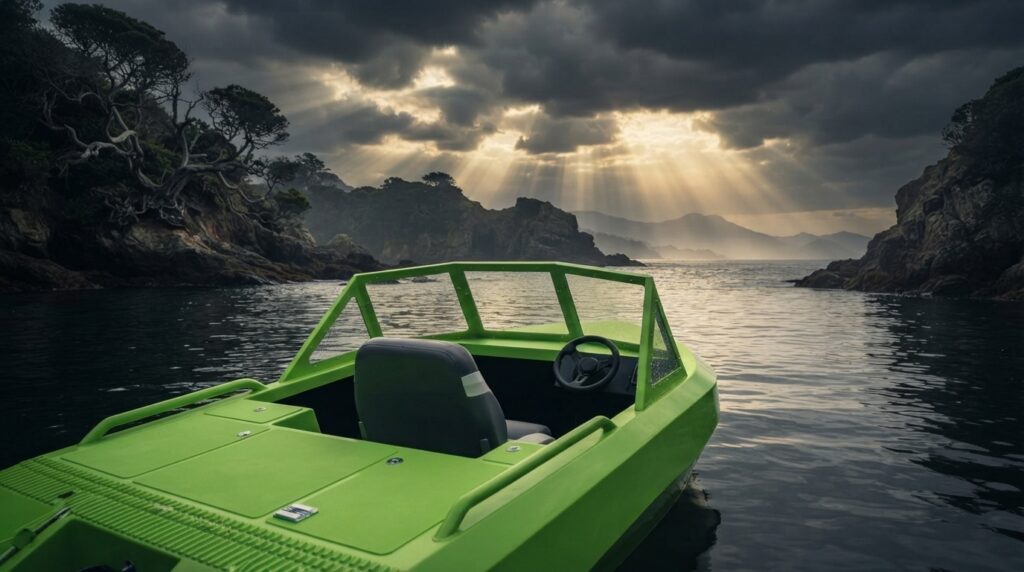
Checking the weather before a boating outing might seem like an obvious, almost trivial step, but genuinely useful weather forecasting for small watercraft goes considerably beyond glancing at a general forecast app and noting whether it says "sunny" or "rain." For mini jet boat owners specifically, given the compact hull characteristics discussed throughout this series, developing real skill in reading and interpreting marine-relevant weather information is one of the most valuable, and most underrated, safety habits to build.
Standard weather apps and forecasts are designed primarily around land-based conditions and general public interest — temperature, chance of rain, general wind description. What they often don't convey clearly is the specific, marine-relevant detail that actually matters for a small boat: wind speed in knots (rather than a general "breezy" description), wind direction relative to your specific planned route, and how conditions are expected to change over the course of the day rather than a single daily summary.
As covered in the article on water conditions and energy consumption, wind has a direct, measurable effect on both comfort and battery range, which makes genuinely specific wind forecasting more than just a comfort consideration for mini jet boat owners — it's a genuine planning input.
Most Australian states have dedicated marine or coastal weather forecasts, typically issued by the Bureau of Meteorology, that provide considerably more specific detail than general forecasts — wind speed and direction broken down by time period, sea and swell height where relevant, and specific warnings for conditions that might affect small craft. Learning to access and interpret these marine-specific forecasts, rather than relying solely on a general weather app, is one of the most valuable skills a mini jet boat owner can develop.
For inland rivers, canals and sheltered waterways where marine forecasts may be less specifically tailored, general wind forecasts combined with local knowledge of how a particular waterway responds to wind from different directions becomes the more relevant skill to build over time.
A single daily forecast summary can obscure meaningful changes in conditions between morning and afternoon — a very common pattern in many parts of Australia is a calmer morning followed by a building afternoon sea breeze, particularly in coastal and near-coastal areas. As discussed in the article on planning a safe journey around battery capacity, this kind of predictable daily pattern is directly relevant to trip timing — planning the more exposed or demanding leg of an outing for the calmer morning period, where the pattern allows for it, is a genuinely useful application of this kind of forecasting awareness.
Skilled small-boat operators generally develop the ability to read current conditions directly, not just rely on forecasts made hours or a day in advance. This includes observing actual cloud development (which can indicate building instability or an approaching change), noticing shifts in wind direction or strength compared to what was forecast, and paying attention to how the water itself is behaving compared to expectations. Forecasts are a valuable planning tool, but conditions on the day can and do deviate from what was predicted, and building the habit of continuously reassessing actual observed conditions against the forecast — rather than treating the forecast as a fixed guarantee — is an important complementary skill.
Marine warnings — strong wind warnings, small craft advisories where applicable, and severe weather warnings — are issued with specific thresholds in mind, but it's worth understanding that a mini jet boat's compact hull, as discussed in the articles on hull length and stability, generally warrants a more conservative personal threshold than the official warning level itself. Conditions that might be entirely manageable for a larger, more substantial vessel can represent genuinely more demanding conditions for a compact craft, meaning a sensible personal rule of thumb is treating official warning thresholds as an outer limit rather than a target, and applying a more conservative personal cut-off specifically suited to a smaller boat.
Genuine weather-reading skill develops through experience — comparing forecasts against actual observed conditions on repeated outings gradually builds an intuitive sense of how reliable forecasts tend to be for a specific local area, and how conditions on familiar waterways typically respond to different wind directions and strengths. New owners are well served by starting with genuinely conservative outings in clearly favourable forecast conditions, gradually building this judgement before attempting outings in more marginal or changeable conditions.
Weather forecasting isn't a standalone consideration — it feeds directly into the range and trip planning practices discussed in earlier articles. Understanding forecast wind conditions specifically informs realistic range estimates, as covered in the article on water conditions and energy consumption, and helps determine an appropriately sized battery reserve, as covered in the companion article on calculating a sensible reserve. Weather judgement, in other words, is the foundation that makes the rest of a mini jet boat owner's trip planning genuinely reliable, rather than an isolated pre-departure checkbox.
Genuine weather forecasting skill for mini jet boat ownership goes well beyond checking a general daily forecast — it involves learning to interpret marine-specific wind and condition information, understanding how conditions typically change through the day in your local area, and developing the judgement to apply a conservative personal threshold suited to a compact hull rather than relying purely on official warning levels. This skill develops with deliberate practice and experience, and it underpins virtually every other aspect of safe, well-planned mini jet boat ownership discussed throughout this series.