
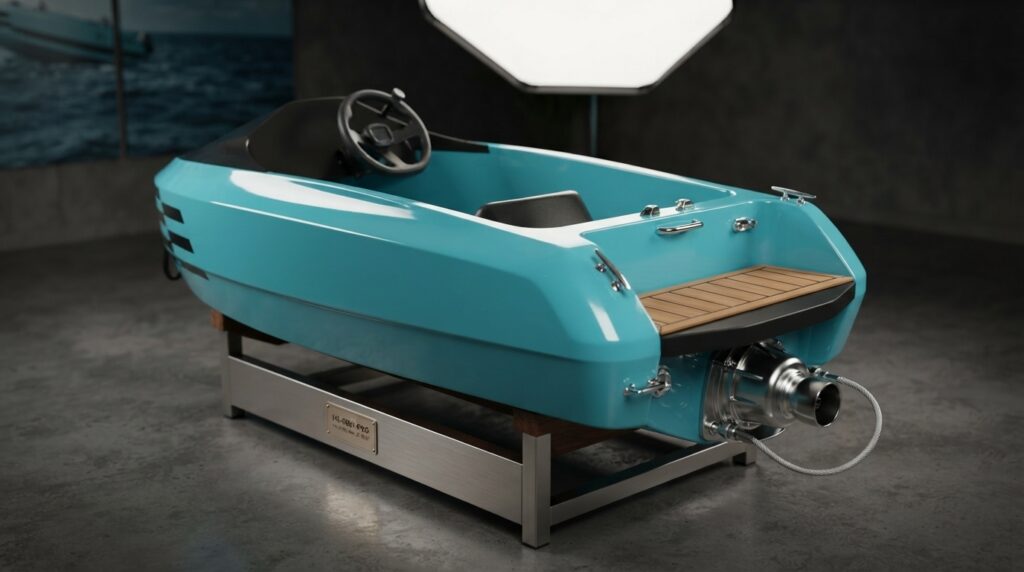
The moment a new boat arrives is exciting, and it's tempting to sign off quickly and get straight onto the water. But delivery day is also the last easy opportunity to catch a problem before it becomes your responsibility to resolve. A careful, methodical inspection at handover — whether the boat arrives on a trailer, is collected in person, or is delivered fully assembled to your door — can save significant time, cost and frustration later. This article sets out exactly what to check before accepting delivery of a new electric mini jet boat.
Traditional petrol-powered boats have a long-established pre-delivery inspection culture, and most buyers instinctively know to check the engine, hull and trailer before signing off. Electric mini jet boats introduce some additional considerations — battery condition, charging system function, and electrical connections — that aren't always front of mind for buyers used to conventional boats, but matter just as much, if not more, since electrical faults can be less immediately obvious than a mechanical one.
Catching an issue at delivery, before you've signed any acceptance paperwork, is generally far simpler to resolve than raising it after the fact. Most manufacturers and dealers are far more accommodating about pre-acceptance issues, since responsibility is unambiguous at that point, than about problems reported after the boat has left with you and been used.
Start with a full walk-around of the hull in good light, checking for scratches, gouges, cracks or any irregularities in the gelcoat or hull surface that weren't disclosed in advance. Pay particular attention to areas that take the most stress — the bow, the transom, and anywhere the hull meets fittings like cleats, rails or the jet intake housing.
Check that all fittings — rails, cleats, tie-down points, any bimini or canopy mounts — are securely attached, with no visible gaps, movement or evidence of poor sealing around mounting points, since a poorly sealed fitting is a common source of slow water ingress over time.
Inspect the hull below the waterline as closely as delivery conditions allow, looking specifically at the jet intake grate and pump housing for any damage, debris, or signs of impact that might not be visible from a standing position — this is worth getting down low or using a torch to check properly.
Sit in the boat and check that the seat, footwell and console all match what was ordered — colour, material and any specified options. Confirm the seat is securely mounted with no excessive play or movement, and that any adjustment mechanisms (if fitted) move smoothly through their full range without binding or excessive resistance.
Check that the console, display and any switches or buttons are firmly mounted, free of scratches or marks, and that all labelling is clear and correctly positioned. Test every switch and button for proper function — lighting, horn if fitted, display power, and any mode or setting controls — before leaving the delivery point.
This is one of the areas most specific to electric mini jet boats, and worth taking particular care over. Ask to see the battery's current state of charge displayed on the console or a diagnostic tool, and confirm it's at a reasonable level for delivery — most manufacturers deliver boats at a partial charge (commonly in the region of 50-80%) rather than fully charged, for battery health reasons, but it shouldn't be critically low.
Request confirmation of the battery's manufacture date or, where available, any diagnostic report showing cell health or capacity — reputable manufacturers and dealers should be willing to provide this for a new boat. Inspect visible wiring and connectors for signs of damage, corrosion, or connections that look less than fully secure, and ask specifically whether the battery and drive system have been bench-tested or water-tested prior to delivery.
If a charger is included, physically inspect it for damage, confirm the cable and connector are the correct type for your home power supply, and if practical, ask to see the boat charging briefly before finalising acceptance — even a short demonstration confirms the charging system engages correctly, rather than discovering a fault the first time you attempt to charge it yourself.
With the boat safely supported (on a trailer or stand, never running the jet system on land without the correct precautions and manufacturer guidance), check the steering moves smoothly through its full range in both directions, with no unusual resistance, play or noise. Ask the dealer or delivery representative to demonstrate throttle response, ideally with the boat in water in a controlled setting, so you can confirm the motor engages smoothly and predictably.
Check the jet intake grate is properly secured and free of any manufacturing debris, and ask whether the impeller and pump housing have been inspected and cleared prior to delivery — a stray piece of manufacturing debris left in the intake is an uncommon but real risk worth explicitly ruling out.
Before signing any acceptance form, confirm you've received: the boat's compliance plate or registration documentation as required in your state; the owner's manual and any quick-start guide; warranty documentation clearly stating coverage terms and duration; battery-specific warranty terms, which are sometimes separate from the boat's general warranty; and contact details for after-sales support and any authorised service points.
Confirm in writing (even a simple photo of the odometer, hour meter or delivery checklist signed by both parties) the boat's delivery condition — charge level, any pre-existing cosmetic marks disclosed and agreed upon, and confirmation that all inspection items have been checked. This protects both you and the dealer by establishing a clear, mutually agreed starting point.
If the boat is being delivered with a trailer, inspect the trailer independently of the boat itself: tyre condition and pressure, wheel bearings (ask when they were last serviced, particularly for a boat that's been in dealer stock for some time), lights and indicators fully functional, coupling and safety chain in good condition, and the boat properly and securely seated on its bunks or rollers with no excessive movement.
Depending on your state's requirements and how the boat is being used, delivery is also the right time to confirm that any mandated or expected safety equipment is present and in good order. This can include lifejackets appropriate to the boat's rated capacity, a fire extinguisher where applicable, a torch or signalling device, a bailer or bilge pump, and a rope or anchor suited to the boat's size and typical use. Even where safety equipment is sold separately rather than bundled with the boat, it's worth confirming at delivery exactly what is and isn't included, so there's no ambiguity about what still needs to be sourced before the boat can be legally and safely used.
Many modern electric mini jet boats include an onboard display or companion app showing battery status, speed, range estimates and diagnostic information. At delivery, it's worth confirming this system powers on correctly, displays accurate and current information, and that any companion app pairs successfully with the boat if one is provided. Ask whether the system's software is up to date, and if updates are periodically released, how those updates are typically applied — some systems update automatically via a connected app, while others require a visit to an authorised dealer. Understanding this now avoids confusion later if a feature seems to be missing or behaving unexpectedly simply because of an outdated software version.
Not every buyer is able to inspect a boat in person on delivery day, particularly for buyers in regional areas receiving a boat via freight or courier from an interstate dealer or manufacturer. Where an in-person inspection isn't possible before signing for delivery, it's worth requesting detailed photos or video of the boat's actual condition immediately prior to dispatch, and being clear with the freight company or dealer about your right to note damage on the delivery docket at the point of receiving the boat, even if a full functional inspection has to wait until you can properly assess it. Photographing the boat thoroughly yourself the moment it arrives, before any unpacking or setup, creates a clear record that protects you if a dispute arises later about whether damage occurred in transit or was pre-existing.
Buyers new to electric boats sometimes assume a boat should arrive fully charged, the way a phone or laptop might. In practice, most manufacturers deliberately deliver electric mini jet boats at a partial state of charge, typically somewhere in the 50-80% range, because storing a lithium battery at 100% charge for extended periods — which can happen while a boat sits in transit or dealer stock — is understood to accelerate long-term degradation compared with storing at a more moderate charge level. This is a genuinely good sign of a manufacturer that understands battery care, not a red flag or a sign of an incomplete delivery.
That said, it's still worth confirming the charge level is high enough for a meaningful test of the boat's systems, and asking the dealer to talk you through what charge level to expect and why, so you have realistic context rather than an unexplained number on a display. If a boat arrives at a notably low state of charge — low enough that a proper test of throttle response and system function isn't really possible — it's reasonable to ask for the boat to be charged further before you finalise delivery, or to arrange a follow-up check once you've charged it yourself at home.
Not all dealers and manufacturers apply the same level of rigour to pre-delivery testing, and it's worth asking directly what a given boat has actually been through before it reaches you. A thorough pre-delivery process typically includes a water test of the propulsion system, a full charge-and-discharge cycle check on the battery, a check of all electrical systems and switches, and a final visual and functional inspection against a documented checklist. A less rigorous process might amount to little more than a visual check before the boat is loaded for delivery.
Asking specifically "has this boat been water tested, and can I see any record of that test" is a fair and reasonable question, and a dealer or manufacturer confident in their process should be willing and able to answer clearly. If the answer is vague or evasive, that's worth treating as useful information in itself about how much independent verification you may need to do yourself at delivery.
Even a thorough delivery-day inspection has limits — some issues, particularly around battery performance and range, only become apparent once a boat has been properly used on the water for the first time, rather than briefly tested at the point of handover. It's worth planning a more extended first outing relatively soon after delivery, specifically paying attention to whether range, acceleration and general performance feel consistent with what was promised or advertised, rather than waiting weeks or months before the boat gets genuine use.
If anything feels off during this first proper outing — noticeably reduced range, unusual noise, or handling that doesn't match expectations — raising it with the dealer or manufacturer promptly, while the boat is still clearly within its early ownership period and any applicable early-issue support arrangements, is generally far more straightforward than raising the same concern many months later.
If an inspection reveals an issue — cosmetic damage, a malfunctioning switch, a battery that won't hold charge, or anything else — the key is to raise it before signing acceptance paperwork, not after. Take clear photographs, note the specific issue in writing, and discuss directly with the dealer or manufacturer representative present at delivery about how it will be resolved, whether that's an on-the-spot fix, a documented commitment to resolve it shortly after delivery, or in some cases declining to accept delivery until the issue is corrected.
Reputable manufacturers and dealers generally want to resolve legitimate pre-delivery issues efficiently, since an unhappy customer at the very start of ownership reflects poorly on the business — but that goodwill is much easier to draw on before you've signed off than after.
When assessing anything found during inspection, it's useful to mentally separate cosmetic issues from functional ones, since they typically warrant a different response. A minor cosmetic mark — a small scuff on the hull from handling during transport, for instance — is worth documenting and discussing, but rarely a reason to decline delivery outright, provided it's disclosed and agreed in writing and any appropriate remedy (touch-up, minor discount, or simple acknowledgment) is arranged.
A functional issue — a battery that won't hold charge, a switch that doesn't work, steering with excessive play — is a different matter entirely, and generally does warrant declining to finalise acceptance until it's resolved, since these issues affect the boat's actual usability and safety rather than simply its appearance. Being clear-eyed about this distinction helps keep the delivery process constructive rather than adversarial, while still ensuring genuinely important issues are properly addressed before you sign off.
For buyers who aren't entirely confident conducting a thorough technical inspection alone, it's genuinely useful to bring a second person along to delivery — ideally someone with some relevant boating, mechanical or electrical experience, though even a second set of eyes without specific expertise can help catch things a single person might miss while managing paperwork, questions and the general excitement of the moment. Some buyers also choose to arrange for an independent marine mechanic or surveyor to attend delivery for a more significant purchase, which, while an added cost, can provide genuine peace of mind for buyers who want an expert opinion beyond what a visual walk-around alone can offer.
Where you have any influence over scheduling, it's worth choosing a delivery time and setting that genuinely allows a proper inspection — good natural light, reasonable weather, and enough time set aside that you're not rushed by a courier's tight schedule or your own competing commitments. A delivery arranged for late in the day, in poor light or under time pressure, makes a thorough inspection considerably harder to carry out properly, and issues are more easily missed simply because conditions weren't conducive to looking closely. If a water test of the propulsion and throttle system is planned as part of delivery, checking the weather forecast and choosing a reasonably calm day also makes that test more meaningful, since a water test in choppy, difficult conditions tells you less about the boat's baseline function than one carried out in calmer water.
Whatever the outcome of your delivery-day inspection, it's worth keeping a simple, organised record — photos, any signed checklist, warranty documents and delivery paperwork — somewhere easy to find later. This record becomes genuinely useful if a warranty claim, resale, or insurance matter arises down the track, since it establishes a clear baseline of the boat's condition and specification at the point you took ownership. A shared folder, a dedicated email, or even a simple physical folder kept with the boat's other paperwork all work well; what matters is that the information is captured while it's fresh and easy to gather, rather than reconstructed from memory months or years later.
A thorough delivery-day inspection takes perhaps thirty to forty-five minutes longer than a quick sign-and-go handover, but it's the single easiest point in the entire ownership journey to catch and resolve a problem. Electric mini jet boats add a few specific items to the traditional pre-delivery checklist — battery condition, charging system function, and electrical connections — that are worth taking just as seriously as the more familiar hull and mechanical checks. Taking the time to inspect properly, and being willing to raise concerns before signing off, sets up a much smoother start to ownership than accepting delivery on trust alone. A little patience and diligence on a single day pays dividends across every outing that follows.
It's worth approaching delivery day with a balance of enthusiasm and diligence rather than treating the two as being in tension. Being thorough doesn't mean being distrustful, and most dealers and manufacturers genuinely welcome an engaged, well-prepared buyer, since it tends to lead to a smoother relationship on both sides from the very start of ownership. Going in with a clear checklist, a bit of patience, and a willingness to ask direct questions sets the tone for a positive, well-informed start to your time on the water.
Vector Watercraft supplies fully assembled electric mini jet boats to Australian buyers, with every boat inspected and tested prior to delivery and full documentation, including battery health information, provided as standard. Every unit leaving the factory goes through a documented, multi-point check covering hull condition, electrical systems, propulsion function and battery diagnostics, so buyers can walk into delivery day with genuine confidence rather than uncertainty. Backed by a 2-year warranty and dedicated after-sales support, Vector Watercraft aims to make delivery day a straightforward, transparent step in the ownership journey rather than a source of uncertainty.