
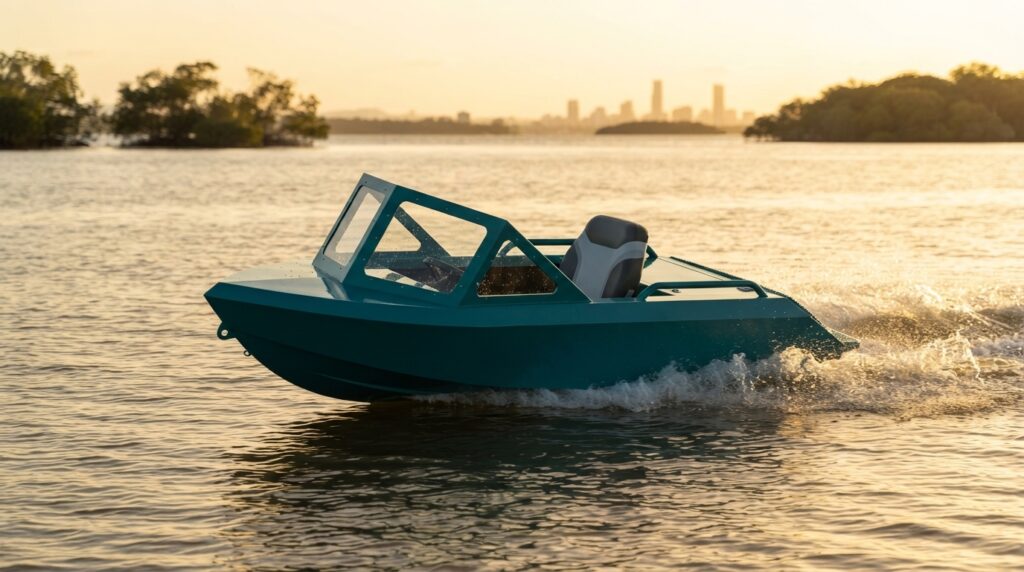
Mini jet boats have become one of the fastest-growing categories in recreational watercraft, and for good reason. They are compact, exciting, easy to store, and increasingly accessible to people who would never have considered boat ownership a few years ago. But as demand has grown, so has a divide in how these boats reach the water. On one side sit fully assembled electric mini jet boats, engineered, tested, and certified before they ever touch a lake or river. On the other side sit engine-less kit boats: hulls sold separately from the propulsion system, left for the buyer or a third party to combine, wire, and commission at home.
That difference sounds like a matter of convenience. In practice, it is a matter of safety. When a boat is designed and built as a single integrated system, every component is chosen, tested, and matched to work with every other component. When a boat is assembled from parts sourced independently, that integration has to happen somewhere else, usually in a garage, by someone without access to the engineering data, test equipment, or liability accountability that a manufacturer has. This article looks closely at why that gap matters, what specifically goes wrong with kit-based builds, and why the fully assembled approach has become the standard that safety-conscious buyers and regulators increasingly expect.
It is worth being clear at the outset that this is not a criticism of hobbyists or of the DIY spirit that has long existed in boating. Building things by hand has a proud history on the water, and for simple, low-power craft the risks of a home build are often modest and well understood by the people taking them on. Mini jet boats sit in a different category. They combine a small, sensitive hull with a powerful, high-thrust propulsion system and, increasingly, a high-voltage electric battery pack, all operating close to swimmers, other small craft, and shorelines. That combination raises the stakes on getting the integration right, and it is exactly why the assembled-versus-kit distinction deserves more attention than it usually gets.
A fully assembled electric mini jet boat begins its life as a single design brief. The naval architect, the electrical engineer, and the propulsion specialist work from the same hull drawings, the same weight budget, and the same performance targets. The battery pack, motor, jet drive, wiring loom, and control electronics are selected together, not bolted on after the fact. Every one of those components has been chosen because it suits the others, not because it happened to be available or affordable at the time.
A kit boat starts from a very different premise. The hull is designed and sold as a standalone product, often with a generic weight and power allowance intended to cover a wide range of possible engines. The buyer, or an installer they hire, is then responsible for sourcing a motor, a power source, mounting hardware, wiring, and control systems, and fitting them into a hull that was never built with that specific combination in mind. Two kit boats with an identical hull can end up with completely different safety profiles depending on what engine was fitted, how it was wired, and how carefully the installer understood the hull’s actual limits.
This is the core distinction that runs through every safety issue discussed below. Assembled boats are engineered as systems. Kit boats are assembled as collections of parts, and the quality of that assembly depends entirely on the skill, equipment, and judgement of whoever does the work.
Every hull has a narrow band of power, weight, and thrust that it was designed to handle safely. Go outside that band and the way the boat behaves in the water changes, sometimes subtly, sometimes dramatically. A hull built to carry a modest, well-matched electric drive system will sit, plane, and turn very differently if a heavier or more powerful unit is dropped into it.
In a fully assembled boat, this risk is eliminated by design. The manufacturer has already run the calculations, and often the on-water testing, to confirm that the motor, battery pack, and jet drive combination sits comfortably within the hull’s intended performance envelope. Weight distribution, centre of gravity, and thrust output are all part of the original engineering process.
In a kit build, this matching is left to guesswork. Sourcing a motor and battery pack is often driven by cost, availability, or enthusiasm for higher performance rather than by a documented engineering assessment of what the hull can safely carry. The result can be a boat that is nose-heavy, tail-heavy, prone to unexpected bow steer, or capable of accelerating faster than its hull was ever designed to handle at speed. None of these problems are visible by looking at the finished boat. They only show up on the water, often at the worst possible moment, such as a sudden turn, an unexpected wave, or a passenger shifting weight.
One of the most significant, and least visible, safety advantages of a fully assembled electric mini jet boat is the testing that happens before it ever reaches a customer. Reputable manufacturers put prototypes and production units through structured test programmes: static load testing of the hull and mounting points, water testing across a range of speeds and conditions, electrical system testing under load and under fault conditions, and often independent verification against recognised marine standards.
This testing catches problems long before a customer ever owns the boat. If a battery enclosure runs hotter than expected under sustained load, that shows up on a test bench, not on a family holiday. If a hull flexes more than anticipated at speed, that shows up during sea trials, not when a teenager is driving it near a jetty full of swimmers. If a wiring harness chafes against a bracket after a few hours of vibration, that shows up during durability testing, not months later as a fault the owner has no way of diagnosing.
Kit boats, almost by definition, skip this entire process. There is no factory testing of the finished combination, because the finished combination does not exist until the buyer or installer creates it at home. Whatever testing occurs, if any, is informal, unrepeatable, and rarely documented. The first “test” of a kit-built mini jet boat is often its first outing with the owner’s own family on board.
Small jet boat hulls have less margin for error than larger vessels. There is less hull volume to absorb an engineering mistake, less freeboard to cope with an unexpected wave, and less time for a driver to react if something goes wrong, simply because everything happens closer to the water and closer to other people.
Overpowering a small hull is one of the most consistent causes of dangerous handling in this category. A motor and drive combination that produces more thrust than the hull was designed to manage can cause the bow to lift excessively at low speed, cause the boat to “porpoise” or bounce unpredictably at speed, increase stopping distances beyond what the driver expects, and make the boat significantly harder to control in a tight turn or sudden manoeuvre.
These are not theoretical concerns. They are well understood failure modes in small recreational hulls generally, and they become more likely, not less, when a hull is paired with a drivetrain chosen without reference to the manufacturer’s original engineering limits. In a fully assembled boat, this risk is designed out from the start. The manufacturer’s own reputation, and often regulatory compliance, depends on the finished product behaving predictably across its intended speed range. In a kit build, the buyer has no equivalent guarantee, because no single party has taken responsibility for confirming the hull and motor were ever meant to work together.
Marine electrical systems are held to a higher standard than most people realise, and for good reason. Water, vibration, salt exposure, and high current draw combine to create conditions where a wiring mistake that would be a minor inconvenience on land can become a serious hazard on the water. Battery packs need enclosures rated for marine use. Wiring needs to be sized correctly for the current it will carry, routed to avoid chafing, and protected against moisture ingress. Control systems need fail-safes that respond correctly if a fault occurs, not just when everything is working normally.
Manufacturers of fully assembled electric mini jet boats build this expertise into the product from day one. Battery management systems are specified, tested, and integrated as part of the design, not added as an afterthought. Wiring looms are engineered to a specification, not improvised with parts from a hardware store. Enclosures are chosen and tested for the specific thermal and moisture conditions the boat will actually face.
This is precisely the area where kit builds carry the most risk, because it is also the area where mistakes are hardest for an untrained buyer to spot. A wiring fault, a poorly sealed connector, or an undersized cable will often work perfectly well in dry, calm conditions and only reveal itself under load, in rough water, or after repeated exposure to moisture over months of use. By the time a problem becomes visible, it has often already been present for a long time.
Mini jet boats have a broad appeal, but a significant share of buyers are families looking for an accessible, manageable way to get out on the water together. This is precisely the group for whom the safety gap between assembled and kit boats matters most. Families are less likely to have the technical background to assess a home-built electrical system or judge whether a hull and motor combination has been properly matched. They are more likely to have children on board, where consequences of an unexpected handling issue are magnified. They are less likely to be doing ongoing diagnostic maintenance on a boat that was assembled without documentation in the first place.
A fully assembled electric mini jet boat removes the need for that technical judgement entirely. The buyer does not need to know how to size a wiring loom or calculate a safe power-to-weight ratio, because that work has already been done, tested, and signed off before the boat left the factory. This is not a minor convenience. It is the difference between trusting an engineered product and trusting an unverified assembly process that nobody has taken responsibility for.
One of the most overlooked aspects of this comparison is accountability. When a fully assembled boat is sold by a manufacturer, that manufacturer stands behind the combination of hull, motor, battery, and control system as a single product. If a fault is discovered, there is a clear path for a recall, a fix, or a warranty claim, and a clear party responsible for making it right. Regulatory bodies can hold that manufacturer to defined standards, because the manufacturer controls every part of the build.
A kit boat has no equivalent chain of accountability. The hull manufacturer is only responsible for the hull. The motor supplier is only responsible for the motor. Whoever combined them, whether that is the buyer, a friend, or a local installer, is rarely in a position to warrant the safety of the finished system, and often has no formal relationship with either original manufacturer. If something goes wrong, working out who is responsible, and getting it fixed properly, becomes far harder, precisely at the moment when clarity matters most.
Australia’s regulatory environment for recreational watercraft is administered at both state and national levels, and it is tightening as smaller electric craft become more common. Marine safety authorities in states such as New South Wales, Queensland, and Victoria set requirements around construction standards, buoyancy, and equipment for powered vessels, and increasingly ask manufacturers to demonstrate that a boat’s design has been assessed as a complete unit rather than a hull sold on trust.
This shift matters directly to the kit-versus-assembled question. A fully assembled electric mini jet boat from an established manufacturer is far better placed to meet these evolving compliance expectations, because compliance documentation, construction records, and test data already exist as part of the build process. A kit boat, built and wired outside any formal manufacturing process, typically has none of this. The buyer, not the original hull or component suppliers, becomes the one left explaining to a marine safety inspector, or an insurer, exactly how the boat was put together and whether it meets the relevant construction requirements.
Insurance is a practical example of where this gap becomes expensive rather than theoretical. Insurers assessing a claim on a recreational watercraft increasingly ask for evidence of how a vessel was built and certified. A fully assembled boat with manufacturer documentation is straightforward to insure and, if necessary, to claim against. A home-assembled kit boat, with no single party able to confirm how the electrical and propulsion systems were integrated, can create genuine difficulty at claim time, on top of the safety questions already discussed.
The upfront price difference between a kit hull and a fully assembled electric mini jet boat is often the first thing buyers compare, but it is rarely the full picture. A kit build carries ongoing costs that are easy to underestimate: the cost of sourcing a suitably rated motor and battery system, the cost of professional installation if the buyer does not have the skills to do it safely, the cost of diagnosing and fixing problems that a factory test programme would have caught before delivery, and the cost, financial and otherwise, if a handling or electrical fault leads to an incident on the water.
Fully assembled boats fold these costs into a single, transparent price. The engineering, the testing, the compliance documentation, and the warranty are all part of what the buyer pays for, and all of it is designed to reduce the chance of an unpleasant surprise later. For most buyers, particularly those without a marine engineering background, this is not just a safety advantage. It is a more honest way of understanding what a mini jet boat actually costs to own responsibly over time.
None of this is an argument against the appeal of mini jet boats, electric or otherwise. It is an argument for understanding what “fully assembled” actually protects against. It protects against mismatched power and hull design. It protects against untested electrical systems operating in a demanding marine environment. It protects against the absence of factory sea trials that would otherwise catch handling problems before a customer ever experiences them. And it protects against a fragmented chain of responsibility that leaves buyers with nowhere to turn if something does go wrong.
For anyone weighing up a mini jet boat purchase, the question worth asking is not simply “how much does this cost” or “how fast does this go.” It is “who is responsible for the safety of this boat as a complete, integrated system.” A fully assembled electric mini jet boat has a clear answer to that question. A kit boat, built from separately sourced parts, very often does not.
As this category continues to grow in Australia and beyond, that distinction is likely to matter more, not less. Buyers are becoming more informed, regulators are paying closer attention to small watercraft, and the manufacturers who have invested in proper engineering, testing, and accountability are the ones setting the standard the rest of the market will eventually have to meet.
Are kit-built mini jet boats illegal in Australia? Not necessarily, but the buyer or installer becomes responsible for ensuring the finished vessel meets relevant state marine safety and construction requirements. Because there is no factory sign-off on the completed hull-and-motor combination, meeting those requirements can be far harder to demonstrate than with a fully assembled, manufacturer-certified boat.
Can a skilled home builder make a kit boat just as safe as an assembled one? A highly experienced marine electrician or boat builder can reduce the risk considerably, but they are still working without the manufacturer’s original design data, load calculations, and factory test results. Even skilled work on a kit boat is, at best, recreating in a shed what a manufacturer has already engineered, tested, and documented at scale.
Does “fully assembled” mean the boat cannot be modified later? No. Fully assembled electric mini jet boats can still be serviced, upgraded, or customised over time. The difference is that any changes happen to a vessel that started life as a tested, documented system, rather than one that was never verified as a complete unit in the first place.
Why do electric drivetrains make this comparison more important, not less? Electric propulsion introduces high-voltage battery packs and battery management electronics that carry their own specific safety requirements. These systems reward careful, factory-level integration and testing even more than traditional petrol engines do, which makes the assembled-versus-kit distinction especially relevant for electric mini jet boats specifically.
Vector Watercraft designs and builds fully assembled electric mini jet boats for the Australian market, with every hull, battery system, and jet drive engineered and tested together as a single product before it reaches a customer. Our approach reflects the standard this article describes: integrated design, factory testing, and clear manufacturer accountability, so buyers can spend their time enjoying the water rather than troubleshooting a system nobody has fully verified. Readers considering a mini jet boat purchase are welcome to reach out to our team with questions about hull design, battery safety, or how our testing process works before any boat leaves the factory.