
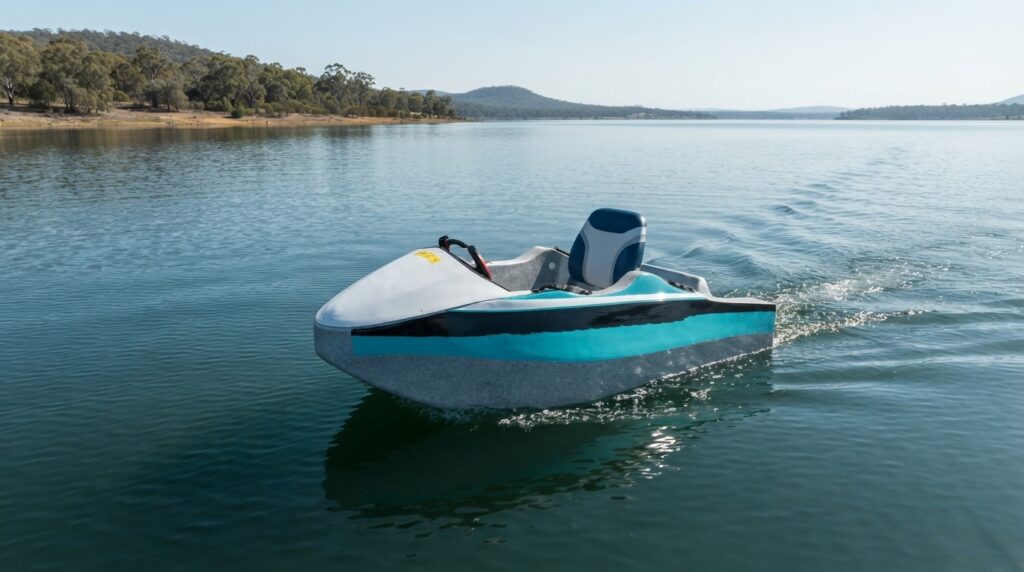
It's a common assumption, understandable but mistaken, that a mini jet boat's maximum range figure and its maximum speed figure are two independent specifications that can simply be enjoyed together on the same outing. In reality, they sit at opposite ends of the same underlying trade-off. Chasing one actively works against achieving the other, and understanding why helps set far more realistic expectations for any given trip.
Manufacturer-quoted maximum range and maximum speed figures are almost never achieved simultaneously, because they're generated under fundamentally different test conditions. Maximum range figures are typically produced at a moderate, efficient cruising speed, sustained steadily over an extended period. Maximum speed figures are typically a brief, peak measurement, often unsustainable for more than a short period due to the thermal and battery discharge factors discussed in companion articles.
These two figures represent opposite ends of the boat's performance envelope, not two features that can be stacked together on the same outing.
As covered in detail in the article on speed and battery consumption, the drag a hull experiences doesn't rise proportionally with speed — it rises sharply, particularly as a boat pushes toward its upper speed range. This means the energy cost of maintaining a boat's absolute top speed is disproportionately higher than the energy cost of a moderate, efficient cruising speed — not just a little higher, but often dramatically so.
Riding at or near top speed for any extended period draws down the battery considerably faster than moderate cruising, which directly and substantially reduces achievable range for that portion of the outing.
Think of a mini jet boat's available battery energy as a fixed budget that can be "spent" in different ways. Spending it slowly, at a moderate, efficient pace, buys the most distance per unit of energy — this is how maximum range figures are achieved. Spending it quickly, at or near top speed, buys considerably less distance per unit of energy, because a large proportion of that energy is being consumed fighting the sharply rising drag at higher speeds rather than efficiently converting into forward progress.
This is why a rider chasing maximum range and a rider chasing maximum speed are, in effect, making opposite choices about how to spend the same finite energy budget — and why a single outing genuinely can't optimise for both simultaneously.
Most real outings fall somewhere between these two extremes — some cruising, some acceleration, occasional bursts of higher speed. Understanding the trade-off doesn't mean avoiding higher speeds altogether; it means understanding that time spent at or near top speed comes with a real, disproportionate range cost, and factoring that into trip planning accordingly.
A rider who wants to enjoy some higher-speed riding on a particular outing can reasonably do so — but should expect and plan for a shorter overall range on that outing compared to a trip spent entirely at a moderate cruising pace. This connects directly to the trip planning and battery reserve practices covered in companion articles: an outing with planned high-speed sections warrants a more conservative range estimate than one planned entirely around efficient cruising.
It might seem inconsistent for a manufacturer to publish both a maximum range figure and a maximum speed figure if they can't be achieved together, but both figures serve a genuine, legitimate purpose: they describe the outer limits of the boat's performance envelope in two different dimensions. Maximum range answers "how efficient can this boat be under ideal cruising conditions." Maximum speed answers "how fast can this boat go under ideal peak conditions." Neither figure is dishonest — the potential for confusion arises only if a buyer assumes both apply simultaneously on the same outing, which was never the implication.
Because the trade-off is real but not absolute, most riders end up finding a personal balance point that suits their priorities for a given outing:
Maximum range and maximum speed represent two opposite ends of a mini jet boat's performance envelope, not two independently achievable features. The sharply rising energy cost of higher speeds means time spent near top speed directly and substantially reduces achievable range, and there's no way around this basic physical relationship regardless of how a particular boat is engineered. Riders who understand this trade-off, rather than expecting both figures to apply simultaneously, are far better equipped to plan outings that genuinely match their priorities — whether that's covering maximum distance, enjoying maximum performance, or striking a deliberate, informed balance between the two.