
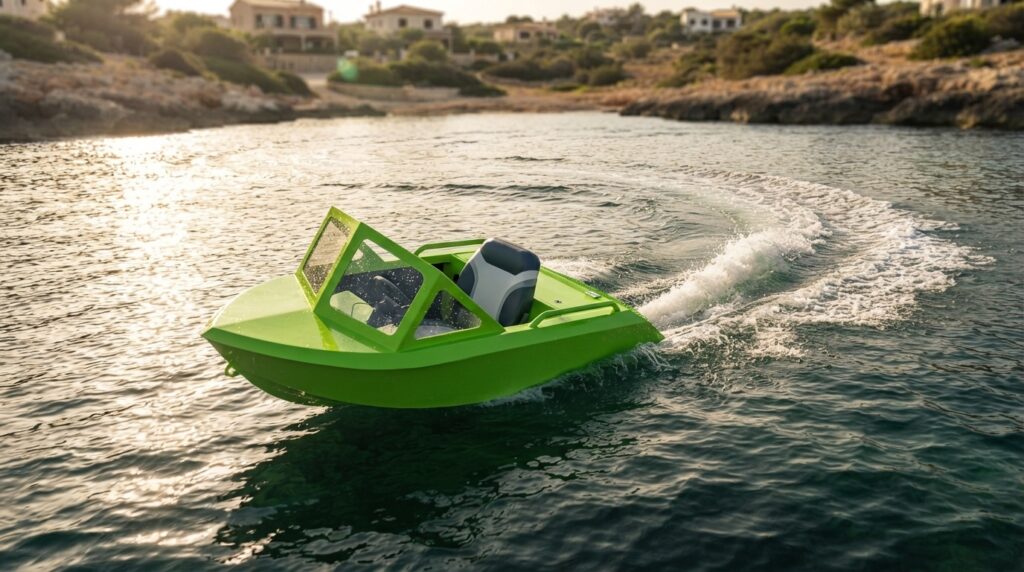
Top speed is the single most quoted figure in mini jet boat marketing, and it's understandable why — it's a simple, easy-to-compare number that seems to promise a straightforward answer to "which boat is faster." In practice, top speed is one of the least useful figures for predicting how a mini jet boat will actually perform, because it captures a single, narrow moment (maximum velocity in ideal conditions) while ignoring almost everything that determines how a boat actually feels and behaves during a typical outing.
Top speed is usually recorded under close to ideal conditions: flat water, a single rider, minimal gear, and often a fully charged battery. It tells you the ceiling the boat can reach under those specific circumstances — nothing more. It says nothing about how quickly the boat gets there, how it handles with a passenger aboard, how it copes with chop, or how long that top speed can actually be sustained before battery output or thermal limits intervene.
Two mini jet boats can share an identical top speed figure and still deliver completely different real-world experiences, because top speed alone doesn't capture acceleration, handling, load sensitivity, or sustainability.
For the vast majority of mini jet boat outings, top speed is rarely held for extended periods. Far more of the ride consists of accelerating out of turns, adjusting speed around other water users, and cruising at a comfortable mid-range pace. A boat with a modest top speed but strong acceleration and a generous power-to-weight ratio (covered in more detail in a related article) can feel considerably more lively and satisfying to ride than a boat with a higher top speed but sluggish acceleration.
This is because acceleration is what riders actually feel moment to moment — the responsiveness of the throttle, how quickly the boat climbs onto the plane, and how eagerly it regains speed after a turn. Top speed, by contrast, is a single data point reached only briefly, if at all, during a typical ride.
An advertised top speed figure is almost always a peak, momentary figure — not a speed the boat can sustain indefinitely. Electric mini jet boats in particular are subject to battery output limitations and motor thermal management, both of which can reduce available power output if maximum speed is held for an extended period.
This means the genuinely useful question isn't "what is the top speed," but "how long can that speed actually be maintained, and what happens to performance after that." A boat that can briefly touch a high top speed but tapers off quickly afterward offers a very different practical experience to one with a slightly lower top speed that can be held consistently. Manufacturers rarely volunteer this distinction, which is exactly why it's worth asking about directly.
Two boats travelling at the same speed can feel completely different depending on hull length, beam width, and weight distribution — all covered in more detail in related articles. A boat that reaches a high top speed but does so with a choppy, spray-heavy, unsettled ride delivers a fundamentally different experience to a boat that reaches a slightly lower top speed smoothly and predictably.
Top speed figures say nothing about this handling character. A rider who values comfort and confidence at speed may find a boat with a lower top speed but composed handling far more enjoyable than one that technically goes faster but feels unsettled getting there.
Almost all published top speed figures assume a single, relatively light rider with minimal gear. Add a second passenger, and top speed typically drops — sometimes significantly — because the same motor output now has to move meaningfully more mass (as explained in the earlier article on power-to-weight ratio).
This means the solo top speed figure quoted in marketing material may bear little resemblance to what a boat can achieve on a typical two-up outing. A boat with a genuinely strong two-up top speed and a boat that only hits its headline figure solo can look identical on a spec sheet while performing very differently for anyone regularly carrying a passenger.
Pursuing maximum speed also has a direct cost in range. Energy consumption in a planing hull increases sharply, not linearly, as speed rises — meaning the last increment of top speed is usually the most energy-expensive to achieve and sustain. A rider chasing the boat's absolute top speed will see battery range drop noticeably compared to cruising at a moderate, efficient speed.
This is worth factoring into any comparison based on top speed: a boat advertised with a high top speed may only be practical to use at that speed for very short bursts before energy consumption forces a return to a more moderate pace, which somewhat undercuts the headline figure's real-world relevance.
Rather than treating top speed as the primary performance indicator, it's more useful to weigh it alongside:
Top speed is a single, narrow snapshot — a boat's absolute ceiling under close to ideal, rarely-replicated conditions. It says almost nothing about acceleration, comfort, handling, how the boat performs with a passenger aboard, or how long that speed can actually be sustained before range or thermal limits step in. Buyers who compare mini jet boats primarily on top speed risk choosing a boat that looks impressive on paper but underdelivers on the kind of riding they'll actually be doing most of the time. Looking past the headline number, to the factors that shape how a boat actually feels and performs across a typical outing, leads to a far more reliable comparison.