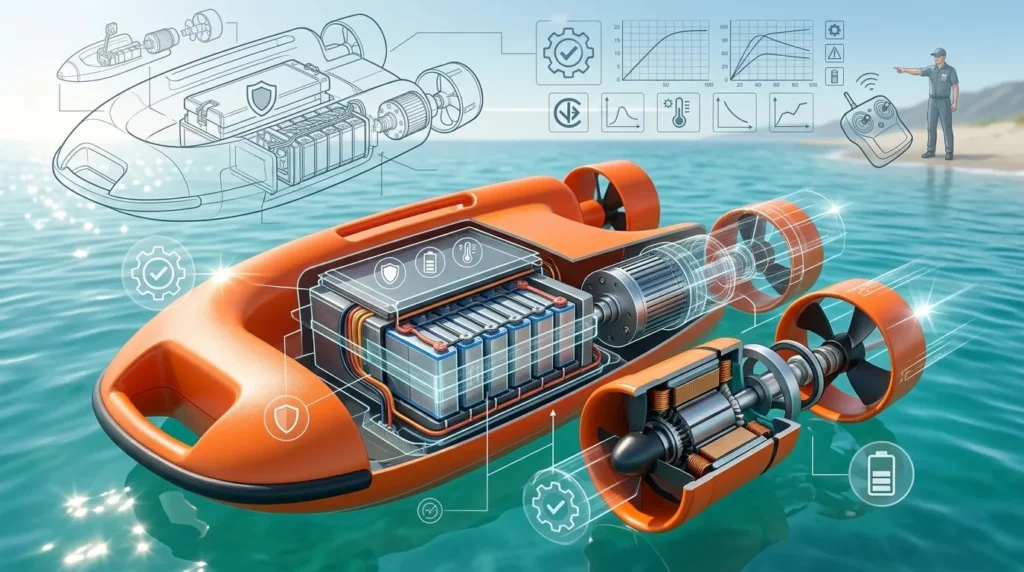
Why battery and motor quality is a life-safety issue
With rescue equipment, “good enough” is not good enough. When a device is used in an emergency, failure isn’t an inconvenience—it can be the difference between a rescue and a recovery. Battery and motor quality sit at the centre of that risk because they affect:
- reliability under load (current, waves, towing)
- predictable run time
- safety during charging and storage
- resistance to water intrusion
- performance consistency over years, not months
An RCRB may sit idle for long periods, then be expected to perform instantly, at full power, in harsh conditions. That is exactly the kind of use case that exposes poor battery systems and weak motor engineering.
The two main risks: failure and fire
Battery discussions often get reduced to “Will it catch fire?” That is one risk—but there are two:
- Operational failure: the unit stops mid-rescue, loses thrust, or control becomes erratic
- Thermal event/fire: charging or battery damage leads to overheating, smoke, or fire
Both are serious. Buyers should treat battery safety as both a performance and a storage/charging safety matter.
What “battery safety” means in practical terms
Battery safety is built from layers:
- Cell quality and chemistry
- Battery Management System (BMS) design
- Pack construction and sealing
- Charging method and protection
- Mechanical protection against shock and vibration
- Temperature monitoring and limits
- Water ingress protection
- Maintenance and inspection routines
A responsible supplier should be able to explain these layers clearly and provide documentation.
Lithium batteries: what matters most for rescue equipment
Most modern RCRBs use lithium-based batteries because of energy density and power delivery. For rescue devices, look for:
- Robust BMS with overcharge, over-discharge, overcurrent protection
- Balance charging protection to keep cells equalised
- Safe charging equipment matched to the pack
- Clear storage guidelines (especially for long idle periods)
- Sealed pack housing resistant to salt spray and immersion
- Clear procedures for damaged packs (do not “just keep using it”)
A cheap battery pack can work in hobby devices, but rescue equipment demands more conservative engineering.
Motor standards: why “it runs” isn’t enough
The motor must deliver consistent thrust without overheating, shorting, or suffering water ingress. Key factors include:
- Quality of motor windings and insulation
- Sealing against water intrusion
- Corrosion resistance (especially in saltwater)
- Thermal management under continuous load
- Efficiency (better efficiency means longer run time and less heat)
- Propulsion safety design (ducted/jet vs exposed prop)
If a motor draws excessive current under load, it stresses the battery, heats the system, and can trigger BMS cut-outs—exactly what you do not want mid-rescue.
What buyers should ask suppliers to provide
Australian buyers should be firm. Ask for:
- Battery specifications: voltage, capacity, chemistry type, rated discharge current
- BMS protection list and cut-off thresholds
- Charging system specs and safety features
- Waterproofing rating or sealing description
- Motor specifications and thermal protection details
- Any test documentation relevant to electrical safety and durability
- Warranty terms that specifically cover battery and motor failure
If a supplier cannot provide meaningful detail, that’s a warning sign.
“European standards” and what that should mean to a buyer
You will often hear that a product meets “European standards.” That phrase can be meaningful—but only if it is backed by real compliance and testing documentation. In practical terms, a quality manufacturer typically aligns with well-known frameworks for:
- electrical safety
- EMC (electromagnetic compatibility) so the device doesn’t interfere and isn’t easily interfered with
- battery transport safety requirements (important for shipping and storage)
- manufacturing quality systems (traceability, testing, consistency)
A buyer doesn’t need to be an engineer, but they should insist on something better than vague claims. Documentation matters.
The hidden danger of “cheap” electrics in rescue devices
Cheap battery systems and motors tend to fail in predictable ways:
- reduced capacity after limited cycles
- voltage sag under load (loss of thrust when it’s needed most)
- poor sealing leading to corrosion and intermittent faults
- chargers that do not properly manage cell balancing
- lack of thermal protection, leading to overheating
In a recreational toy, a failure is annoying. In a rescue tool, it’s unacceptable.
Charging and storage: where most battery problems begin
Many battery incidents happen not during use, but during charging. Good practice includes:
- charge in a dry, ventilated area away from flammable materials
- use only the manufacturer-approved charger
- avoid charging immediately after heavy use if the pack is hot
- inspect for swelling, damage, salt residue, or connector corrosion
- do not store fully flat for long periods (most lithium packs prefer partial charge storage)
- keep a simple log of charge cycles and inspection checks
For councils, clubs, and resorts, a disciplined checklist is the best “standard” of all.
Water ingress and corrosion: the Australian reality
Saltwater is unforgiving. It finds weak seals, corroded connectors, and poorly protected electronics. The best RCRBs are designed for it; the cheap ones are not.
Buyers should look for:
- sealed connectors
- corrosion-resistant materials
- easy rinse-down design
- maintenance instructions that include freshwater rinse after use
- clear service intervals
A device that is never rinsed after saltwater use is living on borrowed time.
Maintenance: the old-fashioned discipline that protects modern gear
The most reliable rescue equipment is rarely the most “high-tech.” It is the gear that is:
- checked regularly
- kept clean
- stored correctly
- used in drills
- serviced as recommended
This is traditional preparedness applied to modern tools. An RCRB with excellent engineering still needs that discipline.
A practical Australian-ready safety checklist
If you want a simple “ready-to-rescue” routine:
- Weekly: controller power check, device power check, short propulsion test
- After saltwater use: freshwater rinse, dry, inspect seals and connectors
- Monthly: battery charge cycle test, check run time consistency
- Quarterly: scenario drill and full inspection
- Annually: service check as per manufacturer, replace worn seals/parts
Bottom line
Battery safety and motor standards are not marketing extras—they are the foundation of whether an RCRB can be trusted in an emergency. A serious Australian buyer should prioritise:
- documented battery management and safety
- robust sealing and corrosion resistance
- motor engineering that performs under load without overheating
- disciplined charging, storage, and maintenance routines
- supplier support that ensures long-term reliability
When lives are on the line, reliability is the true premium feature.