
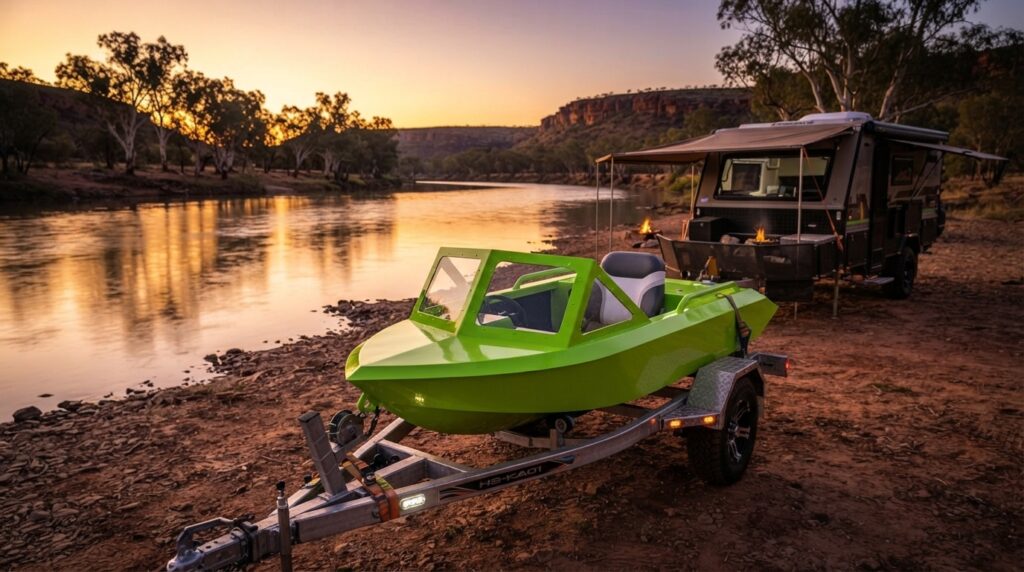
Towing a separate boat trailer behind a motorhome or camper trailer isn't always practical or even legally straightforward, given combination length limits and the towing capacity many motorhomes and camper trailers already have fully committed elsewhere. This raises a genuinely practical question for travellers considering a mini jet boat: is towing the only option, or can a compact electric mini jet boat actually be carried more directly?
A conventional caravan setup involves a tow vehicle separate from the accommodation, which often leaves some towing capacity available for an additional light trailer, as discussed in the companion article on caravan and camping appeal. A motorhome, by contrast, is typically a single, self-contained vehicle, and many motorhomes have limited or no rated towing capacity remaining once the vehicle's own considerable weight is accounted for. This makes the question of carrying rather than towing considerably more relevant for motorhome owners specifically, and also relevant for camper trailer setups where combination length or towing capacity is already tightly committed.
Carrying a mini jet boat, as distinct from towing it on its own trailer, generally means transporting the boat directly on or within the motorhome or camper trailer's own structure — commonly a rear-mounted carrier, a roof-based rack system where size and weight permit, or in some larger motorhome configurations, a dedicated garage or storage bay built into the vehicle itself.
Whether any of these approaches is genuinely practical depends heavily on the specific boat's dimensions and weight, discussed in detail in the article on hull weight, and on the specific motorhome or camper trailer's own carrying capacity and available mounting points.
This is where a mini jet boat's comparative light weight, relative to conventional boats, becomes directly relevant to feasibility. Motorhomes and camper trailers have their own rated payload capacity — the total additional weight, beyond the vehicle's own base weight, that can be safely carried. This payload capacity has to account for water, gas, personal belongings, and any other equipment already being carried, meaning the genuinely available capacity for an additional item like a boat may be considerably less than the vehicle's headline payload figure suggests.
A mini jet boat's weight needs to be checked specifically against genuinely remaining payload capacity, not against the vehicle's total rated capacity in isolation, since much of that capacity is likely already committed to other essentials.
Some motorhome and camper trailer owners use rear-mounted carrier systems, similar in concept to a rear-mounted bike rack but scaled and rated for heavier items, to carry a compact boat. This approach keeps the boat's weight low and towards the rear of the vehicle, which has implications for the vehicle's own handling and weight distribution that should be assessed by, or in consultation with, the vehicle manufacturer or a qualified fitter, rather than approached as a simple aftermarket addition without proper engineering consideration.
For genuinely lightweight, compact mini jet boats, roof-based carrying is sometimes considered, though this introduces its own set of considerations: significantly raised centre of gravity affecting vehicle handling, practical difficulty loading and unloading a boat at height without assistance, and roof rack rated capacity limits that need to be carefully checked against the boat's actual weight. This option tends to suit only the lightest, most compact mini jet boat configurations, and generally requires professional-grade racking rather than standard roof bars.
Larger motorhomes sometimes include a dedicated rear garage space, originally intended for items like motorcycles or larger equipment, which can potentially accommodate a compact mini jet boat depending on the boat's specific dimensions relative to the garage space available. This is generally the most secure and weather-protected carrying option where it's genuinely available, though it's specific to certain larger motorhome configurations rather than a broadly available option.
Despite the various carrying options available for suitably compact and lightweight boats, towing on a dedicated light trailer remains the more straightforward, widely applicable solution for many motorhome and camper trailer owners, provided sufficient towing capacity and combination length allowance genuinely exist. Towing avoids the payload and weight-distribution complications of carrying, and offers a purpose-built, appropriately rated solution specifically designed for transporting a boat safely.
The choice between towing and carrying ultimately comes down to what genuine capacity — towing or payload — is actually available on a specific vehicle, rather than a universal preference for one approach over the other.
Carrying a mini jet boat directly on a motorhome or camper trailer is a genuinely achievable option for suitably compact, lightweight configurations, particularly where towing capacity is limited or already committed elsewhere — but it depends heavily on the vehicle's genuinely remaining payload capacity and the availability of an appropriately rated carrying solution, whether rear-mounted, roof-based, or via a dedicated garage space. For many owners, towing on a dedicated light trailer remains the simpler, more broadly applicable option, and the right choice ultimately comes down to an honest assessment of what capacity, towing or payload, is genuinely available on the specific vehicle being used.