
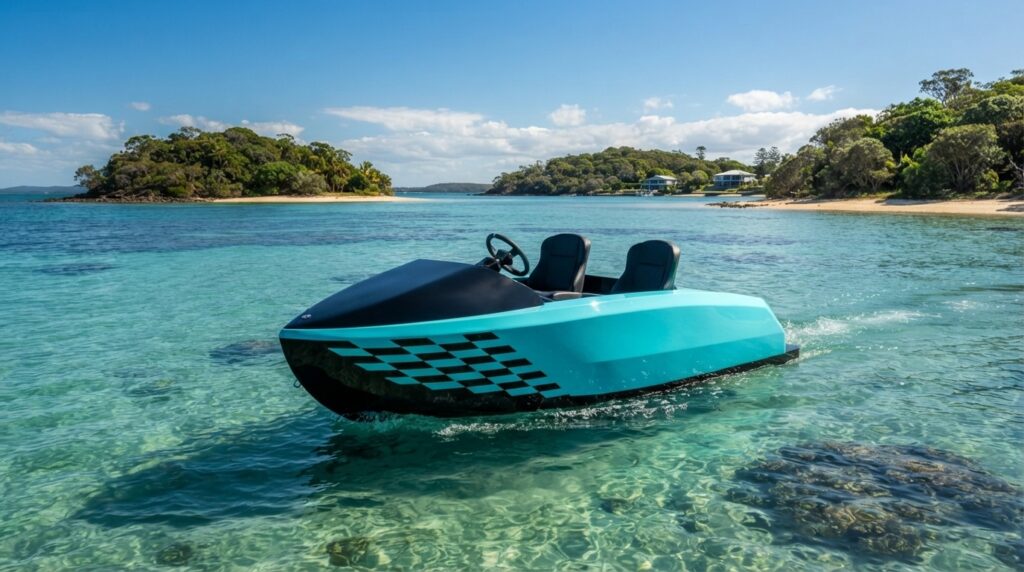
Island hopping conjures images of open-water crossings and larger vessels, but Australia has an abundance of genuinely sheltered island systems — bays, sounds, and protected archipelagos — where the water conditions are considerably calmer than the open ocean crossings the term might initially suggest. In these specific settings, a mini jet boat can be a genuinely capable island-hopping platform, provided the limitations of its compact size and design are properly understood and respected.
Not all island groups are created equal from a small-craft perspective. Genuinely sheltered island systems are typically protected from significant ocean swell by surrounding landmasses, reefs, or their position within a bay or sound, meaning wind chop rather than ocean swell is usually the primary condition to manage. Examples of this kind of setting in Australia include sheltered bays with scattered islands, protected sounds, and certain reef-protected coastal areas where the outer reef or landforms substantially reduce swell before it reaches the inner waters.
This distinction matters enormously for mini jet boat suitability. Genuinely exposed island crossings, where ocean swell is a significant factor regardless of wind conditions, are not appropriate for a compact craft of this type, as discussed in the article on hull length and stability. Sheltered island systems, where swell is minimal and wind chop is the main variable, are a considerably more realistic proposition.
As covered in detail in the range and runtime articles, achievable distance depends heavily on speed, weight aboard, and water conditions. Island hopping typically involves a series of point-to-point legs rather than a single continuous journey, which actually suits the kind of trip planning discussed in the article on planning a safe journey around battery capacity — each leg can be assessed and planned somewhat independently, with charging opportunities (where available, such as at an island with power access) potentially extending the practical range of a full day's hopping between several islands.
Without on-island charging available, though, a full day of island hopping needs to be planned around the boat's total realistic range for the day, factored across all planned legs plus a genuine reserve, rather than assuming each leg can simply be planned in isolation.
While island hopping in sheltered waters is considerably more manageable than open-ocean crossings, it's worth being clear that conditions between islands, even within a generally sheltered system, can still be more exposed than the calm, enclosed conditions of a river or canal. Open stretches of water between islands can experience meaningfully more wind and chop than the sheltered anchorages at each end, and this is worth factoring into both comfort and range planning, as discussed in the water conditions article.
This means weather forecasting and a conservative approach to conditions — covered in more detail in a companion article on weather forecasting as an essential ownership skill — becomes particularly important for island-hopping trips specifically, more so than for many other mini jet boat uses.
Island hopping often involves carrying gear for a full day away from a home base — food, water, sun protection, and potentially snorkelling or beach equipment for stops along the way. As discussed in the article on how carrying a passenger changes range and performance, this additional weight has a genuine effect on both range and performance, and should be factored into planning rather than assumed to be negligible simply because it's not a second person.
Island hopping in sheltered waters tends to appeal particularly to owners based near, or travelling to, genuinely protected island systems, who are comfortable with careful trip planning and conservative weather judgement, and who value the kind of exploratory, point-to-point boating that a mini jet boat's compact size and manoeuvrability support well. It's a considerably more demanding use case than sheltered river cruising, in terms of the planning and weather awareness required, but for the right setting and the right level of preparation, it's a genuinely achievable and rewarding way to use the boat.
It's worth being direct about the limits here: island systems with meaningful ocean swell, longer open crossings without intermediate shelter, or conditions that are frequently unpredictable or exposed are not well suited to a mini jet boat, regardless of how carefully a trip is planned. In these settings, a larger, more capable vessel designed for genuine open-water conditions is the appropriate choice, and no amount of careful planning substitutes for a hull genuinely designed for the conditions being encountered.
Mini jet boats can genuinely support island hopping in the right setting — sheltered bays, sounds and protected archipelagos where swell is minimal and wind chop is the primary condition to manage — provided trips are planned with realistic range budgeting, careful attention to conditions on the open stretches between islands, and a genuine safety reserve built into the plan. This isn't a use case to approach casually, but for owners based near genuinely sheltered island systems who are willing to plan carefully, it's a distinctive and rewarding way to make use of a mini jet boat's compact size and manoeuvrability.