
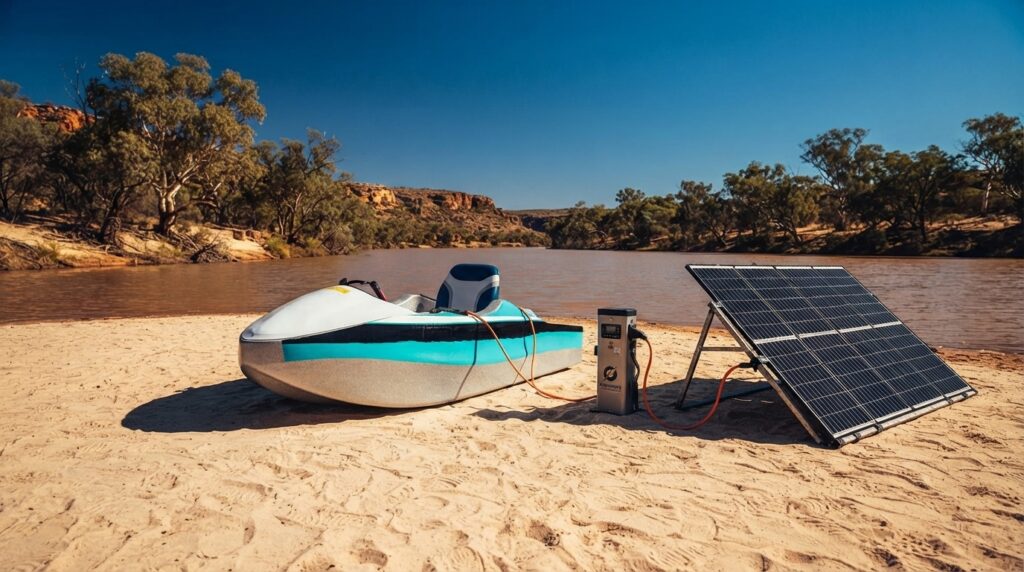
Australia's high solar uptake, combined with growing interest in electric mini jet boats, naturally raises a practical question: can you genuinely charge a mini jet boat from home solar power? The short answer is yes, in most typical residential setups — but the practical details matter a great deal. This article works through exactly how solar charging works, what to realistically expect, and how to plan a setup that makes the most of it.
For most Australian homes with rooftop solar, the system generates electricity during daylight hours, used to power the home's immediate needs, with surplus either exported for a feed-in credit or stored in a home battery. Charging a mini jet boat from solar simply means using the charger during daylight hours when generation is active, so some or all of the draw is met by self-generated electricity rather than grid power.
Most owners aren't installing solar specifically for their boat — they're taking advantage of an existing or planned household system and timing their charging to align with generation.
System size relative to household consumption. A system with meaningful daytime surplus is far better positioned to cover boat charging than one sized tightly around existing consumption.
Timing relative to solar generation. Charging during peak midday generation captures considerably more solar coverage than overnight or early morning/late afternoon charging.
Whether a home battery is part of the system. A battery allows daytime solar to be stored and used later, including overnight — meaningfully expanding flexibility compared with a solar-only setup with no storage.
Seasonal and weather variation. A system that comfortably covers charging on a clear summer day may fall well short on an overcast winter day.
Without a home battery, charging during daylight hours — ideally around midday — is the most direct way to maximise solar coverage. This suits owners with genuine daytime flexibility. For owners who need to charge overnight, a home battery becomes considerably more relevant, since it lets daytime solar generation be discharged later. Without one, overnight charging draws entirely on grid power regardless of daytime generation.
For a well-sized system with genuine surplus, charging a smaller-to-mid battery (roughly 3-8kWh) during a sunny midday window can cover the majority or even entirety of a session from solar alone. For larger batteries, more modest systems, or less favourable conditions, coverage is likely partial rather than complete — a realistic outcome given the physics involved, not a failure of the approach.
A typical Australian residential system ranges from around 5kW to 10kW or more. A well-positioned 6.6kW system can generate roughly 20-30kWh on a good sunny day, varying with location, orientation, shading and season. If household daytime consumption uses a meaningful portion of that generation, remaining surplus for boat charging shrinks accordingly — worth assessing for your own household rather than assuming generic ample capacity.
Some chargers and home energy systems offer scheduling or automation that aligns charging with generation without manual timing each day. It's worth asking whether your charger or home system offers this, since it can meaningfully simplify achieving consistent solar coverage.
Consider a household with a well-sized 8kW system and genuine midday charging flexibility two days a week — very well positioned for strong solar coverage. Compare a household with a smaller 5kW system, high daytime consumption, and no flexibility to charge outside evening hours — without a battery, this household sees essentially no solar contribution at all. These examples illustrate how much genuine coverage depends on the specific combination of system size, consumption patterns, and daytime flexibility or battery storage.
For most owners, a dedicated, boat-specific solar installation isn't necessary — the existing household system, used thoughtfully, is generally sufficient. A dedicated setup might make sense for a remote property without grid connection, but for most suburban or regional households, working with the existing system is the more practical, cost-effective approach.
For households on a standard tariff, solar charging during the day genuinely avoids grid electricity cost — a straightforward saving. For households with cheaper off-peak overnight rates, the comparison is more nuanced, depending on your feed-in tariff relative to your off-peak rate. This is worth calculating for your own circumstances — for some households solar is clearly cheaper, for others the difference is more marginal, though many owners still prefer solar for reasons beyond pure cost.
Solar charging doesn't inherently differ from grid charging in terms of the process itself. What matters is the pattern it creates — if solar charging naturally leads to more frequent, shorter top-ups rather than deep, infrequent full charges, this can align well with generally recommended battery health practices.
Many owners are drawn to solar charging partly for reasons beyond cost — reducing grid reliance and the carbon intensity of their boat's energy use. This is a legitimate motivation even where the financial comparison is fairly marginal.
For many households, a mini jet boat is one of several electricity-consuming additions being weighed against a solar investment, alongside an EV or other appliances. It's worth thinking about boat charging as part of this broader picture when deciding on system sizing or a home battery investment, rather than in isolation — and worth discussing with a solar installer if you're planning or upgrading with boat charging specifically in mind.
Charging an electric mini jet boat from solar power is genuinely achievable for most Australian households with an existing rooftop system, particularly when charging is timed to align with peak daytime generation. The degree of coverage depends on system size, timing, seasonal variation, and whether a home battery is part of the setup — worth setting realistic expectations around partial rather than guaranteed complete coverage. Understanding your own household's generation and consumption pattern, rather than relying on generic assumptions, is what separates owners who achieve strong solar coverage from those left disappointed.
Vector Watercraft supplies fully assembled electric mini jet boats to the Australian market, with charging systems designed to work seamlessly with standard household power regardless of source, including solar. Backed by a 2-year warranty and dedicated after-sales support, Vector Watercraft is happy to discuss solar charging considerations specific to your household as part of the buying process.