
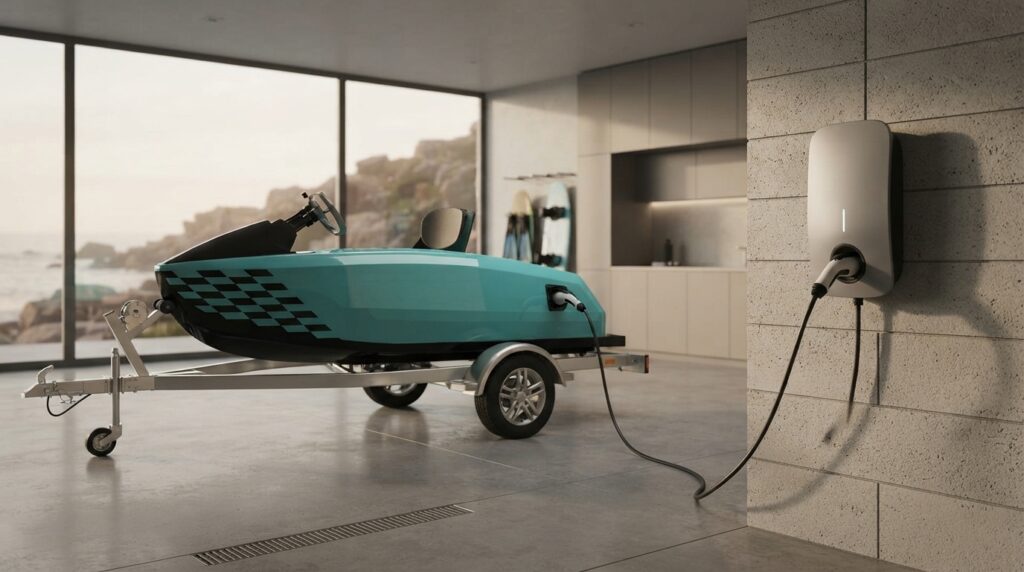
Setting up to charge an electric mini jet boat at home is, for most owners, a straightforward process — but "straightforward" doesn't mean it should be approached casually. Getting the power supply, location and safety setup right from the outset makes charging a simple, worry-free part of ownership, while getting it wrong can create genuine safety risks, inconvenience, or unnecessary strain on your home's electrical system. This article works through exactly what's involved in setting up safe, practical home charging.
Most Australian homes run on a standard single-phase 230-240 volt supply, with general power outlets typically rated to 10 amps continuously, and dedicated circuits sometimes rated up to 15 or 20 amps. Some newer or larger properties have three-phase power available, supporting meaningfully higher continuous loads if genuinely needed.
It's worth checking your home's specific setup, ideally via your switchboard or a licensed electrician, before assuming a particular outlet is suitable for regular charging — especially if your home already has significant other loads like ducted air conditioning, an EV charger or a pool pump.
For occasional or lighter charging needs, a standard outlet in good condition is often entirely adequate. For more frequent charging, larger batteries, or households wanting a genuinely dependable setup, a dedicated circuit is worthwhile — it removes the risk of the circuit being overloaded by other appliances, can be sized correctly from the outset, and gives an electrician the chance to properly assess and upgrade wiring specifically for this purpose.
Any new dedicated circuit, wiring assessment, or higher-power charging setup should always involve a licensed electrician. This isn't a formality — improperly installed electrical infrastructure genuinely creates fire and shock risks. An electrician can also advise on switchboard capacity and ensure appropriate circuit protection (correctly rated breakers or RCDs) is in place.
Many owners charge outdoors near trailer storage rather than in an enclosed garage. Any outdoor outlet used for charging should be genuinely weatherproof-rated, properly sealed against moisture, and ideally protected by a residual current device (RCD) for that circuit. It's also worth keeping the charger and cabling off the ground, away from standing water, and out of direct weather exposure unless specifically rated for it.
Standard household extension cords are often not rated for the sustained current draw and extended duration of charging a mini jet boat, and an unsuitable cord can create a genuine fire risk through overheating. If one is genuinely necessary, use a heavy-duty, appropriately rated cord kept fully uncoiled during use, and inspect it regularly. The better long-term solution is a properly installed outlet close to where the boat is actually charged.
A good charging location is reasonably sheltered, has convenient access to a suitable outlet without an extension cord, allows safe unobstructed access, and keeps cabling away from foot traffic. For trailer-stored boats, establishing a consistent parking and charging spot makes good habits — and noticing anything unusual — easier.
Choosing a charging location that also serves as a reasonable general storage spot — sheltered from extreme heat and prolonged direct sun — offers a genuine secondary benefit, since the battery spends its idle time in more favourable conditions rather than baking on an exposed driveway.
A breaker trips when current exceeds its rated capacity — exactly what it's designed to do. If it trips repeatedly when charging begins, it's telling you something: inadequate circuit capacity, another appliance sharing the load, or a genuine fault needing professional investigation. If it trips even in isolation with nothing else running, that's worth having assessed by an electrician rather than simply resetting and retrying.
For households with more than one person charging a boat, or sharing infrastructure with an EV or solar setup, a simple shared understanding — "the boat charges overnight, the car charges in the evening" — avoids both capacity conflicts and confusion about whether something is actually charging.
If investing in a dedicated circuit, it's worth thinking beyond immediate needs — a second boat, a higher-power upgrade, or growing household electrical demand. Installing modest extra headroom at the point of initial installation often represents better value than a completely separate upgrade later.
A basic routine — check the charger and cable, confirm the area is dry and clear, connect in the correct sequence, confirm charging has genuinely begun, do a final visual check before leaving it overnight — takes a minute or two but meaningfully reduces the chance of an overlooked issue, particularly early in ownership.
Unusual heat, a burning smell, visible sparking, or a breaker tripping repeatedly means stop charging immediately and don't resume until properly investigated — by an electrician for infrastructure concerns, or the manufacturer for charger or battery concerns. Losing a night's charge is far better than continuing to use equipment that might present a real risk.
It's worth checking whether your home insurance has specific requirements around battery charging infrastructure, since this is a developing area and requirements vary between insurers. Keep documentation of any electrical work completed specifically for boat charging.
Setting up safe, practical home charging involves more consideration than simply plugging into the nearest outlet, though for many owners with a straightforward existing setup it can genuinely be that simple once the basics are checked. Understanding your power supply, deciding on a dedicated circuit, ensuring weatherproofing, avoiding unsuitable extension cords, and following consistent safety practices together create a setup that's genuinely convenient and appropriately safe for years of regular use.
Vector Watercraft supplies fully assembled electric mini jet boats to the Australian market, with clear guidance on home charging setup, including power supply requirements, weatherproofing, and when a dedicated circuit is likely worthwhile. Backed by a 2-year warranty and dedicated after-sales support, Vector Watercraft helps Australian owners establish a charging routine that's genuinely safe and suited to their specific home.