
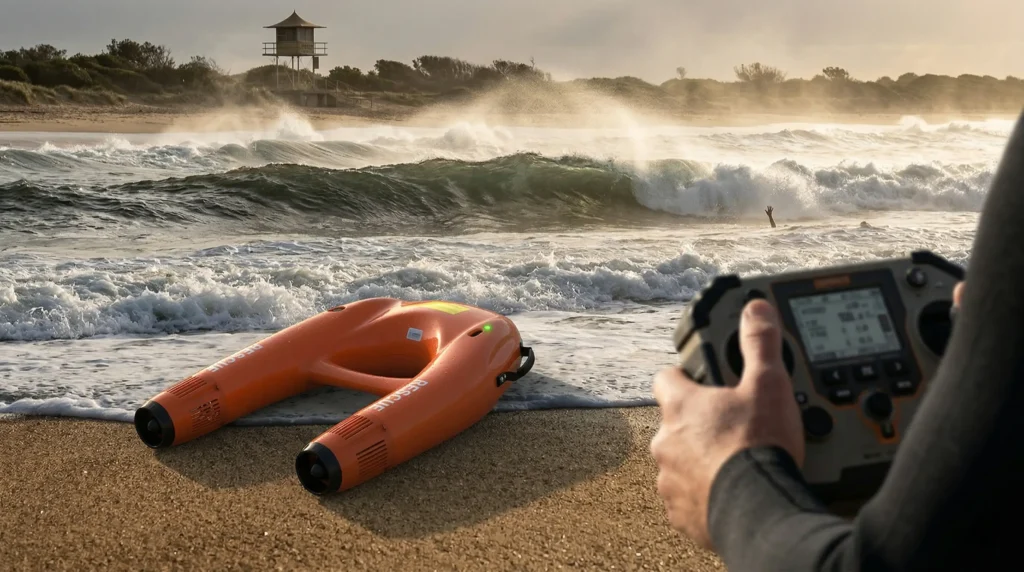
Remote Control Rescue Buoys (RCRBs) are no longer experimental or “nice-to-have” devices. In Australia, they are rapidly becoming a critical layer in modern water-rescue strategy, particularly as surf conditions intensify, waterways grow more crowded, and expectations around public safety continue to rise.
This article is written specifically for Australian Surf Life Saving Clubs, local councils, marine safety authorities, emergency services, and professional event operators. It is not a consumer overview. It is a practical, evidence-based guide to choosing the right RCRB for Australian conditions — where surf energy is high, rivers are unpredictable, heat is extreme, and failure is not an option.
Choosing incorrectly does not merely waste money. It risks delayed rescues, increased rescuer exposure, and avoidable loss of life. Choosing correctly means faster time-to-contact, reduced risk to personnel, and a defensible safety decision aligned with Australian duty-of-care expectations.
Australia’s waterways are among the most demanding in the world. Any rescue device deployed here must withstand conditions that quickly expose weaknesses in design, power systems, sealing, and control logic.
Australian rescue environments include:
Unlike controlled test environments, Australian rescues occur in dynamic, chaotic conditions — often with panicked victims, limited visibility, and intense time pressure. Equipment that performs adequately overseas or in calm water may fail quickly when exposed to these realities.
This is why Australian buyers must evaluate RCRBs differently. Marketing claims are irrelevant. What matters is performance under load, in adverse conditions, repeatedly, with different operators.
An RCRB exists for one reason only: to reduce the time between a person entering distress and effective flotation support reaching them — without placing a rescuer in danger. Everything else is secondary.
A correctly selected RCRB allows responders to:
If a device does not reliably achieve these outcomes in Australian conditions, it does not meet the standard required for professional rescue deployment.
One of the most common procurement mistakes is focusing on headline top speed figures. In real rescues, top speed is almost meaningless.
What matters is time-to-contact — how quickly the device can be deployed, driven, and brought into effective contact with a distressed person in real conditions.
Time-to-contact is influenced by:
A unit that claims a high no-load speed but struggles to maintain direction in surf or loses momentum when a victim grabs on may arrive later than a lower-speed unit with superior control and thrust. Australian buyers should always prioritise real-world controllability over brochure speed.
In actual rescues, victims rarely behave predictably. Panic causes people to grab, climb, pull down, or attempt to mount the buoy. Equipment must be designed for this reality.
Key considerations include:
Any RCRB evaluated for Australian use must demonstrate that it remains controllable and effective once a casualty makes contact. Performance without load is not a rescue metric.
Surf rescues are among the most demanding use cases for RCRBs. Australian beaches frequently feature:
An RCRB used in surf must:
Stability and control geometry matter far more here than absolute speed. Units with poor hydrodynamic balance may yaw, broach, or flip — turning a rescue asset into an obstacle.
Fast rivers introduce additional complexities:
In these environments, thrust and precision control are critical. The unit must be able to:
RCRBs used in rivers must be rugged, predictable, and capable of being driven with confidence by trained operators under stress.
Battery design is one of the most overlooked aspects of RCRB selection — and one of the most important.
In Australian conditions, batteries must perform reliably despite:
Key evaluation points include:
Runtime figures should reflect mixed-use emergency operation, not low-power cruising. In rescue contexts, bursts of maximum output are common. A professional-grade RCRB battery system prioritises reliability, safety, and predictable behaviour over theoretical maximum duration.
Motor systems are the heart of any powered rescue device. In rescue equipment, the motor must deliver:
European motor standards are often referenced because they typically involve:
For Australian councils and agencies, choosing equipment built around recognised professional standards supports procurement defensibility. If an incident is reviewed, documented standards matter. This is not about brand prestige. It is about reducing the probability of failure during a rescue.
Remote range figures are frequently quoted but rarely explained. In real conditions, control systems must contend with:
A reliable RCRB control system must:
Lag, dropouts, or unpredictable response erode operator confidence and increase rescue time.
Saltwater ingress is one of the fastest ways to destroy rescue equipment. Professional RCRBs must feature:
Ingress protection is not just about catastrophic flooding. Micro-ingress over time degrades electronics, reduces reliability, and creates hidden failure modes. Australian buyers should demand clarity on sealing design, not vague assurances.
The best rescue device is the one operators can use effectively under stress. Key considerations include:
RCRBs should reduce decision-making burden, not add to it. Training programs must be realistic, repeatable, and suitable for volunteers as well as professionals. A device that requires exceptional skill to operate safely is not suitable for widespread public-safety deployment.
Australia’s climate places unique demands on stored equipment. Best practice includes:
An RCRB that works perfectly in a showroom but degrades in a beachside shed is not fit for purpose.
For councils, Surf Life Saving Clubs, and emergency agencies, RCRB selection is not just operational — it is legal and ethical. Decision-makers must be able to demonstrate that:
Cheap equipment that fails or underperforms can expose organisations to significant liability.
At its best, an RCRB becomes a force multiplier:
Choosing the right RCRB for Australian conditions is not about novelty. It is about adopting a mature, evidence-based approach to water safety that reflects the realities of our environment.