
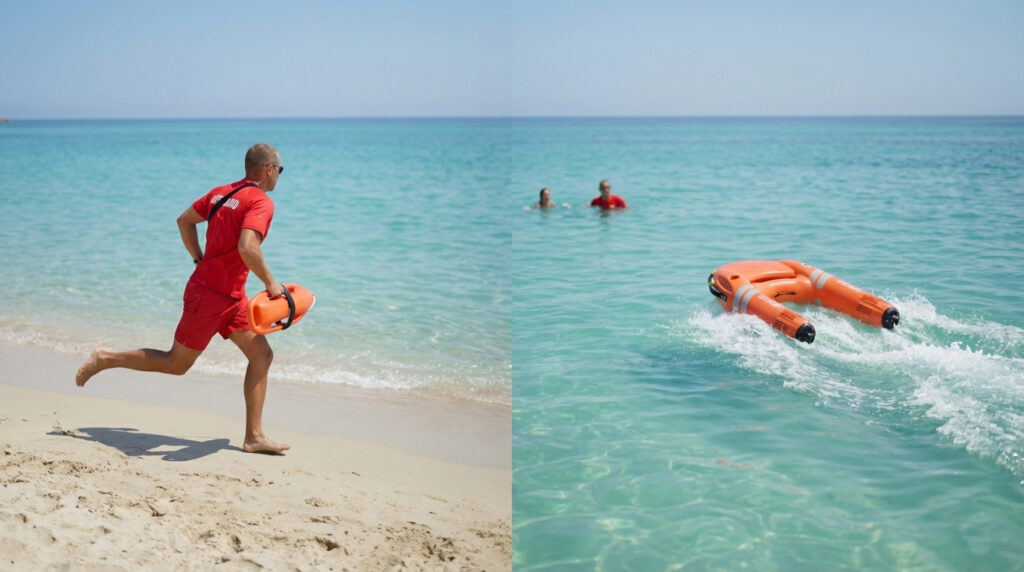
In water rescue, seconds are not an abstract concept. They are measurable, physiological, and often irreversible. Every rescue method — whether a trained swimmer, rescue board, boat, helicopter, or Remote Control Rescue Buoy (RCRB) — ultimately competes against the same enemy: time.
This article examines the real-world comparison between deployment time of RCRBs and human-based rescue response, specifically within Australian surf, river, and open-water environments. It does not diminish the importance of trained rescuers. Instead, it evaluates where technology measurably reduces delay, risk, and physiological deterioration — and where it does not.
For Surf Life Saving Clubs, councils, and emergency services, this comparison is essential. It informs procurement decisions, training frameworks, and how RCRBs are integrated into layered rescue strategies.
In rescue planning, time is often discussed operationally. In reality, time is biological. When a person is in distress in water, several physiological processes begin immediately:
The concept of “minutes matter” is not a slogan. It reflects well-documented physiological decline curves. Any rescue method that reduces time-to-flotation directly improves survival probability.
Human-based rescue methods remain central to Australian water safety. However, they follow an unavoidable sequence of events. A typical human-based response involves:
Each step consumes time. Some steps are fast. Others are not. Even with highly trained personnel, recognition and decision latency alone can account for tens of seconds. Physical entry and travel then introduce further delay, especially in adverse conditions.
A common assumption is that trained swimmers are faster than devices. In ideal conditions, a highly trained surf lifesaver can swim very quickly over short distances. However, this assumption fails in many real scenarios.
Factors that slow human rescuers include:
Importantly, a rescuer must return with the casualty. This doubles exposure time and physical demand.
RCRB deployment follows a fundamentally different time sequence:
The key difference is removal of human water entry from the initial phase. Once activated, the RCRB begins moving immediately. There is no need for the operator to physically enter hazardous water or fight conditions directly. This structural difference is why RCRBs often reduce time-to-flotation even when their absolute speed is lower than a swimmer’s peak sprint.
Rescue effectiveness correlates with time-to-contact, not raw speed. In Australian surf environments:
RCRBs, by contrast, maintain propulsion regardless of fatigue or fear. They do not need to breathe. They do not hesitate. This leads to a counterintuitive but consistent outcome: the slower-looking solution often arrives first.
One of the most overlooked aspects of rescue timing is panic suppression. When a distressed swimmer sees flotation approaching, panic often decreases immediately. This slows breathing, conserves energy, and reduces erratic movement.
Human rescuers rarely provide flotation until they physically arrive. RCRBs provide flotation at the moment of contact, without delay. This early stabilisation alters the entire rescue trajectory.
Human response: Decision to enter water, board or tube selection, entry through shore break, travel into rip, and physical engagement. Even with skilled personnel, this sequence often exceeds one minute before flotation contact.
RCRB response: Activation, direct propulsion into rip, and immediate flotation on contact. In many real-world cases, RCRBs reach the casualty significantly faster, despite lower apparent speed.
Human rescuers are limited by physical capacity. One rescuer, one casualty. An RCRB can reach the first casualty, provide flotation, and be redirected rapidly to another person. This ability to serially stabilise multiple people alters response dynamics in crowd or event scenarios.
In fast rivers, human response is further constrained by entry point limitations, downstream drift during approach, obstacle avoidance, and high physical risk to the rescuer. Human rescuers often must reposition downstream, increasing time-to-contact. RCRBs can be launched from optimal vantage points and ferried across current without placing a rescuer in danger.
Human fatigue compounds rescue time in ways that are rarely acknowledged. Fatigue affects swim speed, decision quality, grip strength, victim control, and return capability. RCRBs do not fatigue. Their performance at second 10 is identical to second 100, provided power is available. This consistency becomes critical during extended or repeated incidents.
Rescue time is not only about casualty survival. It is also about rescuer exposure. Every second a rescuer spends in hazardous water is a second of cumulative risk. RCRBs reduce the number of rescuer water entries, the duration of rescuer exposure, and physical strain on personnel. From a governance perspective, this is as important as casualty outcomes.
Human response time varies dramatically based on fitness, experience, confidence, fatigue, and stress. RCRBs behave consistently. This consistency allows organisations to design response protocols that are less dependent on individual capability.
A critical point must be stated clearly: RCRBs are not replacements for human rescuers. They are time-compression tools. Their role is to bridge the gap between distress and human contact, reduce physiological deterioration, reduce rescuer exposure, and improve overall rescue efficiency. In best-practice models, RCRBs arrive first, humans arrive second — under safer, more controlled conditions.
Training humans to swim faster has diminishing returns. Training operators to deploy RCRBs efficiently yields immediate gains because activation replaces water entry, control replaces physical exertion, and flotation replaces grip strength. This shifts training focus from endurance to decision-making and situational awareness.
While Australian-specific longitudinal studies are still emerging, international operational data consistently shows reduced time-to-contact, reduced rescuer water entry frequency, and increased casualty stabilisation rates. These patterns align with physiological and mechanical logic.
Some argue that human rescuers make better judgments in dynamic situations. This is true — but only once they are present. RCRBs do not replace judgment. They buy time for judgment to be applied safely and effectively.
From a duty-of-care perspective, organisations must consider whether faster stabilisation methods were reasonably available. If technology exists that measurably reduces time-to-flotation and rescuer risk, its omission may be difficult to justify.
Heroic rescues are celebrated because they overcome delay and danger. The goal of modern rescue systems is to eliminate the need for heroics. RCRBs contribute to this by changing the time equation.
Organisations that integrate RCRBs effectively gain faster initial response, reduced rescuer injuries, improved survival odds, a stronger governance position, and greater public confidence. Those that rely solely on human response accept longer delays and higher risk as unavoidable — when they no longer are.