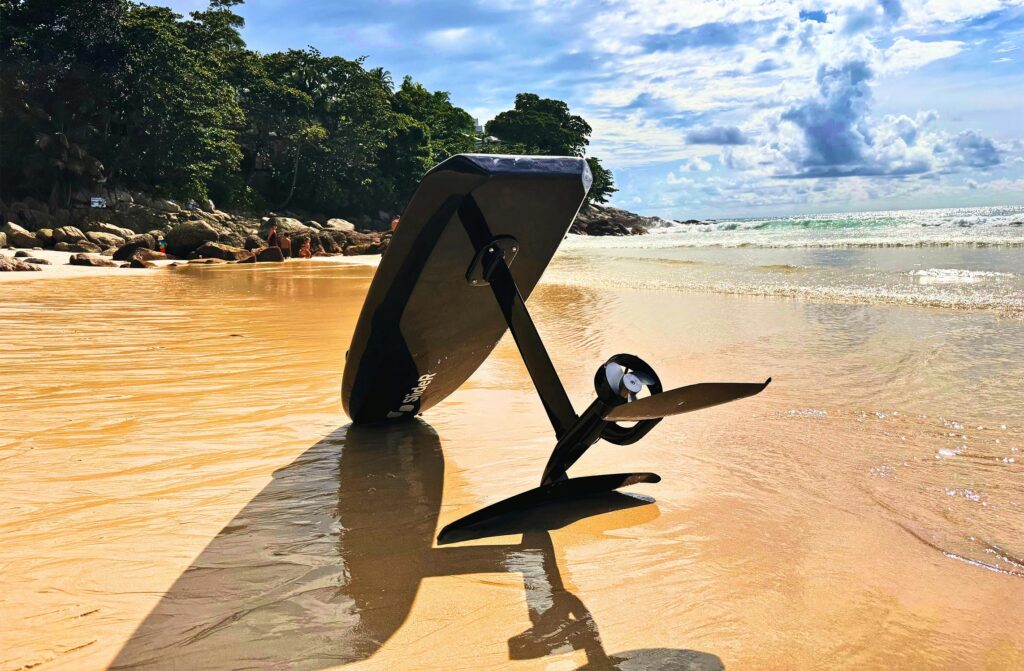
Foiling has become one of the most important evolutions in modern board sports. Whether it’s surf foiling, wing foiling, SUP foiling, kite foiling, or electric foiling, the sensation is the same: lift out of the water, reduced drag, and a smooth glide that feels like flight.
But there’s a question that comes up constantly, especially among experienced surfers and watermen:
Are eFoils “cheating”?
Do they reduce skill, or do they simply change the skill?
And which is better—traditional foil boards or eFoils?
The truth is more practical than emotional. eFoils and traditional foil boards are different tools with different learning curves, different physical demands, and different “skill stacks.” One doesn’t replace the other. They simply reward different capabilities.
This article compares eFoils and traditional foil boards honestly—without hype, without ego, and with a focus on what actually matters to real riders.
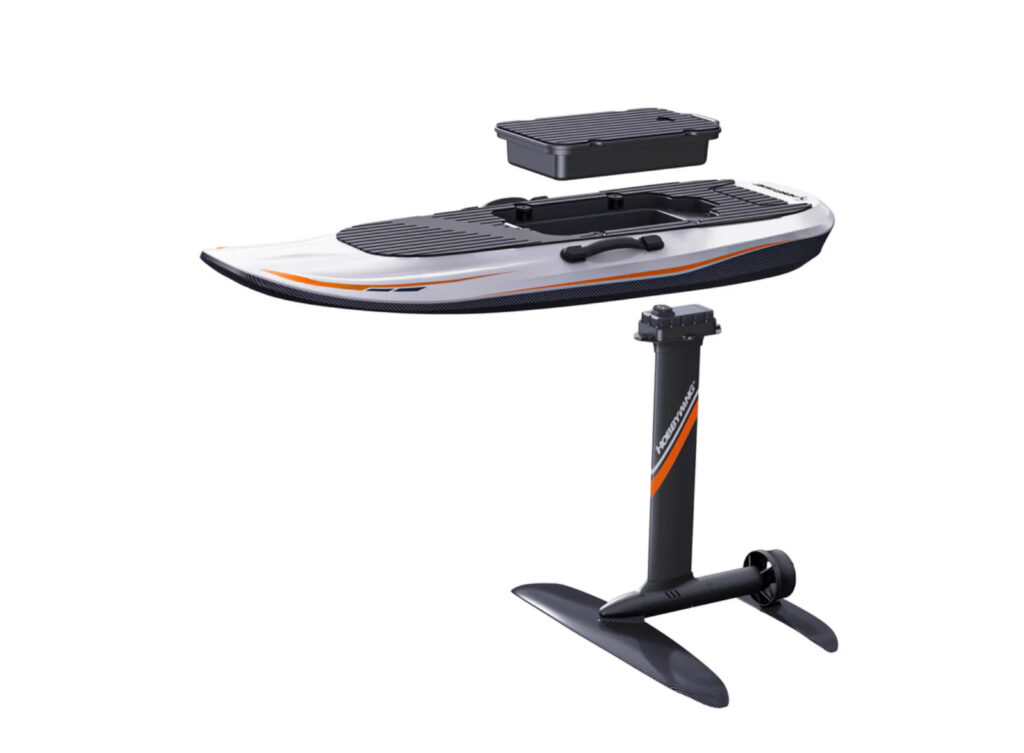
eFoil (electric foil board)
A foil board with a battery and motor that provides forward propulsion. The rider uses a controller (handheld or integrated) to manage speed and power.
Traditional foil board (non-electric)
A foil board that relies on external power sources or natural forces such as:
They may share similar foil hardware, but the propulsion method changes everything.
Everything comes back to one question: Who provides the energy to keep the foil flying?
With an eFoil:
With traditional foiling:
This doesn’t mean eFoiling takes “no skill.” It means the required skills shift from power generation to control, judgement, and efficiency.
For most beginners, eFoiling is easier to start because the motor provides predictable, controllable speed. You can practise take-off repeatedly without waiting for waves or wind.
Traditional foiling can be harder initially because:
However, once you reach intermediate levels, traditional foiling often builds a deeper instinct for reading energy—waves, swell, wind angles, gust timing—because your success depends on it.
A fair way to say it:
eFoil skill focuses on:
Traditional foil skill focuses on:
Both require skill. They simply require different categories of skill.
Traditional foiling typically demands more from the body because:
eFoiling is not effortless—it can be hard on legs, core, and balance—but it generally allows longer sessions with less cardio strain because the motor supplies propulsion.
That’s why eFoiling has opened foiling to a wider range of riders, including older riders or those who want the glide without the punishing paddle/pump workload every time.
Both can be safe or unsafe depending on where and how they’re ridden.
Traditional foiling risks can include:
eFoil risks can include:
Neither is “automatically safer.” Safe riders make either safe.
In Australia, the practical safety rule is consistent: keep generous distance from swimmers, paddlers, and shorelines, and treat your foil like a sharp, fast object—because it is.
Traditional foil boards (surf/wing/kite) excel at:
eFoils excel at:
If you want “nature-powered” authenticity and the discipline of timing, traditional foiling is hard to beat.
If you want consistency, skill-building reps, and freedom from wind/wave dependency, eFoiling dominates.
People argue about “cheating” because they frame it as: “I worked hard to learn this, therefore motorised versions are lesser.”
But that’s not how tools work.
A better question is: What kind of riding do you want, and what kind of skill do you want to build?
Traditional foiling is closer to surfing culture: earning waves, reading conditions, making the most of nature.
eFoiling is closer to aviation training: repeatable conditions, deliberate practice, controlled progression.
Neither is inferior. They’re different.
Often, yes—if you use it properly.
eFoiling can improve:
But there’s a catch: eFoiling can also create habits that don’t translate, such as:
If your goal is to be a better surf/wing foiler, use eFoiling as a skills lab, not as a replacement.
Absolutely.
Traditional foilers often bring:
Many experienced surf/wing/kite foilers become competent eFoilers quickly because they already understand the “foil language.”
This is where emotion disappears and reality kicks in.
Traditional foiling ownership tends to involve:
eFoil ownership adds:
If you enjoy equipment maintenance and like reliable routines, eFoiling ownership is manageable. If you want minimal fuss and simple gear, traditional foiling can feel cleaner.
Australia offers everything: ocean swells, bay chop, windy coastal runs, protected rivers.
Traditional foiling shines when:
eFoiling shines when:
A lot of riders end up owning both because they solve different problems.
The debate usually isn’t about performance. It’s about identity.
Traditional foiling is tied to surfing and wind sports culture. Effort and “earning it” are part of the value system.
eFoiling is newer, tech-driven, and looks easy from the outside, which triggers the same reaction people once had to:
The mature view is simple:
Respect comes from how you ride, not what you ride.
Choose an eFoil if you want:
Choose a traditional foil board (surf/wing/kite) if you want:
Choose both if you can, because:
eFoils do not remove skill. They relocate it. They replace the constant requirement to generate propulsion with a requirement to manage propulsion responsibly and ride with discipline. Traditional foiling builds a unique mastery of nature’s energy. eFoiling builds a unique mastery of controlled flight and repeatable technique.
If you’re serious about foiling, you don’t need to pick sides. You need to pick the right tool for the ride you want—and then ride it properly.