
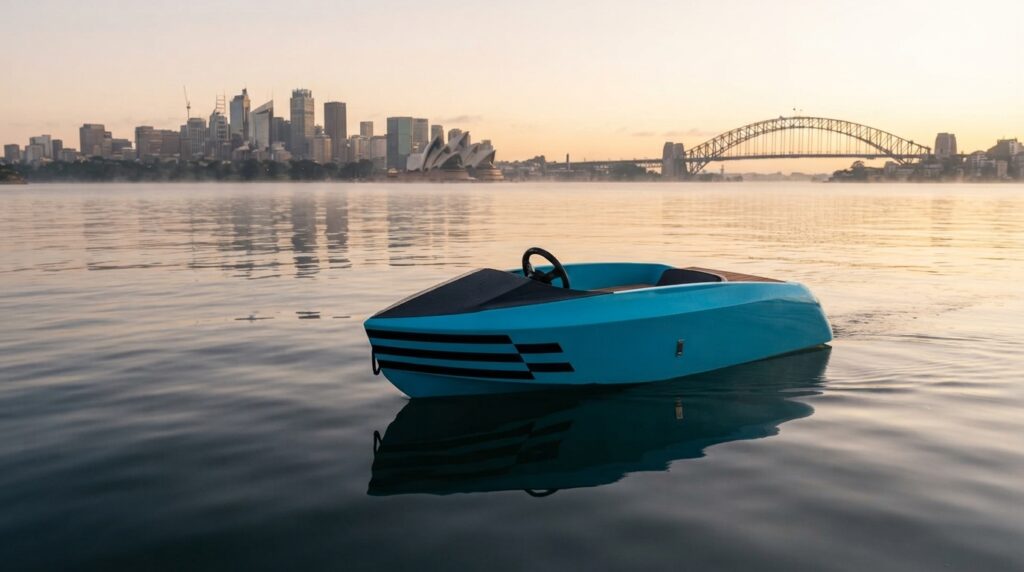
Australia has one of the strongest recreational boating cultures in the world. From Queenslandâs coastal waterways and New South Wales estuaries to Victorian bays, South Australian coastal areas and Western Australiaâs extensive boating destinations, Australians have traditionally regarded time on the water as an important part of the outdoor lifestyle.
For decades, recreational boating has largely revolved around petrol-powered craft. Conventional outboard engines, personal watercraft and larger trailer boats have provided generations of Australians with opportunities for fishing, exploring, family recreation and high-performance water activities.
However, marine technology is changing.
Electric propulsion, improved battery technology and increasingly sophisticated compact watercraft are creating an entirely new category of recreational boating.
Electric jet boats in Australia are becoming particularly interesting because they combine several technologies and ownership advantages in one craft:
Rather than simply replacing a petrol engine with an electric motor, modern electric jet boats can change the entire ownership experience.
Compact electric Mini Jet Boats are especially relevant to Australian buyers who want the excitement of boating but do not necessarily want the complexity traditionally associated with owning a large boat.
This combination of performance, practicality and electric technology is helping create a new direction for recreational boating in Australia.
An electric jet boat is a watercraft using an electric propulsion system combined with a jet-drive system.
Instead of driving an exposed propeller behind the boat, the propulsion system draws water into an intake and accelerates it through the jet unit to create thrust.
Steering is achieved by directing that thrust.
Electric power changes the way energy is supplied to the propulsion system.
A conventional petrol boat generally depends upon:
An electric jet boat instead uses a combination of:
The result can be a very different recreational boating experience.
Electric propulsion can provide rapid power delivery while eliminating many of the routine engine-related tasks associated with petrol propulsion.
For recreational buyers, this matters because the appeal of boating is rarely the maintenance itself.
People buy boats because they want to enjoy the water.
The Australian boating market is extremely diverse.
Some owners want large offshore boats.
Others want fishing boats.
Some want luxury cruising.
A growing section of the market, however, wants recreational craft that are:
This is where electric Mini Jet Boats can offer a distinctly different proposition.
Modern lifestyles have changed considerably.
Many Australians have limited recreational time and increasingly value products that can be used without extensive preparation.
A boat that takes significant time to organise, tow, launch, fuel, clean and maintain can become difficult to use regularly.
The practical question increasingly becomes:
Electric Mini Jet Boats have the potential to improve that equation.
Their compact format and electric propulsion can reduce several of the barriers that discourage regular recreational boating.
One of the strongest arguments for electric recreational boating is simplicity.
Petrol engines have served the marine industry extremely well for generations and will continue to play an important role.
However, internal-combustion marine engines inherently contain substantial mechanical complexity.
Depending on the particular engine and installation, maintenance can include attention to:
Electric propulsion removes many conventional internal-combustion engine components.
This does not mean electric boats require no maintenance.
Jet systems, batteries, electrical connections, cooling arrangements, hulls and other components still need proper inspection and care.
However, the nature of the maintenance is different.
For many recreational owners, fewer routine engine servicing requirements can make boat ownership significantly more manageable.
That can be particularly valuable for owners who simply want a boat ready for weekend recreation rather than a substantial ongoing mechanical project.
Electric motors are particularly interesting in small recreational watercraft because of the way they deliver power.
Electric propulsion can provide strong torque from very low motor speed.
For the driver, this can create responsive acceleration and immediate power delivery.
Combined with jet propulsion, the result can be a lively and engaging recreational craft.
This is important because choosing electric power does not necessarily mean choosing an unexciting boating experience.
One of the misconceptions surrounding electric transport has historically been that environmental or efficiency advantages must come at the expense of performance.
Modern electric cars have already demonstrated how inaccurate that assumption can be.
Marine propulsion is now undergoing a similar transformation.
Electric Mini Jet Boats can combine:
For Australian recreational buyers, this provides an attractive combination.
Jet propulsion is already well established in many marine applications.
One of its most recognisable characteristics is the absence of a conventional exposed propeller behind the boat.
Water enters through the jet intake beneath the hull and is expelled through the jet nozzle.
This arrangement can provide several practical advantages.
The propulsion mechanism remains largely contained within the craft.
This does not eliminate marine safety risks and operators must always follow appropriate boating practices, but it creates a very different propulsion arrangement compared with an externally exposed propeller.
Jet propulsion also contributes to the responsive steering characteristics for which jet-powered recreational craft are known.
In compact Mini Jet Boats, this can produce an enjoyable driving experience combining:
Operators nevertheless need to understand that jet-powered boats can behave differently from propeller-driven boats, particularly when power is reduced.
Proper familiarisation and responsible operation remain essential.
Large boats offer tremendous capability, but that capability also comes with practical requirements.
Traditional boat ownership may involve:
Not every Australian recreational buyer requires that level of capability.
Many simply want an enjoyable craft for:
A compact electric Mini Jet Boat can be more closely aligned with these activities.
Smaller dimensions can potentially simplify storage and transport while electric propulsion can reduce some of the servicing complexity.
The outcome is a recreational craft designed around enjoyment and accessibility rather than maximum size.
Australian residential property has changed.
Many newer homes have:
Traditional boats can therefore create a significant storage challenge.
Owners may need:
These requirements add both cost and inconvenience.
Compact Mini Jet Boats provide a different ownership proposition.
Depending on the particular model and transport arrangement, compact craft can be considerably easier to accommodate than conventional large recreational boats.
For many buyers, storage practicality may ultimately determine whether a boat gets purchased at all.
A boat that fits comfortably into the owner's lifestyle is far more likely to be used regularly.
Transport is closely connected with storage.
Traditional recreational boating usually involves towing.
Towing is perfectly practical for experienced boat owners, but it introduces additional tasks.
Owners need to consider:
Compact Mini Jet Boats can potentially reduce the scale of these requirements.
Some compact watercraft are designed to provide considerably greater flexibility in the way they can be transported.
For certain appropriate models and suitably equipped vehicles, transport solutions may include purpose-designed support systems or vehicle carrying arrangements rather than the large conventional boat-and-trailer combination.
Any transport arrangement must, of course, comply with applicable load restraint, vehicle dimension and road safety requirements.
The important point is that compact design gives owners more possibilities.
That flexibility can help make spontaneous boating more realistic.
Australia has an extraordinary diversity of waterways.
Large offshore boats are only one part of Australian boating.
Across the country there are thousands of recreational environments where compact craft can make sense.
Examples include:
Queensland alone offers extensive river, dam, canal and protected-water opportunities.
New South Wales has major river systems, lakes and coastal estuaries.
Victoria combines inland waterways with large protected areas such as Port Phillip.
South Australia offers extensive gulf and river recreation.
Western Australia has both metropolitan and regional waterways suitable for different forms of recreational boating.
Tasmania also provides numerous lakes, rivers and sheltered boating environments.
Every operator must check the rules applying to the particular craft and waterway before launching.
But geographically, Australia provides an enormous natural environment for compact recreational boating.
Anyone familiar with traditional recreational boating understands the role engine noise has historically played.
For many people it is simply part of boating.
Electric propulsion changes that experience.
Without the same internal-combustion engine noise, electric boating can create a quieter atmosphere.
That can make recreational outings feel more connected with the surrounding environment.
Owners may better appreciate:
This does not mean electric jet systems operate in complete silence.
Water movement, jet-drive operation and hull noise still exist.
However, removing the conventional petrol engine fundamentally changes the character of the boating experience.
For many recreational buyers, quieter operation is likely to become increasingly important.
Another practical difference is the way energy is supplied.
Petrol boat owners typically need to:
Electric boats replace conventional refuelling with battery charging.
That changes preparation for an outing.
Instead of visiting a fuel station or marina fuel facility, owners can charge compatible batteries using the charging system specified for their craft.
Charging does require planning.
Owners need to understand:
Good battery management becomes central to electric boat ownership.
However, many owners may prefer charging at home to dealing with petrol.
The battery is one of the most important components of any electric watercraft.
Prospective owners should therefore evaluate battery specifications carefully.
Questions worth asking include:
Range or running time cannot be considered as one fixed number in isolation.
Energy consumption depends upon factors such as:
High-performance operation naturally consumes more energy than moderate recreational cruising.
A knowledgeable buyer should therefore consider how the boat will actually be used rather than relying on one headline figure.
Electric does not mean maintenance-free.
This distinction is important.
Removing an internal-combustion engine can substantially reduce certain types of maintenance, but the craft remains a marine vehicle operating in a demanding environment.
Owners still need to inspect and maintain items such as:
Saltwater use requires particular attention.
Salt and marine contaminants should not simply be left on the craft after use.
Correct rinsing, flushing where specified by the manufacturer, drying and inspection remain important.
Good ownership practices protect:
Electric propulsion reduces some maintenance requirements, but responsible marine maintenance remains essential.
Propulsion technology tends to receive most of the attention, but hull construction is equally important.
Australian recreational boating conditions can expose boats to:
Many modern compact Mini Jet Boats use materials designed to provide practical durability.
High-Density Polyethylene, or HDPE, is particularly interesting for some Mini Jet Boat designs because it can offer:
Other craft may use different construction methods depending upon their performance and design objectives.
Buyers should consider the complete craft rather than focusing solely on motor power.
A good electric Mini Jet Boat is the combination of:
The potential market extends beyond traditional boating enthusiasts.
Families may appreciate a compact craft that creates opportunities for shared recreational outings without necessarily requiring ownership of a large conventional boat.
Couples may prefer a smaller two-person recreational craft that is easier to organise for weekends and holidays.
Some retirees want to remain active on the water while reducing the physical and mechanical burden associated with larger traditional boats.
Electric propulsion, advanced batteries and modern control systems naturally appeal to buyers interested in new technology.
An electric Mini Jet Boat does not necessarily need to replace a larger boat.
It may become an additional recreational craft for shorter outings where using the main boat is unnecessary.
People with properties near suitable waterways may find compact electric boats particularly convenient because the craft can potentially remain close to where it is regularly used.
Electric Mini Jet Boats are sometimes compared with jet skis and other personal watercraft because both use jet propulsion.
However, the experiences can be quite different.
A Mini Jet Boat generally places occupants inside a small boat hull with seating and controls arranged more like a conventional boat.
This may appeal to people who prefer:
Jet skis remain extremely popular and provide their own distinctive type of performance.
The objective is not to suggest one format replaces the other.
Rather, electric Mini Jet Boats create another choice within the recreational market.
That additional choice is important because many Australians who enjoy performance boating may not necessarily want a conventional personal watercraft.
Not all electric jet boats are the same.
Prospective buyers should first determine how they expect to use the craft.
Questions include:
There is little value in buying on power figures alone.
A boat with the greatest theoretical performance is not automatically the best choice.
The most suitable boat is the one that matches the owner's actual recreational requirements.
New technology does not change the fundamentals of responsible boating.
Electric Mini Jet Boats are still powered watercraft.
Operators must understand and follow:
Rules differ between Australian states and territories and can also vary according to the particular waterway and type of craft.
Owners should always verify requirements with the relevant maritime authority.
Operators should also become familiar with how jet propulsion behaves before attempting aggressive manoeuvres or higher-speed operation.
Responsible use remains fundamental to enjoyable boating.
Electrification is changing transportation internationally.
Passenger vehicles were the most visible early example, but development is now extending into:
Marine electrification faces challenges that differ from road transport.
Water resistance creates significant energy demand, while batteries must perform reliably in a harsh marine environment.
Nevertheless, technology continues to improve.
Advances in:
are steadily increasing what electric recreational craft can accomplish.
Compact boats are particularly well positioned to benefit because they require considerably less energy than very large vessels.
Australia combines several characteristics favourable to this category.
The country has:
Australians also place considerable value on practical recreational products.
A craft that provides genuine performance while reducing some of the traditional burdens of boat ownership has strong lifestyle relevance.
This does not mean electric boats will replace conventional boats.
Australia's boating market is far too varied for that.
Offshore fishing boats, large cruisers and specialist marine vessels will continue serving purposes for which compact electric craft are not designed.
Instead, electric Mini Jet Boats are creating their own recreational niche.
That niche could become substantial.
The strongest argument for compact electric boating may ultimately be simple.
A recreational product provides value when it is actually used.
Many large recreational purchases become underused because preparation eventually feels too difficult.
If boating requires:
owners may gradually use the boat less frequently.
Compact electric Mini Jet Boats are designed around a different philosophy.
Make the craft manageable.
Make preparation easier.
Reduce unnecessary mechanical complexity.
Make storage more practical.
Encourage spontaneous outings.
When these barriers are reduced, owners may find themselves spending more time doing what they purchased the boat for in the first place:
being on the water.
Electric jet boats represent an important emerging development within Australian recreational boating.
They combine established jet propulsion principles with rapidly developing electric technology.
For the appropriate recreational user, the advantages can include:
They will not replace every type of boat, nor should they.
Their significance lies in providing Australian consumers with another way to experience recreational boating.
For buyers who want a compact, exciting and technologically advanced craft without moving into large traditional boat ownership, electric Mini Jet Boats provide a compelling alternative.
Australia's enormous network of waterways, strong outdoor culture and enthusiasm for innovative recreational products make the country particularly well suited to this emerging category.
As battery technology and electric marine systems continue to develop, electric jet boats in Australia are likely to become increasingly visible.
The future of recreational boating will not be defined by one propulsion system or one style of boat.
Instead, consumers will have greater choice.
And for Australians seeking a combination of performance, practicality and modern electric technology, the electric Mini Jet Boat is rapidly becoming one of the most interesting choices on the water.
An electric jet boat uses an electric motor and battery system to power a jet-drive propulsion unit. Water is drawn into the jet system and expelled to create thrust.
They may be suitable for many Australian rivers, lakes, dams, estuaries and protected waterways, depending on the particular craft and local regulations. Owners must check the rules applying to their intended operating location.
Yes. They generally eliminate a number of conventional petrol-engine maintenance tasks, but batteries, electrical systems, jet-drive components, hulls, seals and other marine systems still require regular inspection and care.
No. Jet-drive water movement, hull movement and mechanical components still produce sound. However, electric propulsion removes conventional internal-combustion engine noise and can provide a significantly quieter boating experience.
No. Although both may use jet propulsion, Mini Jet Boats generally place occupants inside a small boat hull and provide a different seating and driving experience from conventional personal watercraft.
Australian buyers can explore the current Mini Jet Boat range, specifications and electric watercraft information through Vector Water Craft Australia: