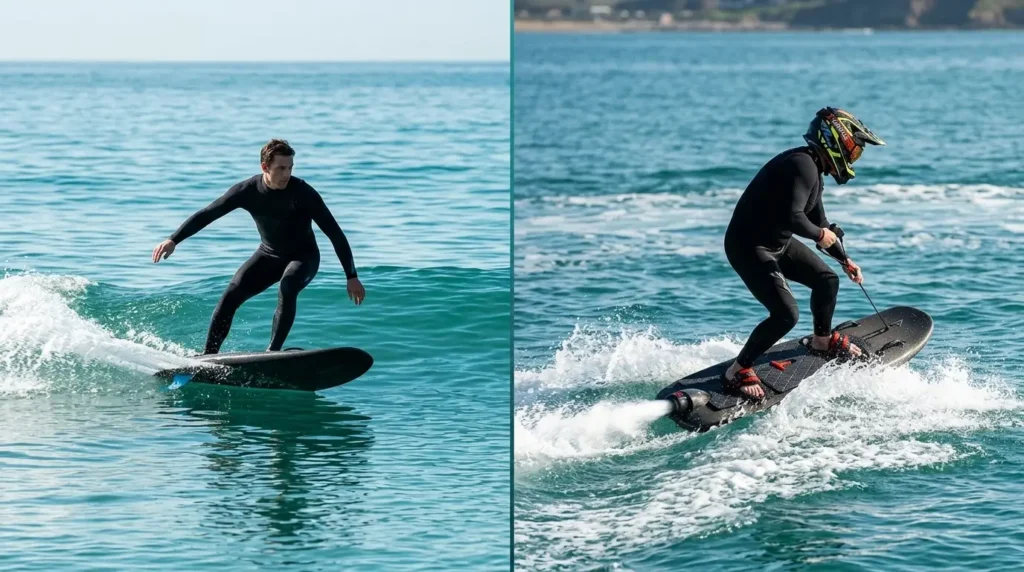
If you’ve been watching the rise of powered boards, you’ve probably noticed people use “electric surfboard” and “jet surfboard” interchangeably. That’s where buyers get tripped up.
In everyday talk, both can mean “a board with a motor.” But in practical terms, electric surfboards and jet surfboards often refer to two different propulsion approaches, and that difference affects everything: how they feel under your feet, how safe they are around swimmers, what they cost to run, what can go wrong, and what sort of rider they suit.
This guide breaks it down in plain language, with enough technical depth to make a confident decision.
Start with the simple truth: both are powered boards, but they push water differently
A powered board needs three main things:
- A power source (usually a lithium battery)
- A motor (electric, almost always)
- A propulsion system (how it converts motor power into thrust)
The propulsion system is the big divider.
What people usually mean by an “electric surfboard”
Most commonly: a board powered by an electric motor driving either:
- A jet pump (water intake → impeller → thrust out the back)
- Or an electric propeller (less common on modern surf-style boards for safety reasons)
In modern marketing, “electric surfboard” is often the umbrella term for powered surfboards generally.
What people usually mean by a “jet surfboard”
Most commonly: a board that uses a jet propulsion system specifically—meaning:
- Water is sucked in through an intake
- Accelerated by an impeller
- Fired out as a high-velocity stream for thrust
So here’s the key point:
Many electric surfboards are jet surfboards (because the motor is electric and the propulsion is jet).
But not all boards people call “electric” are the same style, and not all “jet boards” ride like a surfboard.
The better way to compare them is this:
- Electric surfboard (as a riding category): the experience—surf-style stance, carving, wave play, freeriding.
- Jet surfboard (as a propulsion category): the mechanism—jet drive and its advantages/limitations.
To help you choose, we’ll compare them in the ways that actually matter.
1) How they feel on the water: torque delivery and “push”
Electric surfboard feel (surf-style focus)
When a board is designed as a surfboard first, the power delivery is tuned for:
- Smooth acceleration (so you can stand up and settle)
- Predictable throttle response
- Enough thrust to get you planing without feeling like you’re being yanked
A good surf-style electric board feels like this:
- It lifts onto the plane, then settles
- It keeps a steady speed easily
- It allows gentle trim changes without sudden surges
This is where controller quality matters. A refined controller gives you progressive power, not “all-or-nothing”.
Jet surfboard feel (jet-drive character)
Jet propulsion typically creates a very particular sensation:
- Strong thrust once the jet is flowing properly
- A “push” that can feel more immediate at higher throttle
- Less obvious cavitation than props, but still possible if intake flow is disrupted
Jet boards often feel strongest once you’re moving, because water flow into the intake improves. That can make some jet boards feel:
- Slightly soft right at the first moment of take-off
- Then very strong once planing and the jet is “fed” properly
Well-designed jet boards manage this with intake shaping, pump design, and controller tuning. Poorer designs feel inconsistent.
2) Safety around people: why propulsion design matters
This is a big one for Australian conditions—busy beaches, rivers, lakes, and mixed-use waterways.
Jet drive safety (a real advantage)
A modern jet system is typically considered safer than an exposed prop because:
- There’s no external spinning blade
- The impeller is housed inside the pump
- The most dangerous moving parts are not accessible like a propeller
That doesn’t mean “risk free”. A jet outlet can still produce:
- A strong thrust stream
- Potential hazards if misused at close range
- Intake risks if someone interferes with it
But in a practical, everyday sense, jets reduce the worst-case injury risk compared to exposed props.
Propeller systems (why many modern boards avoid them)
Prop systems can be:
- Efficient at some speeds
- Mechanically simple
- Easier to service in certain designs
But exposed props carry obvious injury risk and can be a deal-breaker for locations with swimmers, learners, or family environments. If you’re buying for a household, a shared holiday setup, or mixed-use areas, jet is usually the safer direction.
3) Performance profile: speed, planing, and “real-world usable power”
Top speed isn’t the whole story
Many people fixate on peak speed numbers. In the real world, what matters is:
- How reliably it gets you onto the plane
- How it handles chop
- Whether it maintains speed on turns
- How it behaves when the water is aerated (wash, bubbles, surf zone foam)
Electric surfboard performance (surf use)
A surf-focused board tends to be optimised for:
- Stable planing at moderate speeds
- Controlled carving
- Riding in smaller conditions and mixed water texture
This is where hull shape and rail design matter as much as power.
Jet surfboard performance (jet mechanics)
Jet systems tend to shine in:
- Cleaner, predictable thrust at speed
- Better safety profile
- Better protection of the propulsion unit compared to props
Jet systems can struggle more when:
- The intake sucks air (aerated water, bouncing, heavy chop)
- The board’s tail lifts and the intake starves intermittently
- Weed or debris blocks the intake grille
High-quality intakes and pump design reduce these issues dramatically, but it’s the reality of how jets behave: they need good water flow.
4) Range and runtime: where buyers get unrealistic fast
Powered boards consume serious energy. You’re pushing a human across water at speed, and water drag is unforgiving.
What determines runtime
Runtime depends on:
- Battery capacity (watt-hours)
- Average power draw (how hard you ride it)
- Rider weight and stance efficiency
- Water conditions (chop, wind, current)
- Board efficiency (hull, pump, controller tuning)
A common buyer mistake is assuming: “If it says 60 minutes, I’ll get 60 minutes.” In reality, those numbers often reflect ideal conditions at moderate throttle.
Electric surfboards
A surfboard-style ride often involves:
- Bursts of throttle
- Carving, slowing, accelerating again
- Occasional full-power runs
That pattern can reduce real-world runtime if you ride aggressively.
Jet surfboards
Jet systems can be:
- Very efficient in their “sweet spot”
- Less efficient if you constantly surge throttle or starve the intake
Your best runtime usually comes from:
- A steady planing speed
- Smooth throttle control
- Minimising unnecessary bursts
If runtime is your top priority, you should focus less on the label and more on: Battery capacity and quality, system efficiency and tuning, and how you personally intend to ride.
5) Maintenance and ownership: what you’ll actually deal with
Electric surfboards (ownership reality)
Common ownership tasks include:
- Battery care (storage charge, dry storage, avoiding heat)
- Saltwater rinse-down and drying habits
- Checking seals and plugs
- Keeping the board clean and free from intake blockage
Jet drive specifics
Jet systems introduce a few specific considerations:
- Intake grille cleaning (sand, weed, debris)
- Occasional impeller inspection (especially if you hit something)
- Monitoring for unusual vibration (could signal damage or imbalance)
- Ensuring the intake area isn’t damaged (affects flow)
The good news is: jets are generally well protected compared to props, but they do demand that you: Keep the intake clear, avoid shallow sand ingestion where possible, and be mindful of debris-heavy waterways.
Propeller systems (if you’re considering one)
Prop systems can be simpler in some ways, but you must be comfortable with:
- Greater safety concerns
- Potential prop damage from impacts
- More obvious “strike” risk in shallow areas
In most modern surf-style boards, the industry trend has leaned strongly toward jets for good reason.
6) Handling and manoeuvrability: not just power, but design
Here’s a big trap: two boards can have the same motor power but feel totally different.
What affects handling
- Board length and width
- Tail shape and rocker
- Rail design
- Weight distribution (battery placement is huge)
- Throttle curve tuning
- Fin setup (some boards use fins for tracking and carve stability)
Surfboard-style electric boards
Designed for:
- Carving turns
- A more “traditional” stance and feel
- Easier control for riders with any surf background
Jet boards built more like “power toys”
Some are designed more like:
- Compact platforms for speed runs
- Stand-on watercraft with less surfboard DNA
- Higher stability but less carve nuance
If you care about a surf feel, don’t just buy “the fastest jet board.” Look for: A shape that behaves like a board, a controller that’s smooth, and a stance and deck layout that encourages proper surf posture.
7) Noise and vibe: what it feels like for you and everyone around you
Most electric boards are quieter than petrol craft, but there are differences.
Electric surfboards
Usually produce:
- Motor whine
- Water noise and spray
- A fairly “clean” sound profile
Jet boards
Jet pumps can add:
- A higher-pitched pump note at certain RPMs
- A noticeable “jet hiss” at the outlet
Neither is obnoxious like petrol, but if you ride in quiet rivers or early mornings, the sound character may matter.
8) Skill and learning curve: who each type is really for
Electric surfboards (surf-style)
Best suited to:
- Surfers wanting more water time on small days
- Beginners who want stable planing and predictable control
- Families (with the right safety setup and supervision)
- Riders who enjoy carving rather than straight-line speed
Often less suited to:
- People chasing maximum speed above everything
- Riders who expect it to “drive itself” with no balance skill required
You still need balance and water sense. The power helps, but it doesn’t replace skills.
Jet surfboards (jet propulsion focus)
Best suited to:
- Riders who value safer propulsion around people
- People riding in varied water where debris is manageable
- Those who want robust thrust and strong acceleration once planing
Less suited to:
- Very shallow sandy launch zones where ingestion is common (unless design mitigates it)
- Areas with heavy weed and floating debris
If you’re often in rivers, lakes, or estuaries, you’ll want to pay attention to intake protection and how easy it is to clear.
9) What to look for when buying: a practical checklist that avoids regrets
Here’s how to compare properly.
Propulsion and safety
- Jet drive vs any exposed prop
- Intake grille design (strength, clog resistance, ease of cleaning)
- Outlet position and protection
Power and control
- Smooth throttle curve (progressive control beats brute force)
- Multiple ride modes (beginner to sport)
- Reliable remote or trigger control with good signal stability
Battery quality and protection
- Strong battery casing and water sealing
- Clear charging and storage guidance
- Thermal protection and sensible safety systems
Board build and sealing
- Quality of seals, ports, and gaskets
- Materials and finish quality
- Warranty terms that actually make sense
Realistic runtime guidance
- Honest runtime numbers by riding style
- Battery capacity stated clearly
- Practical advice for heavier riders and choppy conditions
10) So which should you choose?
Choose a surf-style electric board if you want:
- A board-first feel
- Carving and surf-style control
- A smoother learning curve
- A more “traditional” experience with power assistance
Choose a jet-propulsion board if you want:
- Safer propulsion design (compared to exposed props)
- Robust thrust at speed
- A more protected drive system
- Confidence in mixed-use water settings
And here’s the sensible conclusion:
Most buyers end up happiest with a well-designed electric board that uses jet propulsion.
That combination gives you the surf-style experience while keeping propulsion safer and more protected. Where people go wrong is buying based on a single label or headline speed number. You want: The right shape, the right control tuning, the right safety profile, and the right ownership burden for your local waterways. That’s how you avoid ending up with an expensive toy that sits in the shed.