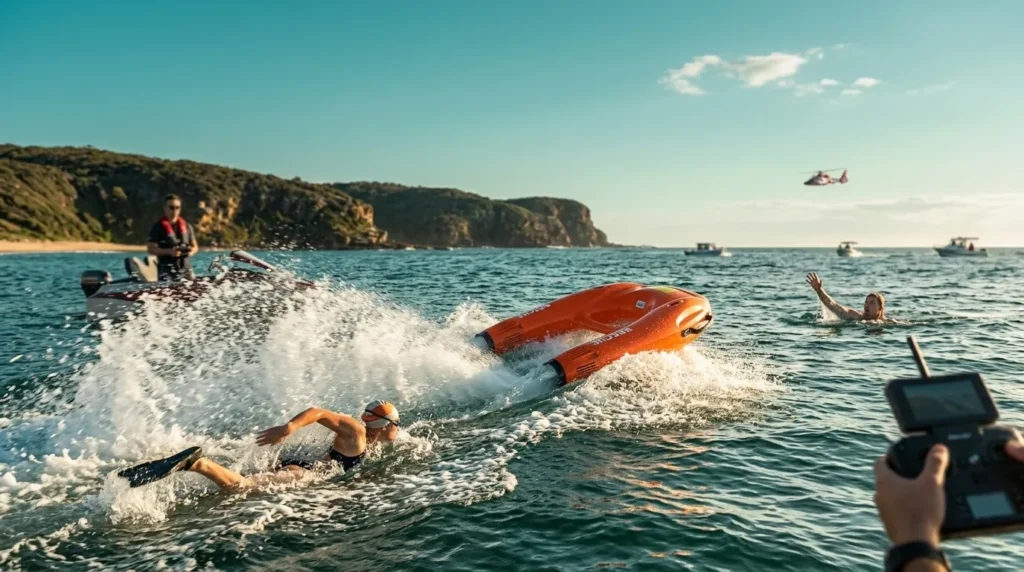
Why “faster” is the wrong measure on its own
People love speed claims because they’re easy to understand. But in a real emergency, the question isn’t only “How fast is the device?” It’s:
- How fast can you launch it?
- How fast can you reach the casualty in current?
- How precisely can you place it beside them?
- How reliably can you keep it with them while they grab on?
- How well does it handle waves, chop, and drift?
“Faster than a swimmer” is often true in practical terms, but the real value is consistent, controllable speed, especially in difficult conditions.
The swimmer disadvantage (even for good swimmers)
A strong swimmer in calm water can move quickly. In real conditions, the following slow them down:
- Rip currents that pull them sideways or out
- Breaking waves that disrupt breathing and timing
- Clothing and shoes adding drag and weight
- Cold shock and adrenaline spikes
- Visibility loss as the casualty moves or submerges
- Physical limits—even fit people tire quickly when fighting current
Worse still, the rescuer must also keep enough energy to manage the casualty and return to shore.
A Remote control rescue buoy does not breathe, does not panic, does not fatigue, and can often hold steady against drift better than a swimmer.
What real emergencies demand from an RCRB
In real-world use, RCRBs are judged by a few practical outcomes:
- Time-to-contact (seconds matter)
- Ease of grab (does the casualty actually hold on?)
- Stability (does it stay near them, or roll away?)
- Control under stress (can an operator steer it accurately?)
- Reliability (does it perform the same way each time?)
A unit that is fast but hard to control is less useful than a slightly slower unit that is stable, predictable, and easy to drive.
How operators actually drive an RCRB under pressure
In drills and real incidents, the best approach is disciplined:
- The operator keeps movements smooth, not jerky
- They approach the casualty from the safest angle, considering current
- They slow slightly just before contact to avoid bumping the casualty harshly
- They present the buoy in a way that encourages a natural grab
- They keep the buoy alongside, maintaining contact rather than “drive-by” passes
That’s why training is vital. The difference between a helpful deployment and a wasted one is often operator calm and familiarity.
Typical emergency scenarios and what performance looks like
1) Beach rip rescue
A casualty in a rip often drifts seaward and sideways. A swimmer entering from shore is immediately influenced by the same rip. An RCRB can be launched quickly from shore and driven straight into the rip channel.
Performance strengths:
- fast deployment
- direct route to casualty
- reduced rescuer risk
Potential challenges:
- waves breaking over the unit
- line-of-sight issues if swells hide the device intermittently
- timing the approach so the casualty can see and grab it
In practice, an RCRB that is stable and visible will outperform a swimmer in early-stage response, especially when the “rescuer” is a bystander, not a trained lifesaver.
2) River current rescue
Rivers can be deceptively fast, and the victim may be carried under overhanging branches or into hazards. A swimmer entry is often unsafe.
Performance strengths:
- safe flotation delivery from bank
- ability to track drift and intercept
- avoids sending another person into fast water
Potential challenges:
- debris in water
- turbulence and eddies
- obstacles affecting control signal
In these rescues, “faster than a swimmer” matters less than “safer than a swimmer.” A remote device can keep the response controlled.
3) Harbour or marina fall-in
The casualty may be shocked, injured, or unable to climb. A buoy sent immediately can stabilise them.
Performance strengths:
- immediate launch from the nearest safe edge
- accurate placement in tight spaces
- safer than jumping in near boats and structures
Potential challenges:
- reflections, shadows, and clutter can reduce visibility
- interference from metal structures may affect some control links
- prop wash and boat movement can complicate handling
Here, controlled handling and precision are the winning features.
4) Rough surf close to shore
This is where marketing claims often get tested hardest. In strong shore break, objects get tossed, and the casualty may be tumbling.
Performance strengths:
- still may deliver flotation faster than a swimmer entering late
- can be redeployed repeatedly
Potential challenges:
- breaking waves can overwhelm a small device
- control becomes more difficult as the unit is thrown off course
- casualty may struggle to time a grab
In very rough surf, RCRBs can still be useful, but they work best when combined with trained responders and appropriate rescue craft.
What “faster” looks like in practice: time saved in the first phase
Even if a device and a swimmer reached the casualty in similar times, the device may still be better because:
- it does not create a second casualty risk
- it allows more people to coordinate from shore
- it keeps energy reserves available for recovery and CPR
- it can be deployed again immediately
The “faster” advantage is often about total system response, not just raw speed.
The casualty factor: can they actually use it?
A rescue tool only works if the casualty can engage with it. In real emergencies:
- some casualties are panicked and may struggle to grab properly
- others are exhausted but cooperative
- some may be unconscious, injured, or unable to hold on
Buyers should look for:
- intuitive shape and handle placement
- stability so it doesn’t roll away when grabbed
- enough floatation to support the casualty’s upper body out of the water
- an operator approach method that minimises missed grabs
Training should include drills where the “casualty” is instructed to behave realistically (panic, delayed response, drift).
The operator factor: where performance is won or lost
Even the best device is weakened by poor readiness:
- flat battery
- controller not paired or untested
- device stored in the wrong place
- staff not trained
- no procedure for who operates during an incident
This is old wisdom: tools only save lives when they are ready. A well-run organisation treats an RCRB like emergency gear—checked, charged, practised.
Recommended drill routine (simple and effective)
A practical routine for councils, clubs, resorts:
- short weekly function test (power, controls, propulsion check)
- monthly water drill (reach a target, approach correctly, return)
- quarterly “scenario drill” (rip simulation, river drift simulation, low-light practice if relevant)
- post-drill inspection and rinse/cleaning (especially after saltwater use)
Bottom line
In real emergencies, an RCRB’s advantage is that it can often deliver flotation quickly, reliably, and without sending another person into danger. That’s why it commonly “beats” the typical rescue swimmer in the first phase of response—especially when the alternative rescuer is an untrained bystander.
Speed is important. But the true performance advantage is controlled speed plus safety, repeated reliably, with disciplined readiness and training.