
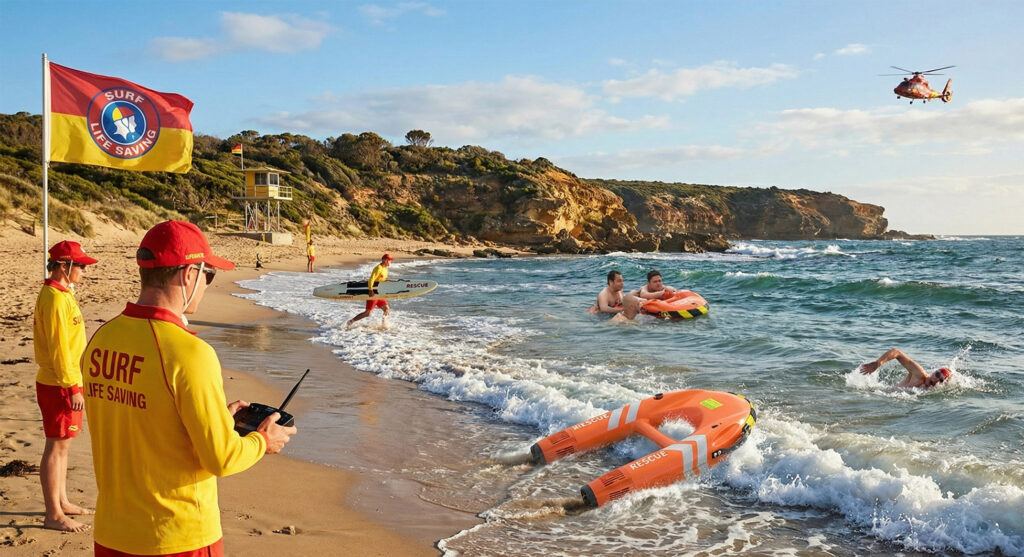
For councils, emergency services, clubs, resorts and marine facilities, buying safety equipment without understanding how it works is a liability.
Remote-control life rescue buoys are increasingly recognised as essential equipment, but their value is often misunderstood or dismissed as “technology for technology’s sake.”
In reality, these devices are the result of practical rescue reasoning, engineering discipline and lessons learned from decades of water-related fatalities — many of which occurred despite good intentions and brave intervention.
This article explains, in clear and traditional terms, how motorised rescue buoys function, why their design choices matter, and why they outperform many legacy rescue tools in real-world conditions.
Every water rescue, regardless of location, conditions or personnel involved, follows the same first principle:
Stabilise the casualty by providing buoyancy as quickly as possible — without creating a second casualty.
Remote-control rescue buoys are engineered specifically around this objective.
They do not rely on:
Instead, they bring flotation directly to the person in distress, under controlled propulsion, guided from a position of safety.
A legitimate rescue buoy is not a toy or recreational float. It is engineered to remain stable under load while supporting a struggling person.
Key design characteristics include:
This ensures the casualty can maintain airway clearance even when fatigued or disoriented.
One of the most important — and often overlooked — safety features is propulsion type.
Jet-driven rescue buoys eliminate exposed propellers entirely.
This matters because:
Propeller-based systems introduce unnecessary danger, particularly when dealing with panicked swimmers or low visibility.
Jet propulsion aligns with conservative rescue doctrine: remove injury risks wherever possible.
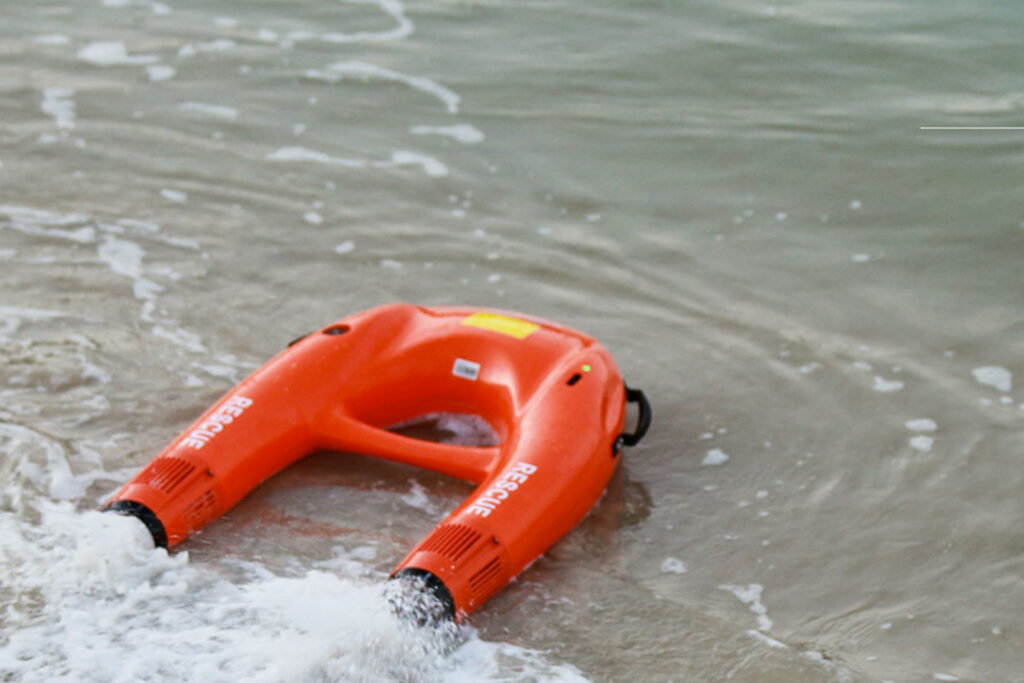
Modern motorised rescue buoys use sealed lithium battery systems designed for predictable output and reliability.
When properly specified, these systems:
Increasingly, serious rescue equipment aligns with European electrical and battery safety standards, which place heavy emphasis on:
For councils and public authorities, this is not a marketing detail — it is a risk-mitigation requirement.
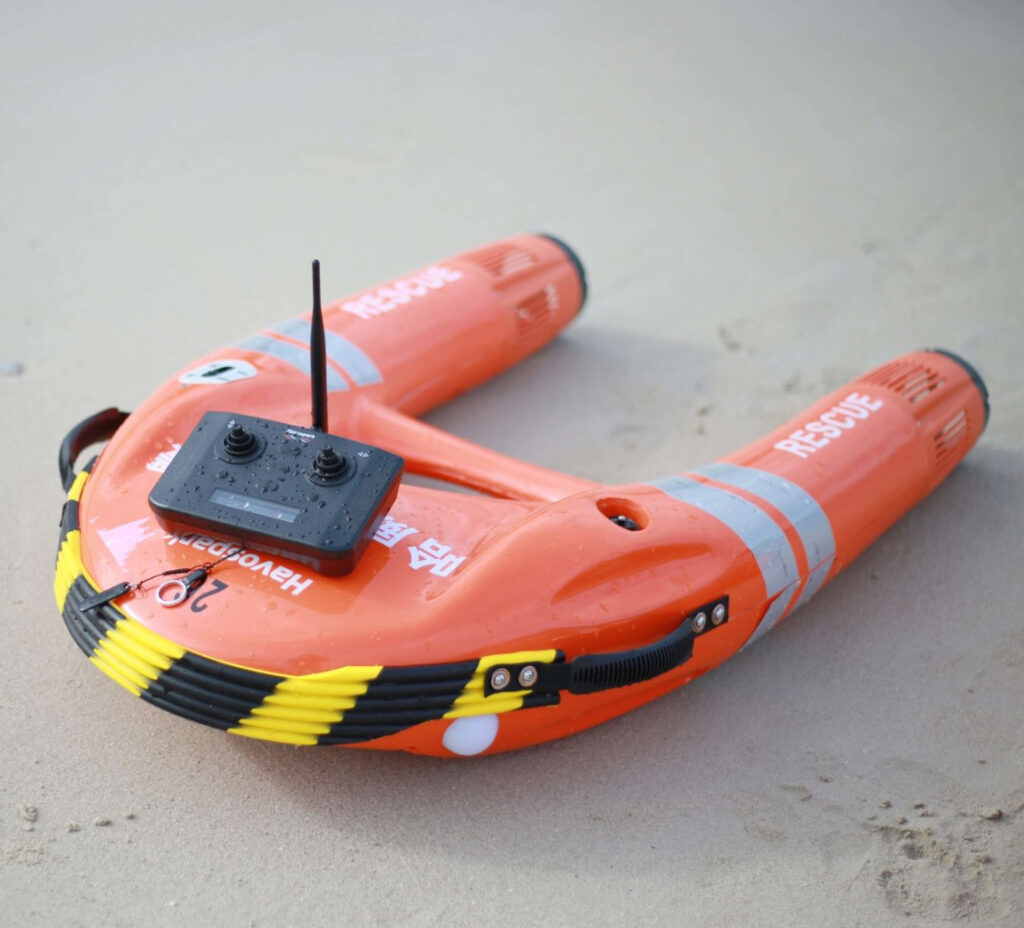
Remote-control systems are deliberately simple. Complexity creates failure points during stress.
Well-designed systems prioritise:
Operators require minimal training — a critical advantage in environments where rescues may be initiated by staff, volunteers or members of the public before professionals arrive.
A rescue device must behave predictably if signal loss or interference occurs.
Reputable motorised rescue buoys:
The design assumption is conservative: flotation is always better than movement when control is uncertain.
A common misconception is that higher speed equals better rescue performance.
In reality:
A rescue buoy needs to reach a casualty faster than a swimmer, not faster than common sense.
Engineering focuses on reliability, not spectacle.
Bright colouration, high-contrast design and purposeful shape do more than improve detection — they influence casualty behaviour.
Psychologically, a visible flotation device moving directly toward a struggling swimmer communicates rescue intent immediately. Panic subsides. Cooperation improves.
This behavioural shift is a critical, though often unspoken, advantage.
Motorised rescue buoys are effective in:
They are not limited by tide, current or wave direction in the way traditional flotation throws often are.
From a governance perspective, rescue equipment must be:
Remote-control rescue buoys require:
They do not require extensive servicing, specialist tools or ongoing calibration, making them suitable for wide deployment.
Unlike traditional water rescue training, which requires swimming competency and physical conditioning, operating a rescue buoy:
This makes the equipment inclusive and practical — particularly important for councils, resorts and clubs where staff turnover and volunteer reliance are realities.
Experienced rescuers understand a simple truth:
“The safest rescue is the one where the rescuer does not enter the water.”
Motorised rescue buoys support, rather than undermine, professional rescue culture by:
They are not shortcuts.
They are reinforcements.
Not all devices marketed as rescue buoys meet professional expectations.
Warning signs include:
Procurement decisions should always prioritise engineering intent over marketing claims.
Just as motorised fire pumps replaced bucket lines, and AEDs replaced “wait for paramedics,” motorised rescue buoys represent evolution, not novelty.
They exist because:
Sound safety practice adapts accordingly.
Remote-control rescue buoys are not impressive because they move fast or look modern.
They are important because they:
That is what real safety equipment does.