
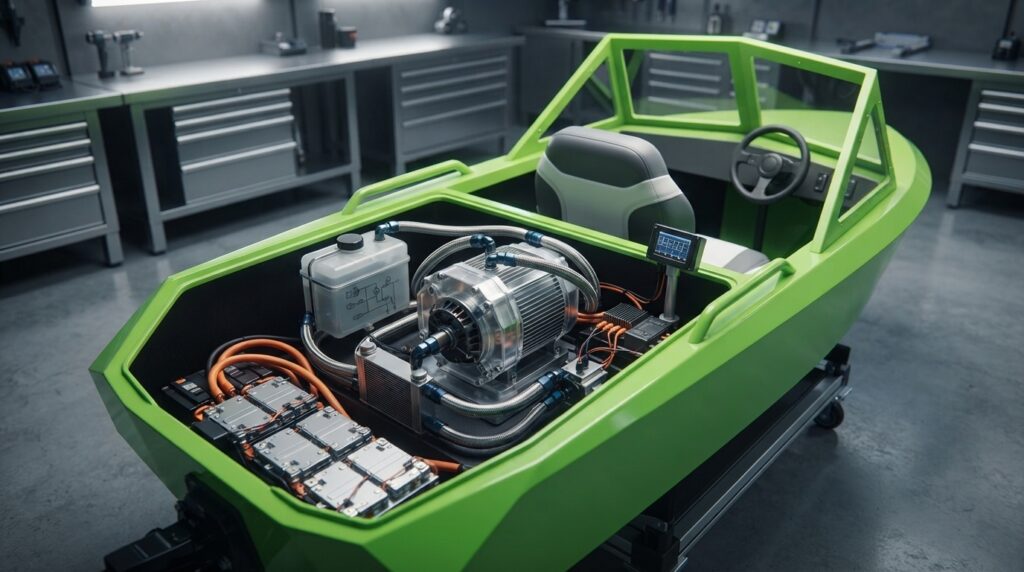
Heat is one of the least visible but most important factors governing how an electric mini jet boat performs, particularly during sustained high-speed running or repeated hard acceleration. Motors and batteries both generate heat as a natural by-product of converting stored energy into motion, and how effectively that heat is managed has a direct effect on performance, longevity and safety. This article looks at how thermal management actually works in electric mini jet boats, and why it matters more than most buyers initially realise.
No energy conversion process is perfectly efficient — some portion of the electrical energy drawn from the battery is inevitably lost as heat rather than converted into propulsion. This happens at multiple points in an electric mini jet boat's drivetrain:
Under light, steady cruising, this heat generation is modest and easily managed. Under sustained high-speed running, repeated hard acceleration, or use in already-hot ambient conditions, heat generation increases significantly, and effective management becomes far more important.
Heat isn't just a background concern — it has direct, measurable effects on performance and component life:
Understanding this helps explain why a mini jet boat might feel slightly less punchy after extended hard use, or why some manufacturers specify maximum continuous run times at full power — these aren't arbitrary limitations, they're a direct consequence of managing heat safely.
Mini jet boats generally use one of two broad cooling approaches for their motors, and sometimes their controllers and battery packs as well.
Air cooling relies on airflow — either passive (natural convection) or active (fan-assisted) — to draw heat away from components. It's mechanically simpler and generally lighter, but is inherently less effective at removing large amounts of heat quickly, particularly in a compact hull where airflow paths may be limited by design constraints.
Water cooling uses the abundant water the boat is already operating in as a cooling medium, typically circulating water (or a water-glycol mixture) through a heat exchanger in contact with the motor and sometimes the controller. Water is a significantly more effective heat transfer medium than air, which makes water cooling generally more capable of managing sustained high heat loads, though it adds mechanical complexity (pumps, hoses, seals) that air cooling doesn't require.
This trade-off between the two approaches is explored in more depth in a companion article specifically comparing air cooling and water cooling in electric mini jet boats.
Separately from motor cooling, many electric mini jet boats include some form of thermal management for the battery pack itself, ranging from passive approaches (insulation and enclosure design that limits temperature swings) to more active systems involving cooling channels or airflow specifically directed at the battery cells.
Battery thermal management matters both during discharge (use on the water) and during charging, since charging also generates heat and is often subject to its own temperature-based charge rate limitations — many battery management systems will automatically slow charging speed if the battery is too hot or too cold, to protect long-term cell health.
The motor controller — the electronic component that regulates how power flows from the battery to the motor — is itself a significant heat source, particularly under high current draw during acceleration or sustained high-speed operation. Controllers typically include their own heat sinks and sometimes dedicated cooling provisions, and many are programmed to reduce power output if their internal temperature approaches a safe operating limit, similar to the protective behaviour seen in motors and batteries.
This is worth understanding because a controller reaching its thermal limit can produce a noticeable, sometimes surprising drop in performance even if the motor and battery themselves have more capacity available — the controller becomes the limiting factor in that moment.
Understanding thermal management has some genuinely practical implications for how a mini jet boat is used:
Thermal management is one of the less visible engineering considerations behind an electric mini jet boat, but it has a direct, sometimes very noticeable effect on real-world performance, particularly during sustained high-speed use or hot weather. Understanding how a given boat manages heat — through its cooling approach, battery thermal design and controller protections — gives buyers a much more realistic picture of how consistently that boat will perform across a full day on the water, rather than just in the first few minutes of a test ride.