
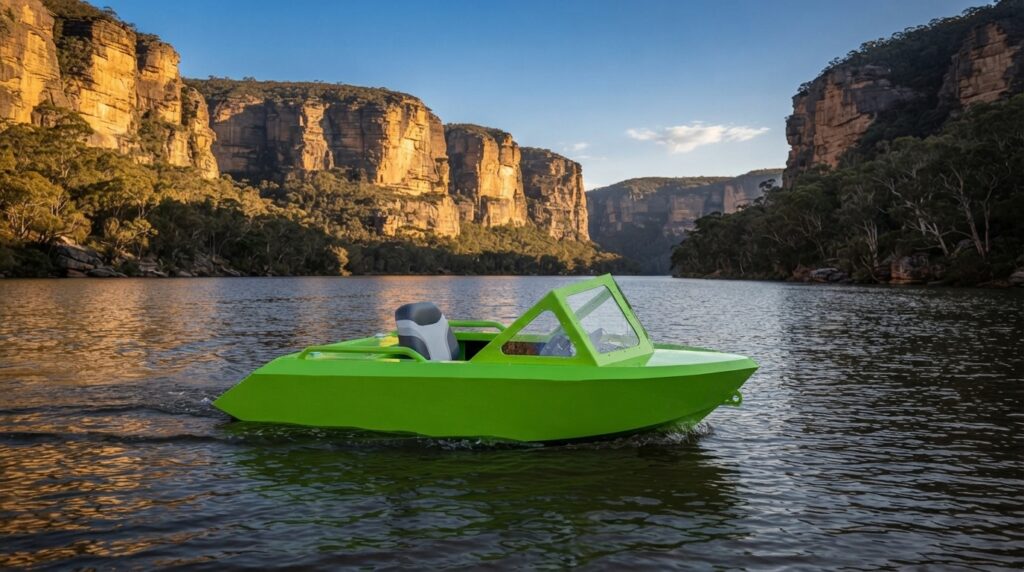
It's one of the first questions anyone considering an electric mini jet boat asks, and it's also one of the hardest to answer with a single number. Range isn't a fixed property of a boat the way, say, hull length is — it's the outcome of several interacting factors, several of which are entirely within the rider's control on any given outing. Understanding what actually drives range gives a far more realistic picture than any single advertised figure can.
Manufacturers typically publish a range figure based on a specific, defined set of conditions — often a single rider, moderate cruising speed, calm water, and a fully charged battery. That figure is genuinely achievable under those conditions, but it represents one point on a much wider spectrum of real-world outcomes, not a guarantee that applies regardless of how the boat is actually used.
The honest answer to "how far can it go" is closer to "it depends" than most buyers initially want to hear — but understanding what it depends on is far more useful than chasing a single headline figure.
Energy consumption in a planing hull doesn't increase in a straight line as speed rises — it increases sharply, particularly once a boat pushes toward its upper speed range. This means the difference in range between a moderate cruising speed and near-top speed is often much larger than riders expect. A boat that might comfortably cover a generous distance at a relaxed cruising pace can see that range fall considerably if ridden consistently near its top speed.
This relationship is explored in more depth in a companion article specifically on how speed selection affects battery consumption, but the key point for range expectations is this: the advertised range figure is almost always based on a specific, moderate cruising speed, not the speed most riders are tempted to use for at least part of an outing.
As covered in the article on hull weight, every additional kilogram the motor has to move through the water draws on the battery. A single rider with minimal gear represents the lightest, most range-efficient configuration a boat will typically see. Adding a second passenger, a cooler, safety equipment and other gear increases total weight, which increases energy consumption at any given speed, which in turn reduces achievable range.
This effect is proportionally larger on lighter mini jet boats, where an added passenger represents a bigger percentage increase in total weight, compared to a heavier boat where the same additional weight is a smaller proportion of the total mass already being moved.
Calm, flat water offers the least resistance and therefore the best achievable range. Chop, wind-driven waves, and any current running against the direction of travel all increase the effective drag the motor has to overcome, which increases energy consumption for a given speed and reduces range accordingly. A boat that comfortably meets its advertised range on a calm morning may fall meaningfully short of that figure on a breezier afternoon with some chop on the water.
How a boat is actually ridden has a significant effect on range, independent of average speed. Frequent hard acceleration — repeatedly getting back up onto the plane after slowing down — is considerably more energy-intensive than maintaining a steady cruising speed, because the planing transition itself is one of the more energy-demanding phases of operation, as discussed in the article on time-to-plane.
A rider who accelerates hard, cruises briefly, slows down, and repeats this cycle frequently will typically see lower range than a rider covering the same total distance at a steady, consistent cruising speed — even if their average speed over the outing works out similar. This is explored in more detail in a companion article comparing continuous cruising to repeated acceleration specifically.
Like all lithium-based batteries, a mini jet boat's battery pack will gradually lose some capacity over its operational life, influenced by factors such as charging habits, storage conditions, and total number of charge cycles. A battery that's several seasons old, even if well maintained, will typically deliver somewhat less range than it did when new. This is a normal, expected part of battery ownership rather than a fault, but it's worth factoring into long-term expectations rather than assuming range will remain completely static over the years.
Battery performance is somewhat temperature-sensitive, with both very cold and very hot conditions generally reducing achievable range compared to a moderate ambient temperature. This is a less significant factor in most Australian conditions than in climates with genuinely extreme cold, but it's worth being aware of, particularly for very hot days where thermal management systems (covered in a companion article) may also engage more actively, with some associated energy cost.
Given all these variables, the most useful approach isn't to fixate on the single advertised range figure, but to think in terms of a realistic range envelope:
Approaching range this way, rather than expecting a single fixed number to apply regardless of conditions, leads to much better trip planning and far fewer unpleasant surprises.
Because range is so condition-dependent, it's worth planning outings with a genuine reserve in mind rather than assuming the full advertised range is available for the return trip as well as the outbound leg — a topic covered in more detail in a companion article on calculating a sensible battery reserve before returning to shore. As a general principle, treating the advertised range figure as an outer limit rather than a comfortable planning target is the safer, more realistic approach.
There is no single honest answer to "how far can an electric mini jet boat go" — the real answer depends on speed, weight aboard, water conditions, riding style, battery condition and ambient temperature, all interacting together. Rather than treating the manufacturer's advertised figure as a guarantee, it's far more useful to understand it as a best-case reference point, and to build a realistic sense of how your own typical usage pattern — passengers, speed preferences, and the waters you usually ride — is likely to compare to that figure in practice.